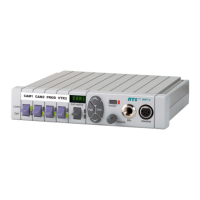
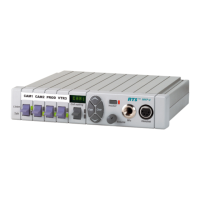
2-4 User Instructions MKP-4, BKP-4, WKP-4, TKP-4, and MKP12 Keypanels
Description: An intercom key can always be turned on for momentary conversation by pressing
and holding the key during the conversation. There is also an electronic latching feature that lets
you tap intercom keys to turn them on or off. This permits convenient hands-free conversation.
However it can also result in a talk circuit being left on unintentionally. For example, a key that
talks to a public address system could be accidentally left on. Or an IFB key (a type of key
assignment that is often used by a director or producer to give instructions to a listener, such as a
news anchor during a television broadcast) could accidentally be left on, causing confusion for
the IFB listener. To prevent such accidents, the latching feature can be turned off. the latching
feature can also be turned on/off using ADAMedit or ZEUSedit software. Please refer to the
respective help file to use this feature.
DIP Switch 6
Open: Default setting. 6-bit English protocol enabled.
Closed: 8-bit Katakana protocol enabled.
Description: Selects the type of protocol used for communications. The default 6-bit protocol
allows the display of English language characters. The optional 8-bit Katakana protocol allows
the display of Japanese language characters.
DIP Switch 7
Open: Default setting. Half-duplex communication disabled.
Closed: Half-duplex communication enabled.
Description: When closed the audio flowing in and out of the keypanel is in half-duplex
mode.When a talk key is depressed, audio coming in to the speaker/headphone is cut off.
Incoming audio is enabled as soon as the talk key is released. This application is seldom used.
DIP Switch 8
Open: Default setting for MKP-4, BKP-4, TKP-4 and WKP-4. Map keys as xKP-4 series.
Closed: Default setting for MKP-12. Map keys as MKP-12.
Description: When closed the four keys normally present in the xKP-4 series are remapped to the
left most keys on the MKP-12 keypanel. If this switch is in the open position on an MKP-12 the
keys will appear as 9-12 on the panel. This function corrects mapping differences between the
xKP-4 series, MKP-12, and how they relate to ZEUSedit.
Address Switch
NOTE
In Zeus, ADAM CS, and ADAM intercom systems, intercom ports are arranged in groups of 8.
Within each group, each keypanel is uniquely identified by its Address switch setting.
The Address switch has a white pointer which points to the current switch setting. Determine the
proper setting as follows:
Important!
Always reset the keypanel after changing the Address switch setting. Do this by briefly removing
power to the keypanel.
NOTE
Address switch settings 0, and 9 through F are not used in ZEUS, ADAM, or ADAM CS systems.


 To Next Page