- 197/250 -
Section 1 Maintenance
SCC1000C Crawler Crane — Maintenance Manual
can be rectified by careful grinding and the cross
section after grinding shall not be less than
specified value. If it is a mechanically connected
element that has been repaired and such an
element has been tested as per relevant standards
by the manufacturer and is attached with a
certicate of such test, load test to such an element
will not be required.
14�5�3 Operation Requirements and Inspection
Criteria of Riggings
1. Do not use the sling to lift a load greater the
rated load.
2. The load applied on a sling increases with the
enlargement of leg angles measured from
vertical. When the leg angles enlarge over a limit
value, it may cause local overload to the sling
or even sudden break of the sling, the latter of
which is hazardous.
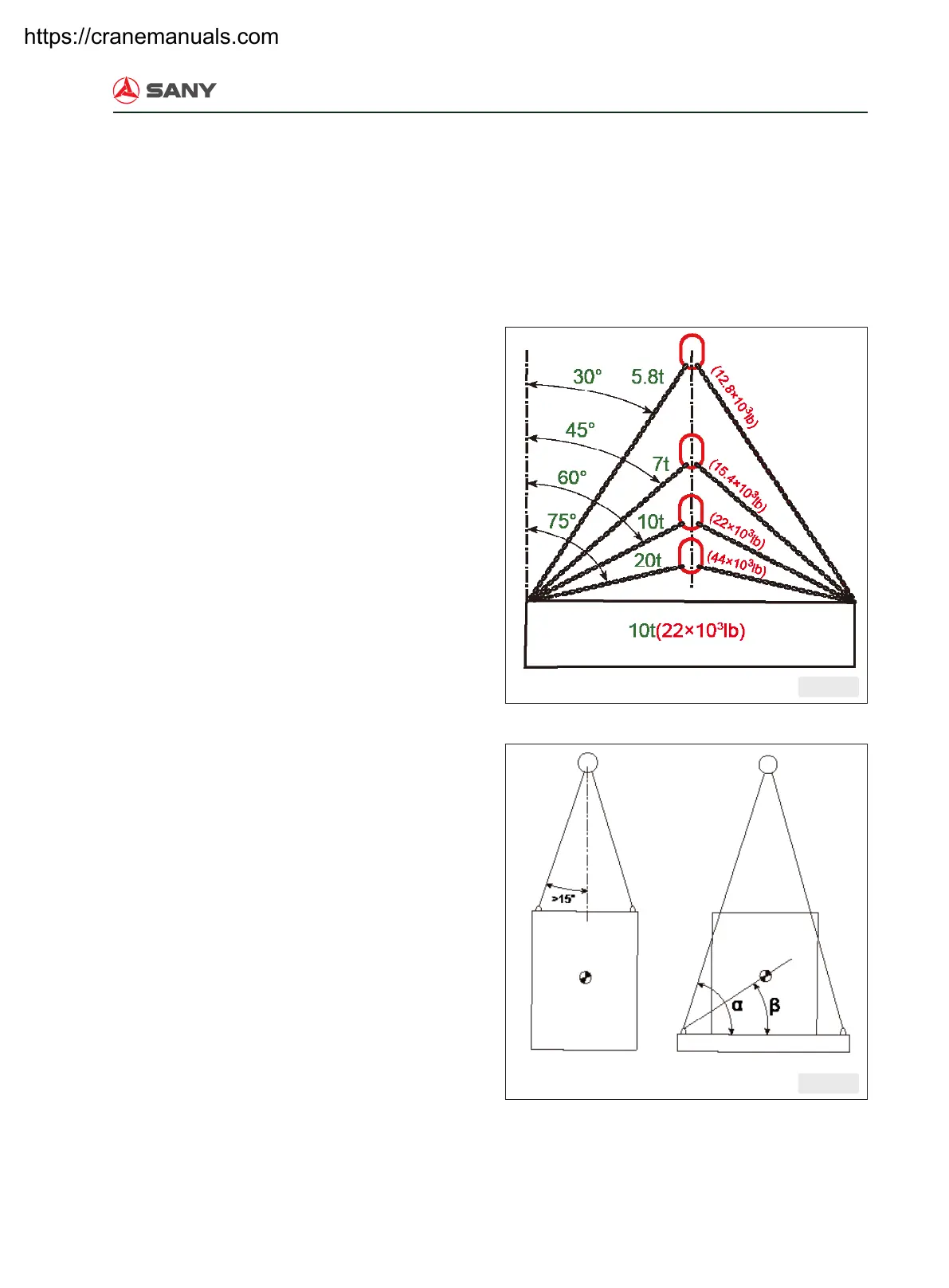
3. Each leg angle from vertical shall not be greater
than 60 degrees (i.e. angle between two
adjacent legs shall not be greater than 120
degrees). An example of a chain sling lifting a
10t load is shown in Fig. TY0214, in which the
load applied to each leg at each specic angle is
illustrated. In crawler self-assembly duty of this
crane, the reference angle between legs shall be
less than 60 degrees.
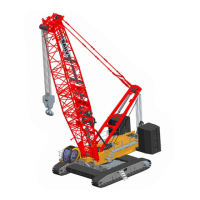
4. Ensure that the lifting point is right above the
center of gravity of the load or that the leg angle
α measured from horizontal is always greater
than angle β measure from horizontal to the line
passing through the center of gravity of the load
and securing point, which will keep the load from
tilting or slipping during the lift. When multi-leg
chain slings are used, each leg angle measured
from vertical shall not be less than 15 degrees,
i. e. the angle between adjacent legs shall not
be less than 30 degrees to ensure stable and
balanced lift (see Fig. TY0215).
TY 0214
TY 0215
https://cranemanuals.com


 To Next Page