16
Corneal deformation
IDRA can also be used to assess the regularity of the corneal profile. By inserting the specific cone inside the
instrument, a series of concentric rings is projected onto the cornea. If the corneal surface is regular, the
concentric rings will all be at the same distance.
Any irregularities in the surface of the cornea will result in irregularities of the reflected image.
Pupillometry
The pupil measurement made by the IDRA has the objective to measure the pupillary diameter (in
millimeters) in three dierent conditions of lights. In fact the device can simulate the natural condition of:
• Photopic vision
• Mesopic vision
• Scotopic vision
By automatic led adjustment.
A summary of this collected results is accessible on the bottom of the main screen (“Pupillometry” Fig. 15).
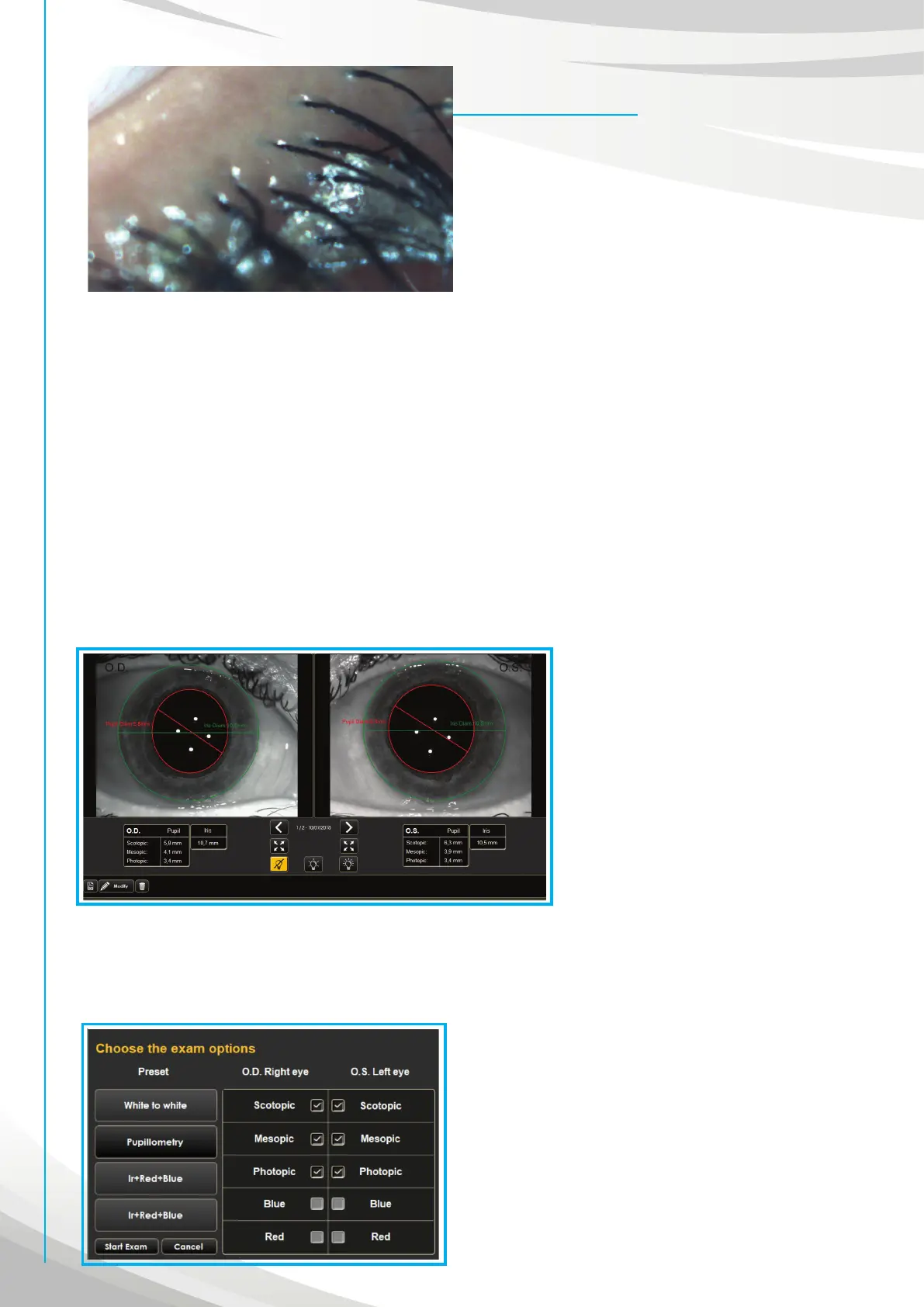
Demodex (Fig. 14)
To take a picture and do this exam, you need you need
to remove cones. The device uses infrared lights which
allows to observe every possible movement of the
parasite.
If there is not Demodex, the eyelashes are clean
and you do not see any white movement. If there is
Demodex, you can observe a general inflammation
and most likely a blepharitis condition.
Fig. 15
Pupillometry examination has to be done without any cone inserted in the device.
It is possible to acquire three dierent images of both eyes, or to choose which images acquire by selecting or
deselecting the options provided in the exam opening screen “Pupillometry” (fig. 15 a).
With this exam it is also possible to measure WTW (white-to-white, so the diameter of iris).
Fig. 15 a


 To Next Page