follows: IM_SEC3_02.01_en.docx
2/70
Introduction
The SECUR 3 modular system allowed our designers to develop innovative and reliable microprocessor
based controllers.
This system assigns to peripheral co-processors the activation of related inputs and outputs. In this
application every node of the system is connected by a simple two-wire connection.
The serial communication system which is used between boards in car and in control panel is based on
CAN (CONTROLLER AREA NETWORK). The protocol follows the ISO-IS 11898 rules for high speed
transmission (over 125 Kbit/sec), and the ISO-IS 11519-2 for low speed transmission (up to 125 kbit/sec).
The CAN network layout is a multi-master. In other words the unit that needs to send an information takes
possess of the bus and send its message, which is received and decoded by the receiving units. If more
units need contemporarily the bus for transmission, automatically the highest priority will be assigned.
If one of the verification gives a negative result the message will be repeated.
This is SECUR 3, a technologically advanced system.
System description
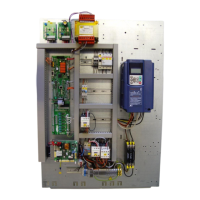
The SECUR 3 system is composed by the combination of the following electronic boards:
• SEC-3Q: controller mother board. It is the base of the system, and holds:
• SEC-3AUX: board with auxiliary relay
• SEC-3IO: additional inputs and outputs board (calls, etc.)
• SEC-3S: the safety circuit supervision board
• SEC-3C: car roof board. It handles the communication between car and controller, and holds:
• SEC-3I/O: additional inputs and outputs board (calls, etc.)
• SEC-3TRG: is the COP board; collects all car commands and signalisations and transmit them to SEC-
3C board; it may be located both inside COP or in the connection box on car roof
• SEC-2L: the landing node board. It handles the landing calls and signalisation, in serial mode, and holds:
• SEC-2LPI: the driver for position indicators at landing (in serial mode only)
• SEC-2FDR: the alarm battery charger and alarm handling.


 To Next Page