7-8
LFO-MOD
A
synthesizer's
expressiveness
stands
on its modulation facilities.
The
term "modula-
tion" refers to a periodic
or consistent
(as
opposed to
random)
aural
change
which
is
interesting or musically
useful. Modulation is created by electronic controllers when
it
is not
possible to adjust a mechanical
controller with the required speed or precision.
Modulation systems thus free
the hands for playing the keyboard.
The
Prophet-600
contains two
distinct modulation systems: LFO-MOD and POLY-
UOD. Modulation involves
the signal-generating
source
and the modulated destination .
The difference
between these two
systems is that LFO-MOD uses a single
low-
frequency oscillator
(LFO) as source, while POLY-MOD is called polyphonic because it
uses
six (or
twelve)
sources within
each
voice
itself.
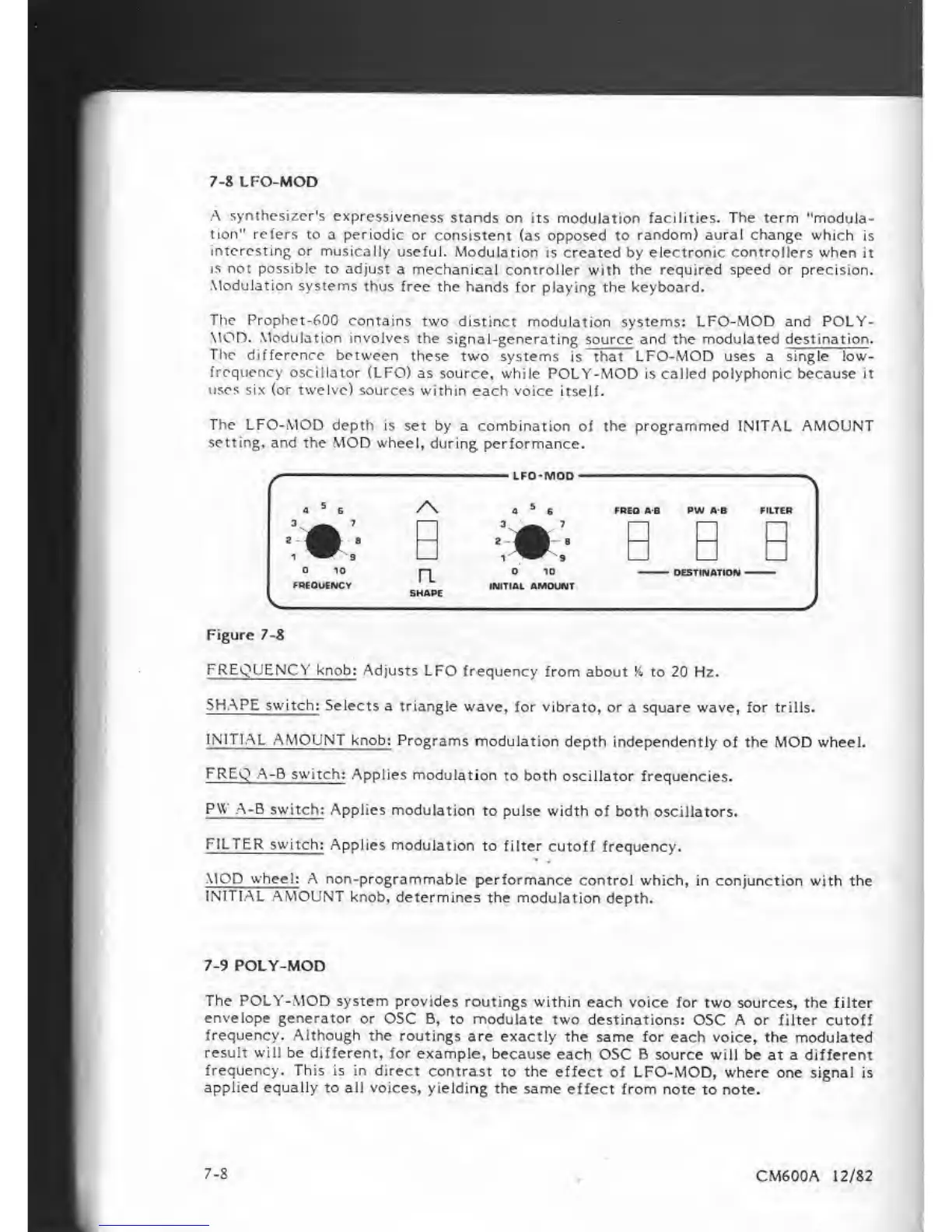
The LFO-MOD depth
is set by a combination of the programmed 1NITAL AMOUNT
setting, and
the MOD wheel, during
performance.
LFO-MOD
4
5
6
A
4
5
6
FREQ A-B PW A-B FILTER
•:•;•
:*:•
O 10
FREQUENCY
n.
10
INITIAL AMOUNT
DESTINATION
._._
Figure 7~S
FREQUENCY knob: Adjusts
LFO frequency
from about K to 20 Hz.
SHAPE switch:
Selects a triangle
wave, for vibrato, or
a square
wave,
for trills.
INITIAL AMOUNT
knob: Programs
modulation depth independently
of
the
MOD
wheel.
FREQ A-B switch:
Applies modulation
to both
oscillator frequencies.
PW A-B switch:
Applies modulation
to pulse width of both
oscillators.
FILTER switch:
Applies modulation
to filter cutoff
frequency.
MOD
wheel:
A non-programmable
performance control which,
in conjunction with the
INITIAL
AMOUNT knob, determines
the modulation depth.
7-9
POLY-MOD
The POLY-MOD system provides routings within
each voice for two sources,
the filter
envelope
generator or
OSC B, to modulate two
destinations: OSC A or filter cutoff
frequency. Although the
routings are exactly
the same for each voice, the modulated
result
will
be different, for
example, because each
OSC B source will be at a different
frequency.
This is in direct contrast
to the effect of LFO-MOD, where
one signal is
applied equally to all voices, yielding
the same effect from note
to note.
7-Z
CM600A 12/82



 To Next Page