6-2
MANUAL MODE
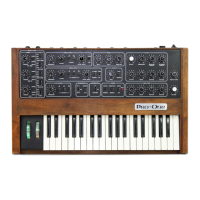
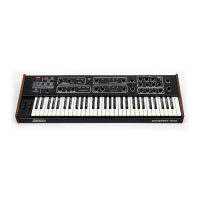
1. To put the Prophet-600 in Manual Mode, switch PRESET off.
This removes computer
control from the programmable
knobs and switches, so
they always indicate the exact
status of the
patch under construction. You can see what signal paths are closed by the
switches which are up. The knob positions reflect their actual settings.
"What you
see
is
what you get."
2. As you
begin tc construct the patch, remember that the sound
which
is produced
will
at first be
the result of wherever the controls
happen
to be set.
For anything to
be
heard, certain minimum conditions need to be
established which may become clearer
after
Section 7 is reviewed. But here it can be said:
a. At least
one oscillator waveform switch must be on.
b. If only a pulse wave is on, the PULSE
WIDTH knob must not be set too close
either to or
10.
c. A
solitary pulse wave should not be over-modulated, or it may "cut out." To
quickly
isolate
the source of over-modulation, simply switch off the
PW
switch
in the
LFO-MOD module.
d. Begin
with the
MIXER
knob approximately centered.
e. The filter cutoff frequency must not be set too low. To check this, set the
FILTER CUTOFF knob to 10.
f. The AMPLIFIER and FILTER ATTACK time should not be set too slow. If
necessary, dial them to 0.
g.
The AMPLIFIER
SUSTAIN
level
must not be too low. If necessary, raise it to
10.
6-3
RECORD MODE
Custom programs can be created in two ways: by recording
edited programs, or by
recording manually-formed patches. (A "patch" becomes
a
"program" when
recorded.)
1.
Select a
program
to be edited or
moved.
Edit it as desired.
2. Switch RECORD on.
3. Select the first digit of the program number being recorded.
ft. If you
somehow
made a mistake, you can exit Record Mode at this point by merely
switching
RECORD
off. The program memory will
not be affected.
CM600A 12/82 6-3



 To Next Page