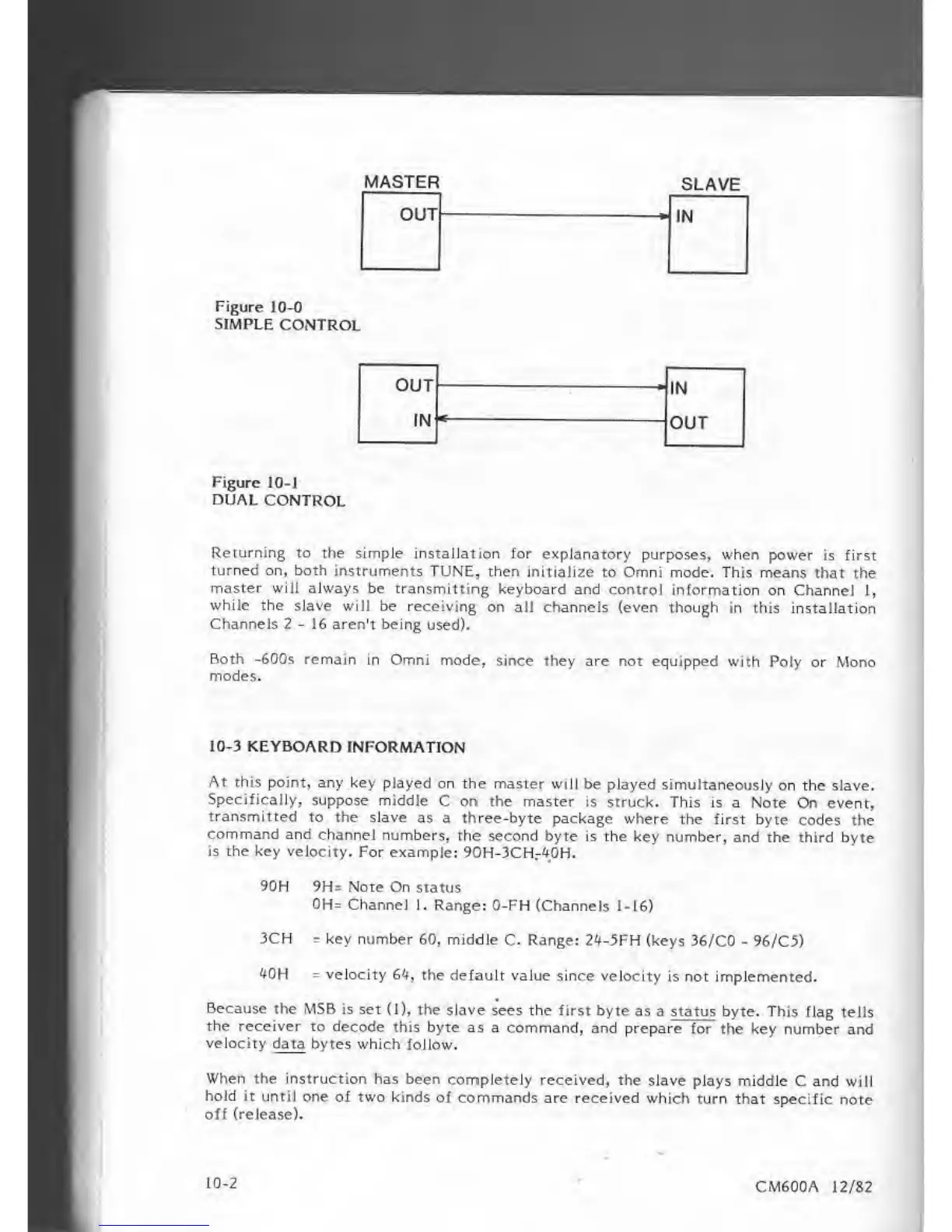
MASTER
SLAVE
OUT
IN
Figure 10-0
SIMPLE
CONTROL
OUT
IN
IN
OUT
Figure 10-1
DUAL
CONTROL
Returning to the simple
installation for explanatory
purposes,
when
power
is first
turned on, both instruments
TUNE, then initialize
to
Omni
mode. This means that the
master will
always be transmitting keyboard
and control information
on Channel
1,
while the slave will
be receiving on
all
channels
(even though in this
installation
Channels 2-16
aren't being
used).
Both -600s remain in
Omni mode, since
they are not equipped with Poly
or Mono
modes.
10-3
KEYBOARD INFORMATION
At this point,
any key played
on the master will be
played simultaneously
on the slave.
Specifically,
suppose middle
C on the master is
struck. This is a Note On event,
transmitted
to the slave as
a
three-byte
package where
the first byte
codes the
command
and channel
numbers, the second
byte is the key number,
and the third byte
is the key velocity.
For example:
90H-3CH.-40H.
90H
9H= Note On status
0H= Channel I. Range:
0-FH (Channels 1-16)
3CH
r
key number
60, middle
C
Range:
24-5FH (keys 36/CO
-
96/C5)
tOH = velocity
6U, the
default
value
since velocity
is not implemented.
Because the MSB
is set
(1),
the slave
sees the first byte as
a status byte. This
flag tells
the receiver
to decode
this byte as a command, and
prepare for the key number
and
velocity data
bytes which follow.
When the instruction
has been completely received,
the slave
plays middle C and will
hold it until one
of
two
kinds
of
commands
are received which turn that
specific note
off (release).
10-2
CM600A 12/82



 To Next Page