The Shimadzu LCMS-8050 and LCMS-8045 are high-performance liquid chromatograph mass spectrometers, designed for stable operation and reliable data acquisition. This document outlines the pre-installation requirements to ensure optimal performance of these instruments.
Function Description:
The LCMS-8050 and LCMS-8045 systems integrate liquid chromatography with mass spectrometry, enabling the separation, identification, and quantification of components in complex mixtures. They are designed for high-sensitivity analysis, with specific configurations for various ionization modes such as Electrospray Ionization (ESI), Atmospheric Pressure Chemical Ionization (APCI), Dual Ion Source (DUIS), and Micro ESI. The instruments are capable of handling a wide range of analytical applications, from routine analyses to advanced research. The system requires a stable environment, proper gas supply, and an efficient evacuation system to maintain performance.
Important Technical Specifications:
Dimensions and Weight:
- LCMS-8050/8045 Unit: 1180 mm (W) x 540 mm (D) x 610 mm (H), weighing 140 kg.
- Rotary Pump E2M28: 600 mm (W) x 180 mm (D) x 280 mm (H), weighing 44 kg.
- Rotary Pump (with Oil mist filter): 650 mm (W) x 200 mm (D) x 600 mm (H), weighing 45 kg.
- Packing Box Size (Only instrument): 1400 mm (W) x 900 mm (D) x 820 mm (H), weighing approximately 160 kg (gross) / 140 kg (net).
Installation Space Requirements:
- Working Surface: Firm, stable, flat, and capable of withstanding the weight of the entire LCMS system, with a depth of at least 75 cm.
- Right of MS Unit: At least 30 cm of space for maintenance.
- Left of MS Unit: At least 5 cm of space between the LC and MS unit.
- Back of MS Unit (for rotary pump): At least 60 cm between the back of the table and the wall. The evacuation hose from the MS to the rotary pump has a limited length of 1.2 m, and extending it is not possible.
Environmental Conditions:
- Room Temperature: 18 - 28 °C. During data acquisition, the room temperature must be constant, with changes limited to within 3 °C over a short period to ensure stability. Operating outside this range can compromise vacuum pump reliability.
- Humidity: 20% - 70% (non-condensing). Avoid static electricity discharge.
- Corrosive Gas and Dust: Avoid dusty locations or areas with corrosive gases to prolong instrument life.
- Electromagnetic Noise: Do not install near strong magnetic fields. Consider noise blocking measures (e.g., noise filter) if power line noise is high.
- Airflow: The instrument must be out of direct air blasts from heaters and air conditioners.
- Sunlight: The instrument must be positioned out of direct sunlight.
- Vibration: The instrument must not be subjected to vibration.
Power Supply:
- Voltage: 230 VAC, single-phase (50/60 Hz).
- Current: 15 A (including LCMS and E2M28 rotary pump).
- Voltage Range (guaranteed performance): 218.5 to 241.5 V.
- Voltage Range (guaranteed operation): 207 to 253 V.
- Frequency Stability: ± 0.5 Hz max.
- Short-circuit Rating: 300 A.
- Grounding: 1000 max.
- Consumption Current (Max.): 10 A (Calorific value: 1600 W).
- Consumption Current (Steady): 4 to 5 A (Calorific value: 736 – 920 W).
- Connection: Must be connected via a circuit breaker or grounded 3-prong power plug. Avoid sharing the same power source with other equipment. Use a power supply with a ground fault (earth leakage) breaker.
Gas Requirements:
- Nebulizer Gas, Drying Gas, Heating Gas (Nitrogen or Dry Air):
- Purity (Nitrogen): 97.0% or more (nitrogen gas generator) or 99.5% or more (gas cylinder, liquid nitrogen).
- Purity (Dry Air): Water-free, Oil-free. A hydrocarbon trap is recommended.
- Supply Pressure: 690 to 800 kPa.
- Gas Flow Rate (Max. Value):
- Nebulizer gas: 3.0 L/min (ESI/DUIS/MicroESI), 4.4 L/min (APCI).
- Drying gas: 20.0 L/min.
- Heating gas: 20.0 L/min.
- Total flowrate (Drying + Heating): 25 L/min (max).
- Tubing: O.D. 6 mm (I.D. 4 mm) resin tubing for connection.
- Nitrogen Gas Generator (Recommended): PEAK Scientific GENIUS 1051 or equivalent, capable of generating dry air.
- CID Gas (Argon Gas):
- Purity: 99.99% or more.
- Supply Pressure: 500 to 800 kPa.
- CID Gas Pressure: 450 kPa (LCMS-8045: 230 kPa, LCMS-8050: 270 kPa).
- Connection: For carrier gas supply pipe (M type). Requires a pressure regulator (S221-35999-01) and gas piping adapter kit (S225-10766-91) if using a gas cylinder.
- Gas Cylinder Operating Time Examples (LCMS-8045, 230 kPa):
- 47L (7m³) Cylinder: approx. 486 days.
- 10L (1.5m³) Cylinder: approx. 104 days.
- Gas Cylinder Operating Time Examples (LCMS-8050, 270 kPa):
- 47L (7m³) Cylinder: approx. 405 days.
- 10L (1.5m³) Cylinder: approx. 87 days.
- Gas Cylinder Operating Time Examples (LCMS-8050, 450 kPa max):
- 47L (7m³) Cylinder: approx. 243 days.
- 10L (1.5m³) Cylinder: approx. 52 days.
Evacuation System:
- Purpose: Vent evacuation gases from the rotary pump and solvent vapors from drain containers to a draft chamber or exhaust facilities.
- Hoses: 5-meter evacuation hoses are provided for the rotary pump and drain containers.
- Evacuation Tube Length: 10 m (max).
- Exhaust Flow Rate: Depends on customer conditions (1 m³/mL max). A general draft chamber with 20 m³/min capacity is sufficient.
- Hose Specifications:
- I.D.: 12 mm, O.D.: 18 mm, Length: 5 m (P/N: S018-31510) for spray drain.
- I.D.: 15 mm, O.D.: 22 mm, Length: 5 m (P/N: S018-31511) for liquid leak drain.
Usage Features:
- System Configuration: The LCMS-8045/8050 can be used as a standalone desktop unit or integrated with a Micro LC system (LC-Mikros, CTO-Mikros, Micro ESI 8060).
- PC Connection: Connects to a PC via a USB cable, with a maximum length of 3 m. For Micro ESI 8060, the camera requires a USB 3.0 port.
- Gas Supply Options: Nitrogen and dry air can be supplied via a gas generator (recommended), centralized piping (liquid nitrogen), or gas cylinders. Argon gas is supplied from a gas cylinder only.
- Solvent Compatibility: Some solvents used are flammable and poisonous. Proper ventilation and safety measures (fire extinguisher, washbasin) are crucial.
- APCI and DUIS Precautions: When using high-purity nitrogen gas and acetonitrile, polymer formation on the needle tip might occur, affecting sensitivity. Using dry air (or synthetic air) as nebulizer gas or methanol as mobile phase can prevent this.
Maintenance Features:
- Accessibility: At least 30 cm of space is required to the right of the MS unit for maintenance access.
- Consumables: Requires preparation of standard samples for tuning and sensitivity checks, mobile phases (Acetonitrile LCMS grade, Methanol LCMS grade, Ultrapure water, Isopropanol), drain bottles, and reservoir bottles.
- Existing System Installation: When installing to an existing HPLC or LCMS system, the sensitivity test may not meet new unit criteria due to the existing system's performance history. Cleaning the existing HPLC and/or replacing consumable parts can help regain sensitivity.
- Gas Cylinder Safety: Gas cylinders should be placed outdoors in a well-ventilated area, away from direct sunlight and open flames. Secure cylinders to prevent tipping. Use a pressure release valve designated as oil-less. Inspect for leaks before operation and close the main cylinder valve when finished.

 Need help?
 General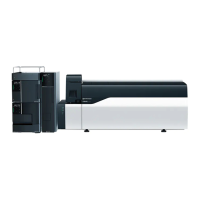



 To Next Page