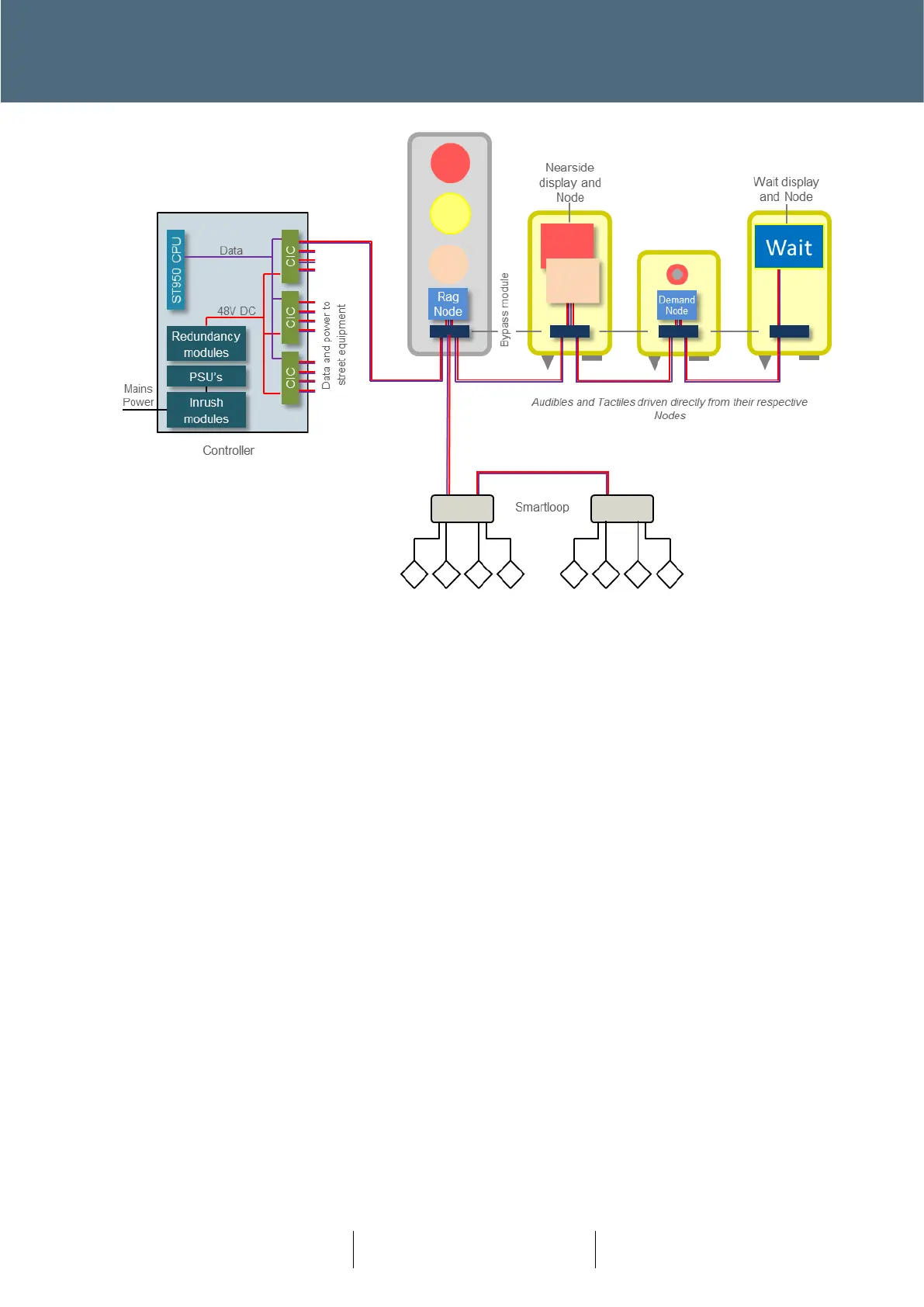
Figure 2 – System Overview
On the street, the armoured street cables terminate at a “Pole Top Board” (PTB) within the Traffic
Signal Pole, located inside the Pole Cap. An option for mid-level or low-level access poles is also
available (using a 16-way protected terminal block assembly, 667/1/58200/026).
From the terminations in the pole, a more flexible non-armoured cable (also known as the Plus
+
Dropper cable) then extends the power and communications to the Plus
+
Nodes, housed in
arrange of signal enclosures attached to the pole.
The Plus+ Nodes provide distributed signal control and monitoring functions as well as loop
detection (Smartloop).
The Plus+ Nodes provide an interface for the use of direct connection for a range of appropriate
detection devices (e.g. Vehicle Actuation, push buttons, solar cell), thus avoiding the need for
additional cabling routed back to the controller cabinet.
Where Plus
+
Nodes have a safety function (Signal Heads, Nearside Display Units, Pedestrian
Demand Units and Wait Indicators), they are designed to be inherently safe to prevent situations
that could endanger traffic or pedestrians in the event of communications disruption or internal
component failure. The Nodes are designed so that they cannot give a false ‘proceed’ indication
under fault conditions.
Specifically, these safety Traffic Signal Nodes are named the ‘RAG Node’ (Signal Heads and Farside
Pedestrian Signals), ‘Nearside Node’ (Nearside Display enclosure) and ‘Wait/PDU Node’ (Pedestrian
Demand Unit and Wait Indicator enclosure), according to their installation location and function.



 To Next Page