April 2006
SKYJACK, Page 36
Section 2 - Operation Battery Maintenance
SJ800 - E Series
Battery Powered
2.9 Battery Maintenance
This section provides the operator with procedures on
how to service and charge the battery. This also
provides charger operation instructions.
2.9-1 Battery Service Procedures
Explosion Hazard
Keep flames and sparks away.
Do not smoke near batteries.
Battery acid is extremely corrosive
Wear proper eye and facial protection as well as
appropriate protective clothing.
If contact occurs, immediately flush with cold
water and seek medical attention.
1. Ensure that the battery connector is properly
connected.
2. Check battery case for damage.
3. Check battery fluid level in each battery. If plates
are not covered by at least 1/2” (13mm) of
solution, add distilled or demineralized water.
4. Clean battery terminals and cable ends thoroughly
with a terminal cleaning tool or wire brush.
5. Make sure all battery connections are tight.
6. Replace any battery that is damaged or incapable
of holding a lasting charge.
7. Do not use any batteries other than flooded lead-
acid batteries of the proper AH rating.
Warning
Use original or equivalent to the original parts and
components for the aerial platform.
Warning
Warning
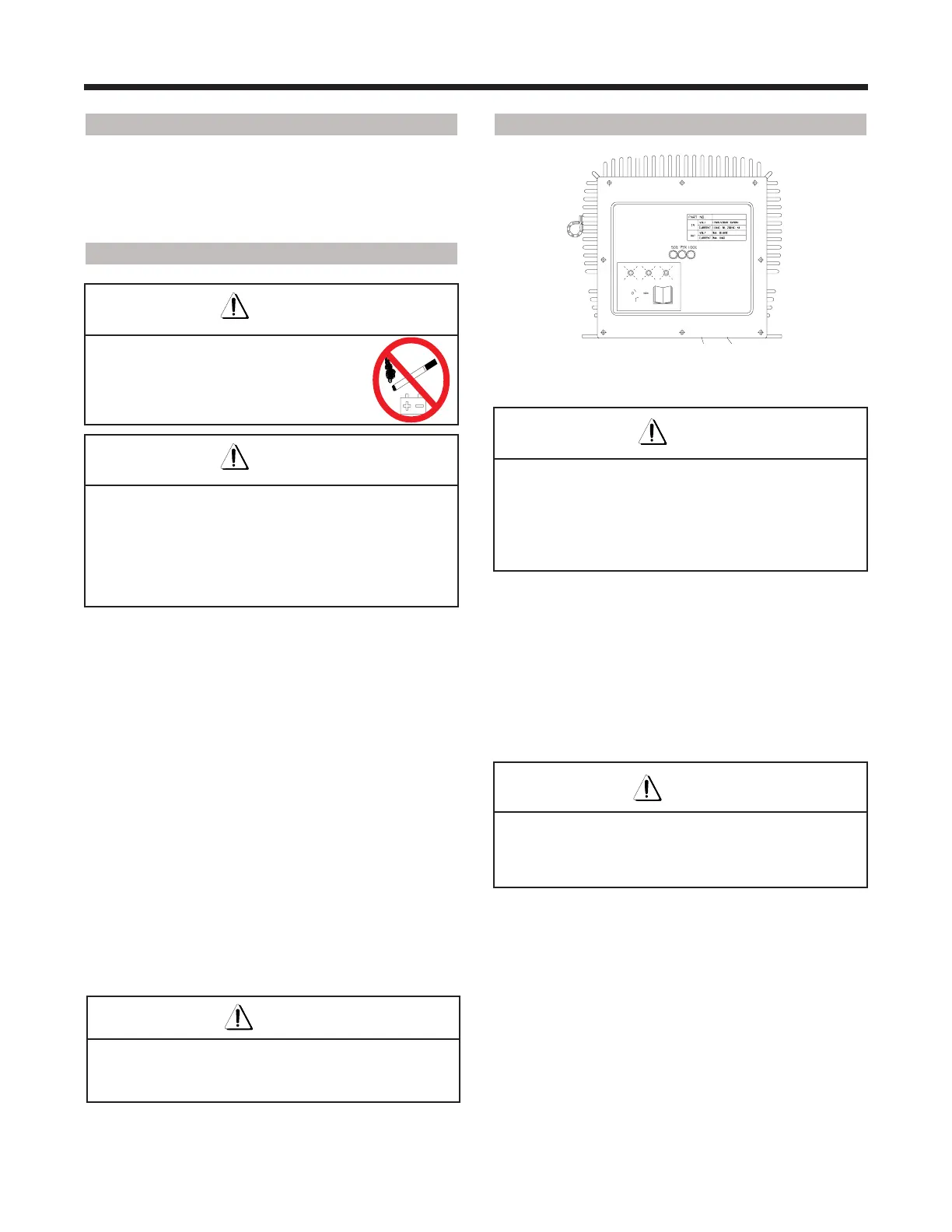
2.9-2 Battery Charging Operation
Figure 2-21. Battery Charger
Danger
Risk of electric shock
Do not immerse the charger in water.
Though the charger is highly resistant to water, it is
not designed for immersion and an electric shock
can occur.
1. Provide adequate ventilation for the batteries and
charger. The convection cooled design requires
access to cooling air for proper operation. Do
not allow blankets or other materials to cover the
charger. Although the charger protects itself
against overheating, the charger cooling fins
should be cleaned if clogged with debris for best
performance.
There could be a spark during charging. Be careful
when using fuels, solvents or other flammables near
the charger or batteries.
2. Connect the power supply cord to a properly
grounded 100V/50 or 60Hz, 115V/50 or 60Hz, or
230V/50 or 60Hz socket. This charger
automatically senses and adjusts to the AC input
voltage range.
Warning


 To Next Page