Introduction to Electricity
What is electricity? Nobody really knows. We only know how to produce
it, understand its properties, and how to control it. Electricity is the
movement of sub-atomic charged particles (called electrons) through
a material due to electrical pressure across the material, such as from a
battery.
Power sources, such as batteries, push electricity through a circuit, like
a pump pushes water through pipes. Wires carry electricity, like pipes
carry water. Devices like LEDs, motors, and speakers use the energy
in electricity to do things. Switches and transistors control the ow of
electricity like valves and faucets control water. Resistors limit the ow
of electricity.
The electrical pressure exerted by a battery or other power source is
called voltage and is measured in volts (V). Notice the “+” and “–” signs
on the battery; these indicate which direction the battery will “pump”
the electricity.
The electric current is a measure of how fast electricity is owing in
a wire, just as the water current describes how fast water is owing in
a pipe. It is expressed in amperes (A) or milliamps (mA, 1/1000 of an
ampere).
The “power” of electricity is a measure of how fast energy is moving
through a wire. It is a combination of the voltage and current (Power =
Voltage x Current). It is expressed in watts (W).
The resistance of a component or circuit represents how much it resists
the electrical pressure (voltage) and limits the ow of electric current.
The relationship is Voltage = Current x Resistance. When the resistance
increases, less current ows. Resistance is measured in ohms (Ω), or kilo
ohms (kΩ, 1000 ohms).
Nearly all of the electricity used in our world is produced at enormous
generators driven by steam or water pressure. Wires are used to
eciently transport this energy to homes and businesses where it is
used. Motors convert the electricity back into mechanical form to drive
machinery and appliances. The most important aspect of electricity
in our society is that it allows energy to be easily transported over
distances.
Note that “distances” includes not just large distances but also tiny
distances. Try to imagine a plumbing structure of the same complexity
as the circuitry inside a portable radio - it would have to be large because
we can’t make water pipes so small. Electricity allows complex designs
to be made very small.
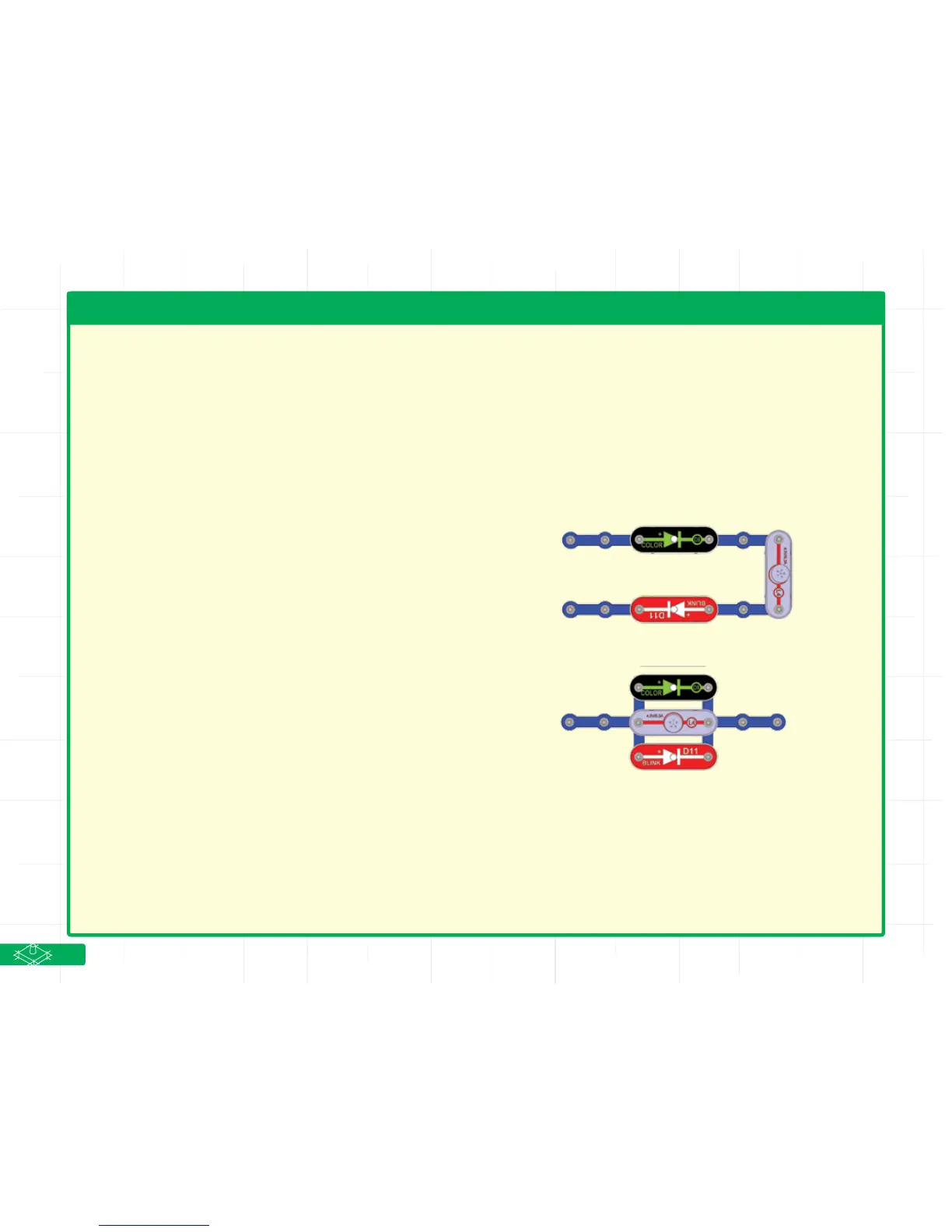
There are two ways of arranging parts in a circuit, in series or in parallel.
Here are examples:
Placing components in series increases the resistance; highest value
dominates. Placing components in parallel decreases the resistance;
lowest value dominates.
The parts within these series and parallel sub-circuits may be arranged
in dierent ways without changing what the circuit does. Large circuits
are made of combinations of smaller series and parallel circuits.
Series Circuit
Parallel Circuit
5


 To Next Page