Introduction Section 1
¾ 5 Different Examination Modes
¾ Cataract
¾ Dense Cataract
¾ Aphakic
¾ Pseudophakic (with three IOL types:
PMMA, Acrylic or Silicone)
¾ Manual
¾ Velocity Compensation for Pseudophakic
Lens Type (PMMA, Acrylic or Silicone)
¾ A-Scan Measurement Review Capability
¾ Axial Length, Anterior Chamber Depth,
and Lens Thickness Measures for Each
Scan
¾ Axial Length Average and Standard
Deviation for Up to 5 Scans
¾ A-Scan Measurement Review Mode
¾ Six Available IOL Formulas
¾ Binkhorst
¾ Regression-II
¾ Theoretic-T
¾ Holladay
¾ Hoffer-Q
¾ Haigis (optional)
¾ Immersion Capabilities
¾ 5 Customizable User Profiles
¾ Clinical Accuracy ±0.1 mm
¾ User-Performed Calibration Check
¾ Self-Test Routines at Start-Up
¾ Standard or Soft-Touch Probe Styles
Available
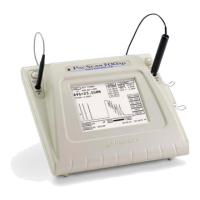
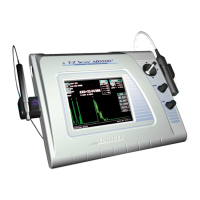
As mentioned, the Pachymeter mode of the
P
ACSCAN™ series allows for measuring and
mapping corneal thickness.
By placing the pachymeter probe against a
patient eye, an ultrasound image can be obtained
and translated into a corneal thickness
measurement. The measurement is displayed
and can be stored within the system’s memory at
a corresponding location on the corneal map.
After completion of measurements and
calculations, a hardcopy may be obtained of the
results using the optional thermal printer.
Several features help to distinguish the Sonomed
P
ACSCAN™ series including:
¾ Average and Standard Deviation Computed
for Each Reading – Reading is Result of 256
Individual Measurements
¾ Multiple Corneal Maps with Graphical
Display
¾ Measurement Range 0.30 mm to 1.00 mm
¾ Measurement Review Mode
¾ Selectable Bias and Corneal Velocity
¾ 5 Customizable User Profiles
¾ Accuracy Better Than ±5 Microns
¾ Precision ±1 Micron
¾ Resolution of 1 Micron
¾ Acceptance Angle of 10º
¾ Automatic Calibration Check and Probe
Sensitivity Test
¾ Straight or Angled Probe Styles Available
1.2
PACHYMETER FEATURES
(For 300P and 300AP Models Only)
1 - 2 Doc # 0300-A-1901-3D



 To Next Page