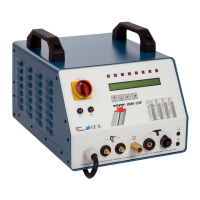
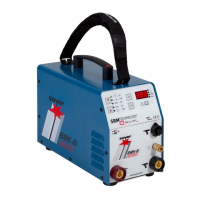
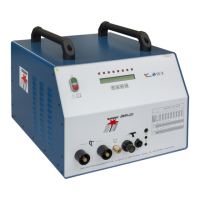
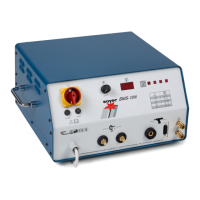
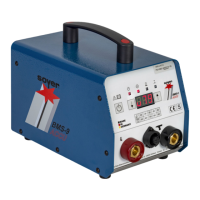
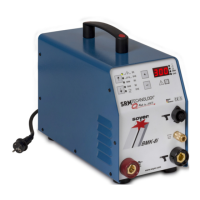
BMK-8 U / BMK-12 W
14
3 Description of stud welder
3.1 Short-cycle drawn arc stud welding technology
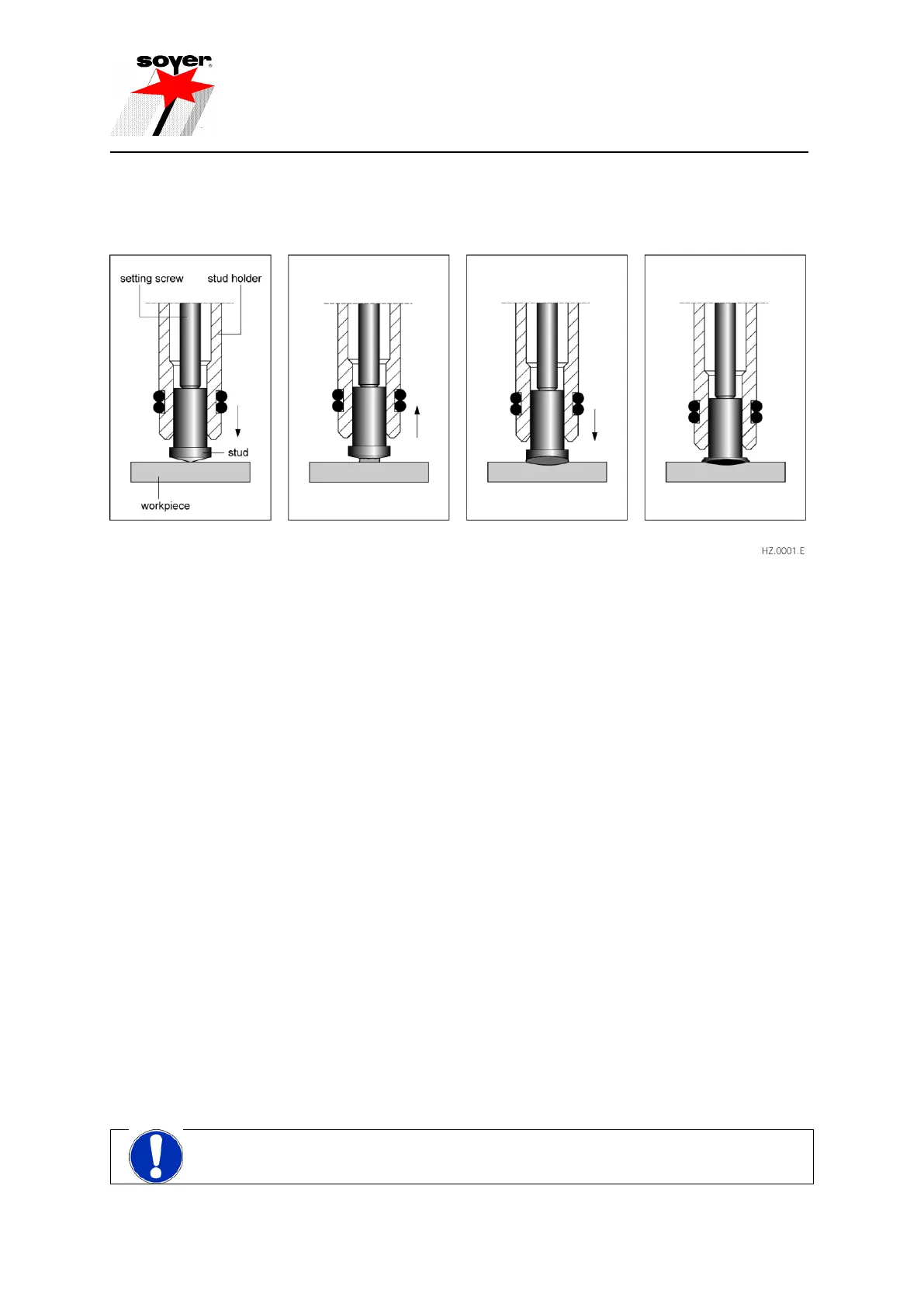
Illustration 1: Short-cycle drawn arc stud welding technology
The BMK-8 U / BMK-12 W SOYER stud welders run according to the principle of short-cycle drawn
arc stud welding.
A d.c. power supply provides the welding current. For detailed information, please refer to the
following regulations:
• DIN EN ISO 14555, "Arc welding of metallic materials"
• DVS Information Sheet 0902, "Drawn arc stud welding"
1. When welding, the stud is positioned on the workpiece.
2. The preweld current is ignited and the stud is lifted off the workpiece.
3. The subsequent ignition of the main current creates a molten pool between stud and
workpiece.
4. The stud immerses in the liquid molten pool and the material solidifies.
This method allows manual, semi-automatic and fully automatic inseparable welding of threaded
studs, pins, tapped studs, insulating pins, special studs and many other fasteners made of steel, CrNi
steel, heat-and acid-resisting steel with the workpieces. Conditionally it is also possible to weld nickel
and titanium depending on the respective requirements. Standard studs for drawn arc and capacitor
discharge welding in compliance with DIN EN ISO 13918 can be welded without requiring any
auxiliary aids. The application of shielding gas or ceramic ferrules is recommended for studs with a
diameter of more than 6 mm to prevent pore formation and to optimise the formation of bulges.
The standard BMK-8U / BMK-12W stud welders are suitable for operation with shielding gas and
ceramic ferrules. A d.c. power supply provides the welding current. The weld duration can be selected.
Owing to the low penetration depth of about 0.4 mm, this method can be applied from a sheet
thickness of 0.6 mm on. It guarantees particularly safe, uniform and reproducible stud welded joints
without high requirements to setting accuracy and stud tip quality. Application is especially
recommended for workpieces with difficult surface characteristics, e.g. oil, grease, zinc and other
galvanic treatments as well as rolling scale, electroconductive priming coats, forging scale, oxide films,
etc. The ratio of minimum sheet thickness and stud diameter amounts to 1:8.
Ensure that the surface is electroconductive.
Grind hot galvanized parts.


 To Next Page