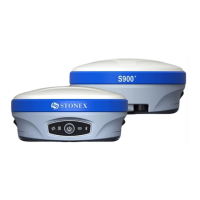
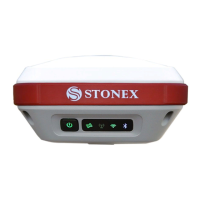
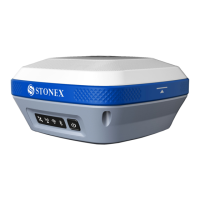
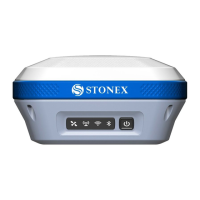
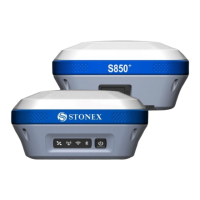
Chapter I : A brief introduction of S9III
STONEX
®
devoted itself to offer to surveyors the most advanced GPS tools. GPS RTK surveying
technology plays an important role in surveying tasks and its use is getting more and more
widespread. As a leading GPS RTK instrument producer, STONEX
®
guarantees that the S9III,
our latest RTK GPS receiver, is suited for nowadays demands of precision, reliability and user
friendliness.
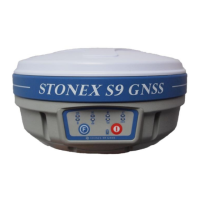
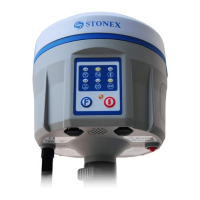
S9III is a multiconstellation (GNSS) receiver, it has been designed to receive and manage GPS
signals from Navstar, Glonass, Galileo and other navigation systems. S9III is totally integrated: in
one body are included the GNSS antenna, the UHF transceiver radiomodem and the Quadri-
band GSM/GPRS modem, the Bluetooth device and the battery. The user just has to switch on
the PDA controller and start the surveying!
The exquisite outlook and the amazing color bring you a fashioned surveying station. This
device has a higher stability, lesser power consumption, smaller volume and lighter weight than
the previous STONEX
®
receivers. S9III has a special design which makes it waterproof,
dustproof and vibration-proof. The batteries and built-in radio are set in the bottom of
mainframe, giving more effective dustproof and waterproof qualities and makes the S9III a
better performer in field of surveying. The Wireless receiver unit (weighs) 1.2 kg: the rover is
light and easy to carry. The low power consumption of receiver allows users to carry out and
work in long time with only one single battery.
Integrated design and anti-jamming property are combined perfectly: the former avoids the
problem of a cumbersome external antenna, and the mainframe design can resolve the
jamming problem effectively.
The performance of data-transfer radio technology is state-of-the-art: the bit error rate (BER) is
10
-7
and the radio collision problem is reduced.
UHF antenna is studied in order to make its electromagnetic center connected with the
electromagnetic center of dual-frequency antenna: in this way it reduces at the same time the


 To Next Page