SunFounder 3in1 Kit
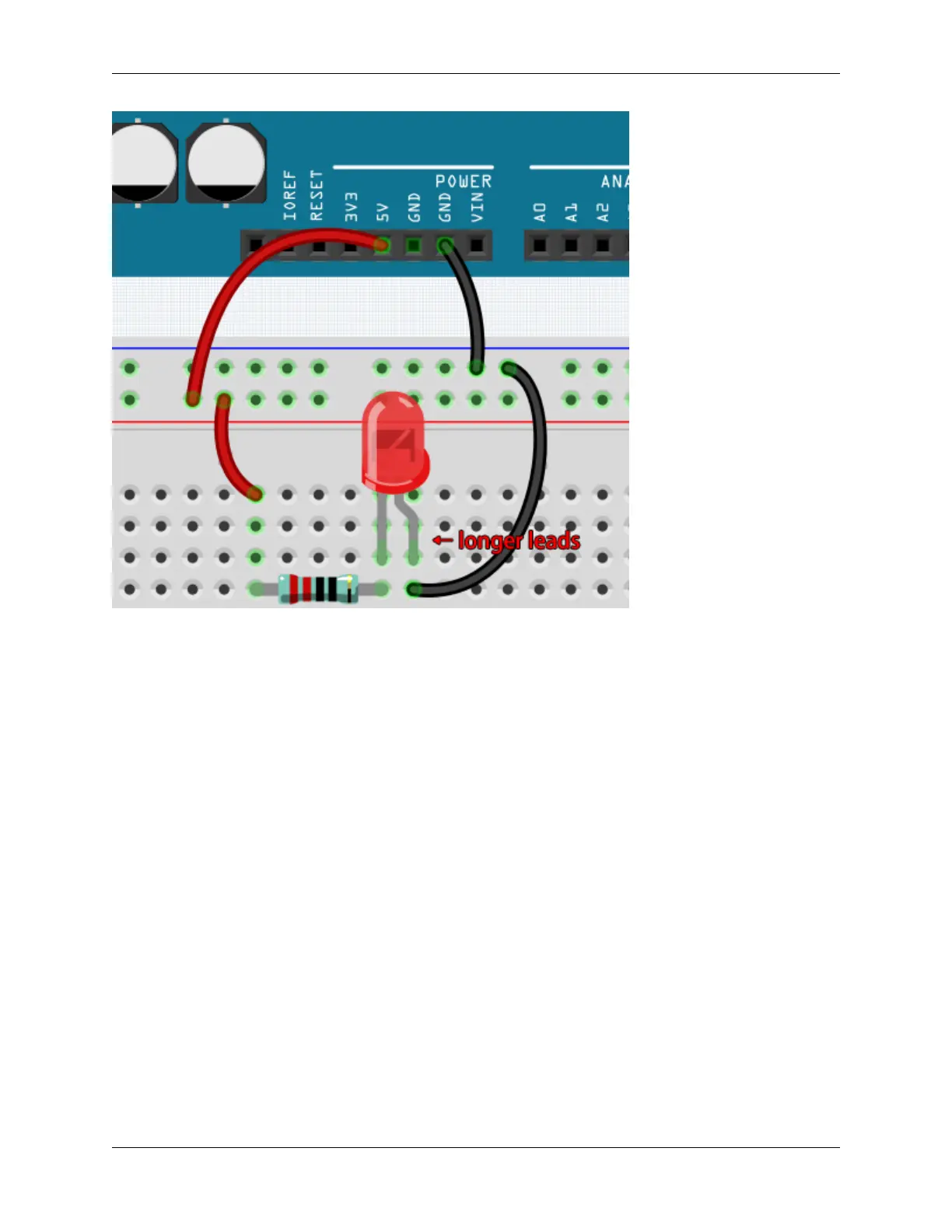
If you reverse the LED in this simple circuit that we built earlier, you will find that it no longer works.
In contrast, some devices have no direction, such as the resistors in this circuit, so you can try inverting them without
affecting the LEDs’ normal operation.
Most components and modules with labels such as “+”, “-”, “GND”, “VCC” or have pins of different lengths must be
connected to the circuit in a specific way.
Protection of the circuit
Current is the rate at which electrons flow past a point in a complete electrical circuit. At its most basic, current = flow.
An ampere (AM-pir), or amp, is the international unit used for measuring current. It expresses the quantity of electrons
(sometimes called “electrical charge”) flowing past a point in a circuit over a given time.
The driving force (voltage) behind the flow of current is called voltage and is measured in volts (V).
Resistance (R) is the property of the material that restricts the flow of current, and it is measured in ohms ().
According to Ohm’s law (as long as the temperature remains constant), current, voltage, and resistance are proportional.
A circuit’s current is proportional to its voltage and inversely proportional to its resistance.
Therefore, current (I) = voltage (V) / resistance (R).
• Ohm’s law - Wikipedia
About Ohm’s law we can do a simple experiment.
80 Chapter 2. Get Started with Arduino



 To Next Page