41
z Do not allow operation on rocks (neither hard rocks nor soft ones).
z Do not allow breaking or flat operation by slewing the machine. (e.g break wall
or flat the ground)
z Do not allow digging the bucket teeth into ground while slewing.
z Do not allow pulling the machine forward by digging bucket teeth into ground.
z Do not allow excavation by walloping or using the weight of the machine.
z Break the hard groundsill rocks into small pieces by hydraulic hammer before
excavation, etc. This can prevent damage to machine and will be more oecumenical.
z During excavation, especially deep digging work, pay attention to avoid bucket
teeth and boom cylinder colliding with dozer blade.
z Try your best to place the dozer blade at the rear end.
z The dozer is used for simple bulldozing work, so never dig the dozer blade too deep,
3.5.2 Composite movement of excavator
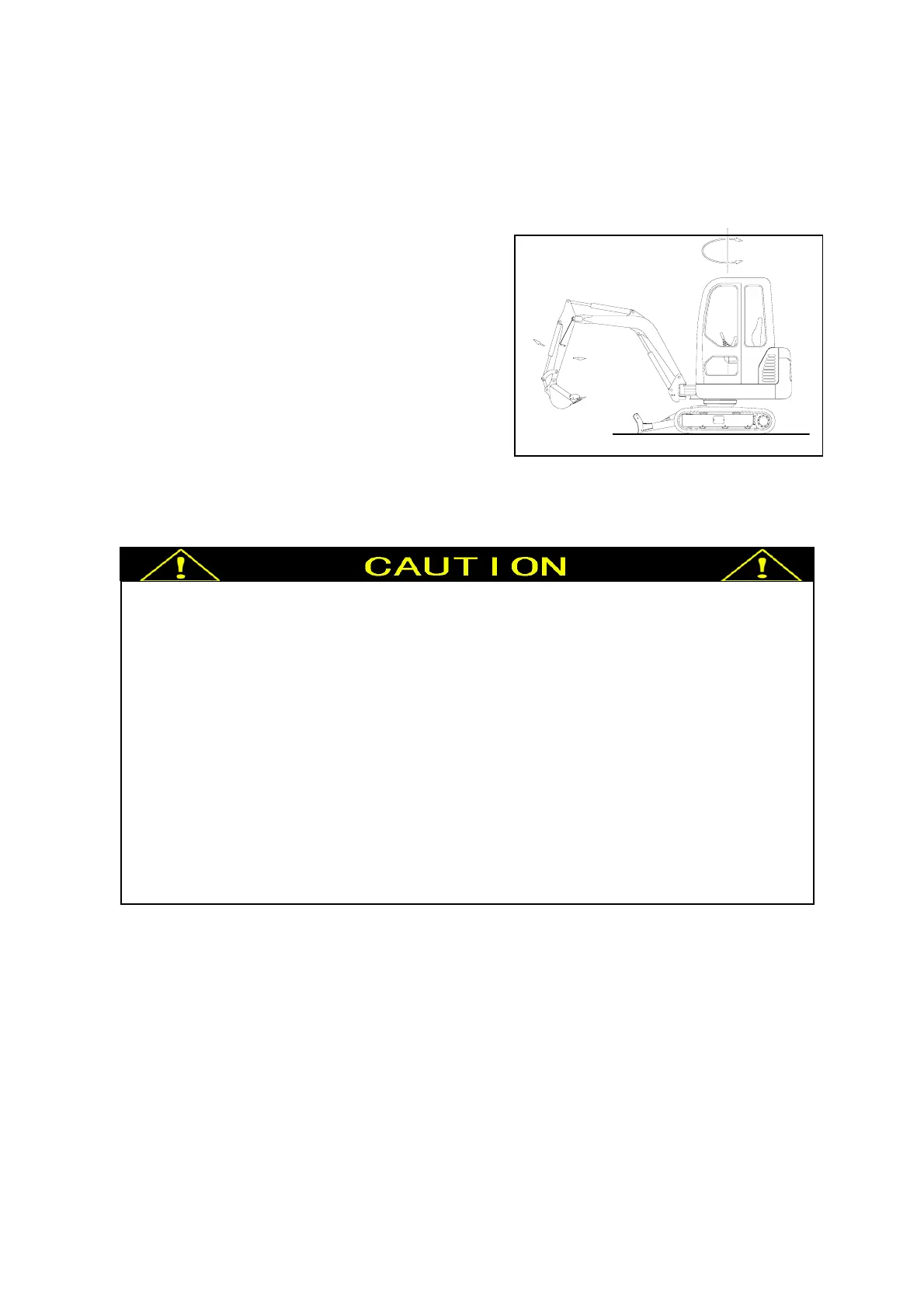
1) When the machine slews, you can operate the composite movement of boom and bucket.
2) It can operate as follows: bucket digs while arm is flexing; arm digs while lowering boom,
etc.
3) Besides the co-operation between right and left
handle, pull either of the handles to any
diagonal orientation (45° direction), can
achieve the adjacent two composite
movements.
3.5.3 Slewing platform brake
Release slewing control handle, return it to neutral
position, it will bring sufficient brake power to
brake platform. While reverse handle operation can
bring more brake torque.
3.5.4 Attention in excavation
1) Operator must wear safety helmet and work clothes, make sure the safety of working area
before starting machine.
2) During digging work, the dozer blade should be placed on ground.
3) Other people are not permitted to stand on the machine or within the range of 6 m away
from working radius. When begin to work or transport with full load, operator should ring
horn to warn.
4) Bucket should dig along the cutting track and avoid digging hard earth constrainedly,
otherwise it will cause the hydraulic oil overheated.
g
h
f
e
FIG.3-23


 To Next Page