2
1.0 Introduction
1.4 Principles of Water Brake Dynamometer Operation
An engine dynamometer (dyno) is a service tool that allows the operator to safely place a controlled load
on an engine. A loaded engine test is the only method of verifying engine capability. With the use of a
dyno, an engine can be properly operated throughout its power range without being placed into service.
Assembly deciencies may be detected before the engine is installed into a chassis and an actual
evaluation of an engine’s operating condition may be performed. The dynamometer is the nal quality test
before an engine is installed.
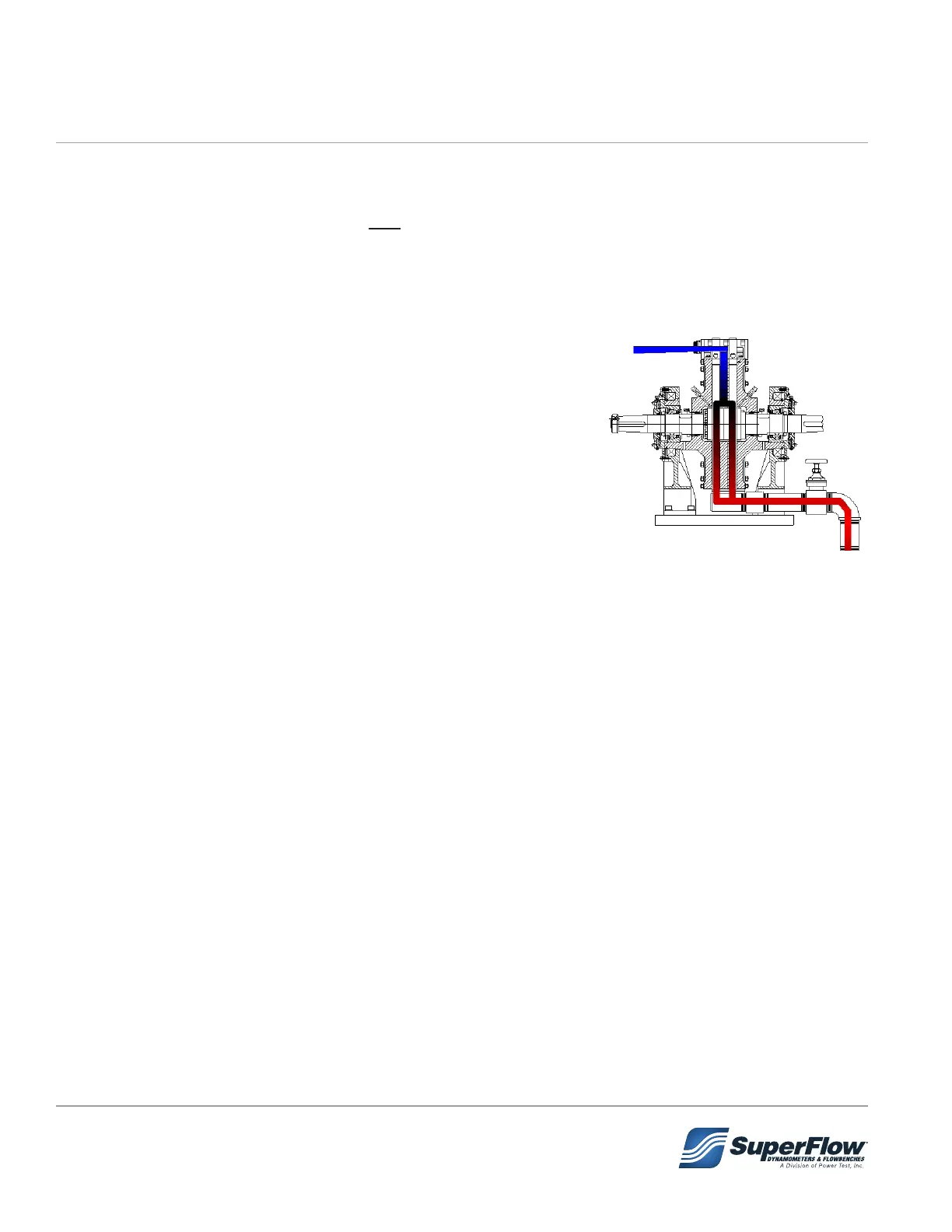
A dynamometer has two major components: the absorption unit
and the torque indication system. A water brake dynamometer uses
an absorption unit (absorber) to absorb power through momentum
exchange; using water as the working uid. A water brake absorber
consists of one or more shaft mounted rotors and at least two stators
(or end bells). The rotors spin freely inside the absorber housing in
the absence of water. When water is introduced into the absorber,
the spinning rotor accelerates the water and “throws” it into the
stators. If the stators weren’t restrained, they would also begin to
rotate, similar to a torque converter. But the stators are restrained
using a torque arm that is connected to a load cell.
The load cell measures the force with which the stators are trying to rotate. By knowing the distance from
the axis of the absorber to the torque arm, torque can be measured by: T = F x d
If we measure speed, horsepower can then be found by the relationship: HP = (T x rpm)/5252
The amount of load absorbed is proportional to the volume of water inside the absorber housing. The
water is ultimately absorbing all of the horsepower in the form of heat, therefore the warm water must be
exhausted and replenished with cool water to avoid boiling. By restricting the exhaust and controlling the
ow of water through the absorber, the volume of water inside, and therefore the load, can be precisely
controlled.


 To Next Page