Need help?
Do you have a question about the SYSMEX CyFlow Space and is the answer not in the manual?
Details the product name (CyFlow™ Space), software version (FloMax® 2.1x), and reference number (CY-S-3001R).
Provides contact information for Sysmex Partec GmbH, including address, phone, fax, email, and website.
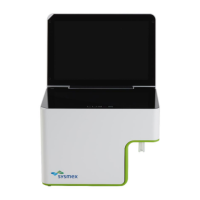
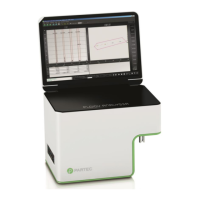
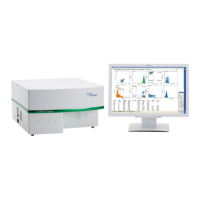
Defines the CyFlow™ Space as a modular desktop Flow Cytometer with adaptable optics and software control.
Lists various applications including Immunophenotyping, Cell Counting, Cell Cycle Analysis, and Environmental Samples.
Outlines the manual's coverage of basic operation and maintenance, noting it excludes software details.
Assumes basic flow cytometry knowledge and suggests consulting expert help or books.
Warns about Class 1 laser product status when closed, and Class 3b when opened, posing skin and eye damage risks.
Advises on accessible wiring, proper placement, and using only adequate spare parts for electrical safety.
Prohibits unauthorized alterations to the device or software to prevent risks to users and the system.
Explains the four hazard levels (DANGER, WARNING, CAUTION, NOTICE) with their severity and recommended actions.
Indicates the purpose of INFORMATION notes as providing further details about the device or procedure.
Describes separating cells in suspension and labeling them with fluorescent dyes for analysis.
Details illumination of cells by laser, emission of fluorescence, filtering, and measurement of scatter light.
Explains how signal intensity is classified into channels in real-time and displayed as histograms or dot plots.
Describes the instrument's ability to perform volumetric counting by monitoring fluid volume and determining cell concentration.
Provides steps for powering on the instrument, lasers, peripherals, and computer.
Covers starting the FloMax® software and performing initial cleaning (priming) of the instrument.
Discusses instrument configurations with up to 4 lasers and managing crosstalk between laser beams.
Details sample preparation, inserting the tube, and the automated acquisition phases (Prerun, Stabilize, Run, Count).
Outlines steps for daily/weekly cleaning, protecting the sample port, shutting down software, computer, and instrument.
Explains Dual Platform and Single Platform techniques for absolute counting and their disadvantages.
Introduces the method based on counting cells (N) in a defined volume (V) using precise counting and mechanical measurement.
Explains the electrode principle for determining sample volume (V) based on liquid contact loss with electrodes.
States that precision and reproducibility can be demonstrated and checked with specific calibration beads.
Highlights benefits like high precision, no calibration errors, less setup time, faster analysis, and lower expenses.
Provides step-by-step instructions for sample preparation, running, and defining subpopulations for concentration analysis.
Describes a 2-laser setup (488 nm, 638 nm) and typical optical parameters like FSC, SSC, and fluorescence channels.
Details a 3-laser setup (488 nm, 405 nm, 638 nm) and its parameters for flow cytometry with cell sorting.
Mentions the possibility of allocating up to 16 detectors and using a CMOS camera for particle flow monitoring.
Explains how to open and use the Parameter Setup dialog box to select and configure analysis parameters.
Details how to select a leading trigger parameter for discriminating particles based on signal thresholds.
Describes how to adjust signal amplification for each parameter using photomultiplier tubes (PMTs) and gain values.
Explains how to set the sample speed (µl/s) and its effect on count rate and accuracy.
Guides on setting the lower level threshold to avoid acquiring unwanted background or 'noise' signals.
States that electrical and electronic equipment requires special treatment and local representative contact.
General guidance on disposing of components and fluids according to local regulations and procedures.
Details procedures for safely emptying and decontaminating the waste bottle, especially with hazardous samples.
Provides instructions for safely unscrewing, securing, and disposing of the sheath fluid bottle.
Specifies that installation and uninstallation must be performed by authorized service personnel only.
Outlines requirements for placement, workspace, ventilation, and avoiding adverse environmental conditions.
Provides sequential instructions for setting up the computer and connecting the instrument to power.
Details connecting the instrument to the computer, camera, and sheath/waste containers.
Describes the flow cuvette as the core component responsible for precise cell guiding and its sensitive nature.
Covers cleaning the instrument casing, emptying waste bottles, and cleaning the sheath reservoir.
States that all service must be performed by authorized Sysmex service personnel.
Includes warnings about device weight during transport and general storage condition requirements.
Directs users to contact the local Sysmex representative for information on proper disposal after decontamination.
Lists system specifications (size, weight, environment) and the broad range of applications supported by the instrument.
Details the instrument's optics, including light sources (lasers, LEDs), detectors, filters, and video monitor.
Describes the flow cuvette, sample delivery system, sampling volume, flow rates, and biosafety system.
Covers the electronics for signal processing, amplification modes, and analogue-to-digital conversion.
Details the capabilities of the FloMax® software, including acquisition, gating, compensation, and report generation.
 General
| Type | Flow Cytometer |
|---|---|
| Forward Scatter (FSC) | Yes |
| Side Scatter (SSC) | Yes |
| Detectors | Photomultiplier tubes (PMTs) |
| Particle Size Range | 0.5-50 µm |
| Power Requirements | 100-240 V AC, 50/60 Hz |
| Data Output | FCS |
| Laser | 488 nm (blue) |

 To Next Page