1-1. INTRODUCTION
This manual provides operation and maintenance infor-
mation for the Model 8020 Function Generator. Section 1
is a general description of the Model 8020. Sections 2 and
3 contain installation and operation instructions. IEEE
programming is explained in Section 4. Maintenance and
performance checks are provided in section 5. The theory
of operation is described in section 6. Section 7 outlines
calibration and troubleshooting procedure. Section 8 con-
tain tables of replaceable parts and recommended spare
parts. Section 9 contains schematic and component loca-
tion diagrams.
1-2. DESCRIPTION
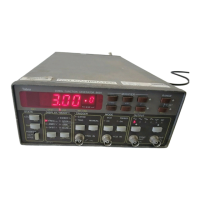
Model 8020 is a high performance - digital function gen-
erator. It provides a variety of signal waveforms, for use as
test stimuli to many different electronic devices. Micro-
processor based, Model 8020 is extremely easy to set up
for manual use as well as simple to program in an IEEE-
488 GPIB system environment. The generator features as
standard: lin/log sweep, pulse waveforms and complete
triggering facilities - including internal trigger generator.
Model 8020 provides a wide frequency coverage and a
large amplitude span; ensuring continuing usefulness for
a variety of tasks, today as well as in the future, when de-
mands change. Rapid, repeatable testing every time is as-
sured by thirty non-volatile stored set-ups thus, ensuring
exact duplication of previous set-ups no matter how com-
plex is assured. Its performance, programmability and
economy make it equally at home in every laboratory.
Output may be selected to be either continuous, gated
or triggered. The function generator features a built-in
trigger generator which can replace an external triggering
device. Additional convenience is achieved through the
MANUAL button permitting user control over triggering
sequences.
Alternately, model 8020 may also be used as an inde-
pendent sweep generator with its output signal swept over
an exceptionally wide range of 10 decades. A choice of
eight sweep modes, both linear and logarithmic, covers
most applications which are known today. A MARKER
output is provided to permit Z-axis modulation of an oscil-
loscope to intensify parts of the scope trace.
Output level ranges from 20 mV to 30 Vp-p into open
circuit or 10 mV to 15 Vp-p into 50 ohms. Maximum DC
offset plus AC signal is variable within a window level
from -15 V to +15 V into open circuit or from -7.5 V to +7.5
V into 50 ohms.
The function generator employs a built-in counter.
This counter is not available to the outside world however,
it is incorporated in an internal loop which automatically
monitors the output frequency. When a deviation of more
than a few tenth of a percent is detected by the counter, the
frequency is automatically corrected by the internal mi-
croprocessor.
There are two other models which will be described in
this manual:
Model 8021 - 20 MHz Pulse/Function Generator.
This instrument is identical in its basic functions to the
Model 8020. In addition, this instrument offers Pulse and
Ramp capabilities. Pulse width and ramp width ranges are
controllable within a range of 25.0 nS to 9.99 S. Pulse com-
plement and inverted ramp functions are also available.
Model 8022 - 20 MHz AM Function Generator. This
model offers an amplitude modulation function in addi-
tion to the 8020 functions. Carrier level is controllable
within the range of 0 to 100 %. Modulating signal is ap-
plied through a front panel BNC connector. The operator
may select as a carrier any of the standard available func-
tions.
SECTION 1
GENERAL INFORMATION
Model 8020 General Information
Page 1-1


 To Next Page