Other small computers that can be used as
controllers have limited IEEE command capability.
The capabilities of some computers depends on the
particular interface being used. Often, little software
“tricks” are required to achieve the desired results.
From the preceding discussion, the message is
clear: make sure the proper software is being used
with the instrument. Often, the user may incorrectly
suspect that a hardware problem is causing fault,
when it was the software that was causing the
problem all along.
4-6. HARDWARE CONSIDERATIONS
Before the instrument can be used with the IEEE-488
bus, it must be connected to the bus with a suitable
connector. Also, the primary address must be properly
programmed as described in this section.
4-6-1. Typical Controlled Systems
The IEEE-488.2 bus is a parallel interface system.
As a result, adding more devices is simply a matter
of using more cables to make the desired connections.
Because of this flexibility, system complexity can
range from simple to extremely complex.
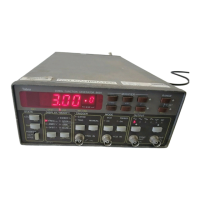
The simplest possible controlled system comprises
a controller and one Model 8020. The controller is
used to send commands to the instrument, which
sends data back to the controller.
The system becomes more complex when addi-
tional instruments are added. Depending on program-
ming, all data may be routed through the controller,
or it may be transmitted directly from one instrument
to another.
4-6-2. Connections
The instrument is connected to the bus through an
IEEE-488.2 connector. This connector is designed
to be stacked to allow a number of parallel connec-
tions on one instrument.
NOTE
To avoid possible mechanical dam-
age, it is recommended that no more
than three connectors be stacked on
any one instrument. Otherwise, the
resulting strain may cause internal
damage to the connectors.
The IEEE-488.2 bus is limited to
a maximum of 15 devices, including
the controller. Also, the maximum
cable length is 20 meters. Failure to
observe these limits will probably re-
sult in erratic bus operation.
Custom cables may be con-
structed using the information in Table
4-2. Table 4-2 also lists the contact
assignments for the various bus lines.
Contacts 18 through 24 are return
lines for the indicated signal lines,
and the cable shield is connected to
contact 12. Each ground line is con-
nected to digital common in the Model
8020.
CAUTION
The voltage between IEEE common
and ground must not exceed 0 V or
damage may result to your instru-
ment.
4-7. CHANGING GPIB ADDRESS
The primary address of your instrument may be
programmed to any value between 0 and 30 as
long as the selected address is different from other
devices addresses in the system. This may be
accomplished using a front panel programming se-
quence. Note that the primary address of the instru-
ment must agree with the address specified in the
controller’s program.
Table 4-2. IEEE-488 Contact Designations
Contact IEEE-488
Number Designation Type
1 DIO1 Data
2 DIO2 Data
3 DIO3 Data
4 DIO4 Data
5 EOI Management
6 DAV Handshake
7 NRFD Handshake
8 NDAC Handshake
9 IFC Management
10 SRQ Management
11 ATN Management
12 SHIELD Ground
13 DIO5 Data
14 DIO6 Data
15 DIO7 Data
16 DIO8 Data
17 REN Management
18-24 Gnd Ground
Model 8020 IEEE-488.2 Operation
Page 4-5


 To Next Page