CAUTION
To avoid operator shock hazard do not exceed
the power mains voltage frequency rating
which limits the leakage current between case
and power mains. Never expose the instru-
ment to rain, excessive moisture, or condensa-
tion.
2-6. INSTALLATION AND MOUNTING
The instrument is fully solid state and dissipates only a
small amount of power. No special cooling is required.
However, the instrument should not be operated where the
ambient temperature exceeds 40 deg C, when the relative
humidity exceeds 80% or condensation appears anywhere
on the instrument. Avoid operating the instrument close to
strong magnetic fields which may be found near high
power equipment such as motors, pumps, solenoids, or
high power cables. Use care when rack mounting to locate
the instrument away from sources of excessive heat or
magnetic fields. Always leave 4 cm (1.5 inches) of venti-
lation space on all sides of the instrument.
2-7. BENCH OPERATION
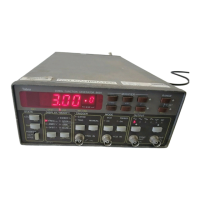
The Model 8020 is shipped with plastic feet, tilt stand in
place and ready for use as a bench or portable instrument.
See outline drawing Figure 2-1 for dimensions.
2-8. RACK MOUNTING
The instrument may be rack mounted in a standard 19 inch
rack. The instrument may be rack mounted in Rack Mount
Kit option 8020-rack.
2-9. PORTABLE USE
The instrument may be used in applications requiring port-
ability. A tilt stand consisting of two retractable legs is pro-
vided with each unit.
2-10. SHORT TERM STORAGE
If the instrument is to be stored for a short period of time
(less than three months), place cardboard over the panel
and cover the instrument with suitable protective covering
such as a plastic bag or strong craft paper. Place power ca-
ble and other accessories with the instrument. Store the
covered voltmeter in a clean dry area that is not subject to
extreme temperature variations or conditions which may
cause moisture to condense on the instrument.
2-11. LONG TERM STORAGE OR
RE-PACKAGING FOR SHIPMENT
If the instrument is to be stored for a long period or shipped,
proceed as directed below. If you have any questions con-
tact your local Tabor field engineering representative or
the Tabor Service Department at the factory.
If the original Tabor supplied packaging is to be used
proceed as follows:
1. If the original wrappings, packing material, and con-
tainer have been saved, re-pack the instrument and acces-
sories originally shipped to you. If the original container is
not available, one may be purchased through the Tabor
Service Department at the factory.
2. Be sure the carton is well sealed with strong tape or metal
straps.
3. Mark the carton with the model number and serial
number with indelible marking. If it is to be shipped, show
sending address and return address on two sides of the box;
cover all previous shipping labels.
If the original container is not available, proceed as fol-
lows:
1. Before packing the unit, place all accessories into a plas-
tic bag and seal the bag.
2. For extended storage or long distance shipping only, use
U.S. government packing method II C and tape a two-unit
bag of desiccant (per MIL-D-3464) on the rear cover.
3. Place a 13 cm (5 inch) by 30 cm (12 inch) piece of sturdy
cardboard over the front panel for protection.
4. Place the counter into a plastic bag and seal the bag.
5. Wrap the bagged instrument and accessories in one inch
thick flexible cellular plastic film cushioning material
(per PPP-C-795) and place in a barrier bag (per MIL-B-
131). Extract the air from bag and heat seal.
6. Place bagged instrument and accessories into a 250 mm
(10 inch) x 360 mm (14 inch) x 508 mm (20 inch) fiber
board box (per PPP-B-636 type CF, class WR, variety SW,
grade V3C). Fill additional spaces with rubberized hair or
cellular plastic cushioning material. Close box in accord-
ance with container specifications. Seal with sturdy water
resistant tape or metal straps.
7. Mark container “DELICATE INSTRUMENT”,
“FRAGILE”, etc. Mark instrument model and serial
number and date of packaging. Affix shipping labels as
required or mark according to MIL-STD-129.
Installation Model 8020
Page 2-2


 To Next Page