MARK - Specifies the frequency of which the sweep
marker changes its voltage level at the marker output
connector. The marker output is only active when the
function generator is set to operate with one of its built-in
sweep modes.
TRIG PER - A built-in generator provides an internal
triggering stimulant in such cases where an external sig-
nal is not available. The displayed value specifies the
interval between consecutive triggering sequences.
Table 3-2 lists the limits for each of the above parame-
ters.
3-2-1-3. Trigger Mode
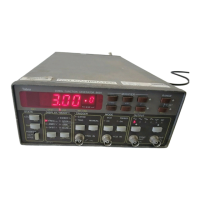
Two push-buttons are grouped in the TRIGGER MODE
section. Selection of one of the trigger modes is done by
depressing one of these buttons. The selected mode is in-
dicated by an LED. Model 8020 may be triggered from
either one of the following sources:
1. External signal which may be applied to the TRIG IN
connector
2. An internal - asynchronous trigger generator
3. GPIB commands (like GET)
4. Front panel [MANUAL] push-button
The [MANUAL] trigger is active when the instrument
set to operate in its external trigger mode. This push-but-
ton when depressed serves as a replacement for an external
trigger source.
3-2-1-4. Operating Mode
Two push-buttons are available at the operating mode
group. Selection of one of the operating modes is done
by depressing one of these buttons. The selected mode is
indicated by an LED.
Model 8020 may operate in several operating mode
such as sweep or VCO modes. Model 8021 provides two
additional modes: pulse and PWM. Model 8022 provides
additional amplitude modulation mode.
3-4-1-5. Output
There are two push-buttons in the OUTPUT group.
These buttons are used for selecting an output wave-
forms for the output connector. The selected function is
indicated by an LED.
3-4-1-6. Modifier
The MODIFIER push-buttons simulate digital potenti-
ometers. The MODIFIER push-buttons operate in con-
junction with the DISPLAY/MODIFY group. There are
four sets of modifying buttons. Three sets are dedicated
for changing the displayed read-out. One set changes the
range of the displayed parameter.
3-2-2 Connectors
The connectors are used for connecting the Model 8020
to the unit under test and to and to external triggering
source.
1. TRIG INPUT - The TRIG INPUT connector is used
for applying an external triggering source to the function
generator.
2. VCO INPUT - The VCO INPUT connector is used for
applying an external dc voltage source to the function
generator. The same input is used for connecting a pulse
width modulating signal (model 8021 only) or for con-
necting an amplitude modulating signal (model 8022
only).
2a. VCO/PWM INPUT - The VCO/PWM INPUT
(model 8021 only) connector serves two functions. In
VCO operating mode this input is used for applying an
external dc voltage source to the function generator. The
same input is used for connecting a pulse width modulat-
ing signal when the instrument is set to operate in pulse
mode.
2b. VCO/AM INPUT - The VCO/AM INPUT (model
8022 only) connector serves two functions. In VCO op-
erating mode this input is used used for applying an ex-
ternal dc voltage source to the function generator. The
same input is used for connecting an amplitude modulat-
ing signal when the instrument is set to operate in its AM
mode.
3. SYNC OUT - The SYNC OUT connector outputs
fixed amplitude pulses from a 50 ohms source. This out-
put is synchronous with the main output.
4. OUTPUT - The OUTPUT connector is used as the
main output for the function generator. Output is driven
from a 50 ohms source. Special care should be taken
when these outputs are connected to the device under test
because these outputs are capable of delivering up to 30
Vp-p.
Model 8020 Operating Instructions
Page 3-3


 To Next Page