2. IFC (Interface Clear) - Setting the IFC line
true (low) causes the bus to go to a known state.
3. REN (Remote Enable) - Setting the REM line
low sends the REM command. This sets up instru-
ments on the bus for remote operation.
4. EOI (End Or Identify) - The EOI line is used
to send the EOI command that usually terminates
a multi-byte transfer sequence.
5. SRQ (Service Request) - the SRQ line is set
low by a device when it requires service from the
controller.
4-3-2. Handshake Lines
The bus uses three handshake lines that operate in
an interlocked sequence. This method assures reliable
data transfer regardless of the transfer rate. Generally,
data transfer will occur at a rate determined by the
slowest active device on the bus.
One of the handshake lines is controlled by the
data source, while the remaining two lines are con-
trolled by accepting devices. The three bus handshake
lines are:
1. DAV (Data Valid) - The source controls the
state of the DAV line.
2. NRFD (Not Ready For Data) - the acceptor
controls the state of the NRFD line.
3. NDAC (Not Data Accepted) - the acceptor
also controls the NDAC line.
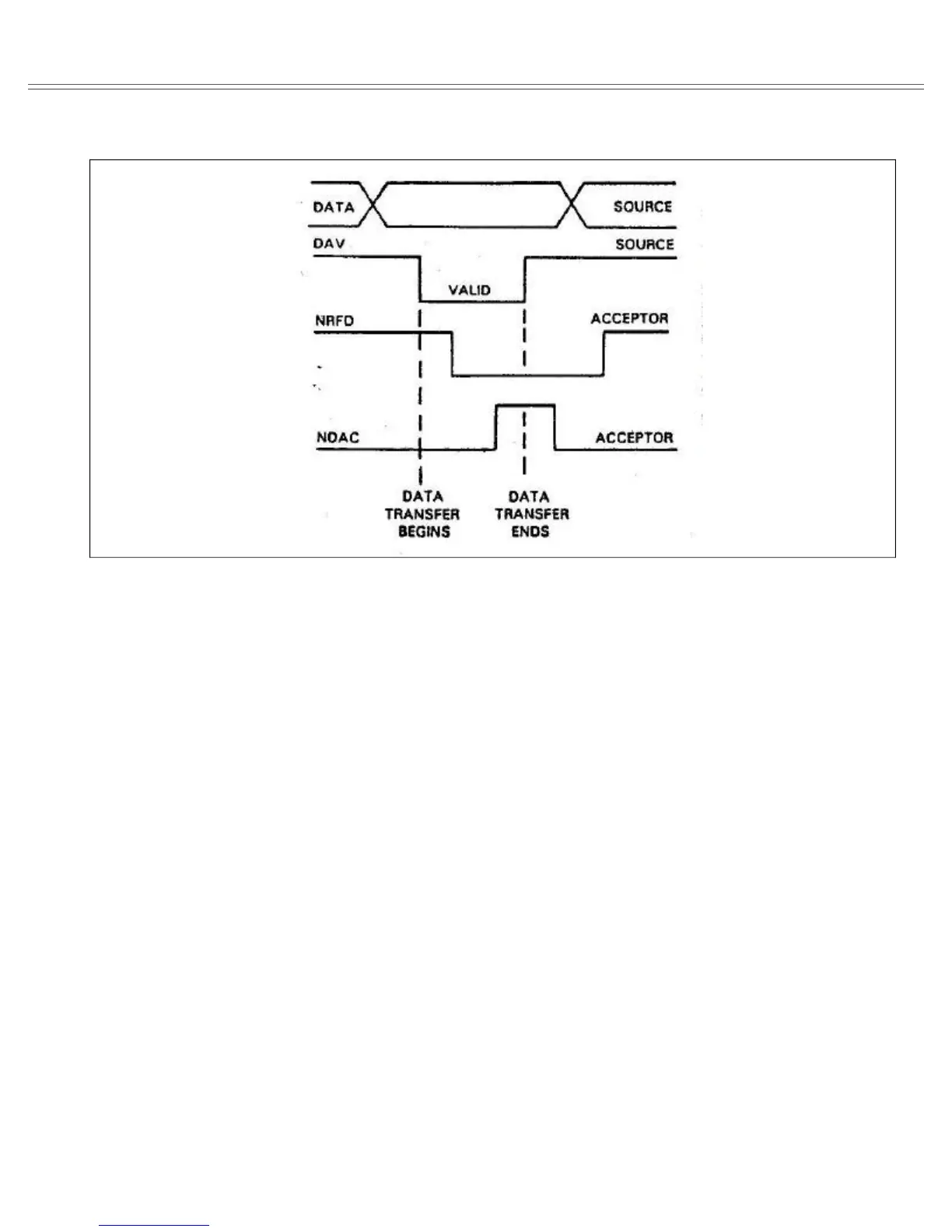
The complete handshake sequence for one data
byte is shown in Figure 4-2. Once data is on the
bus, the source checks to see that NRFD is high,
indicating that all devices on the bus are ready for
data. At the same time NDAC should be low from
the previous byte transfer. If these conditions are
not met, the source must then wait until the NRFD
and NDAC lines have the correct status. If the
source is controller, NRFD and NDAC must remain
stable for at least 100 ns after ATN is set low.
Because of the possibility of bus hang up, some
controllers have time-out routines to display error
messages if the handshake sequence stops for any
reason.
Once the NRFD and NDAC lines are properly
set, the source sets the DAV line low, indicating
that data on the bus is now valid. the NRFD line
then goes low; the NDAC line goes high once all
devices on the bus have accepted the data. Each
device will release the NDAC line at its own rate,
but the NDAC line will not go high until the slowest
device has accepted the data byte.
After the NDAC line goes high, the source then
sets the DAV line high to indicate that the data on
the bus is no longer valid. At this point, the NDAC
Figure 4-2. IEEE Handshake Sequence
Model 8020 IEEE-488.2 Operation
Page 4-3


 To Next Page