I
npu
t
Fader
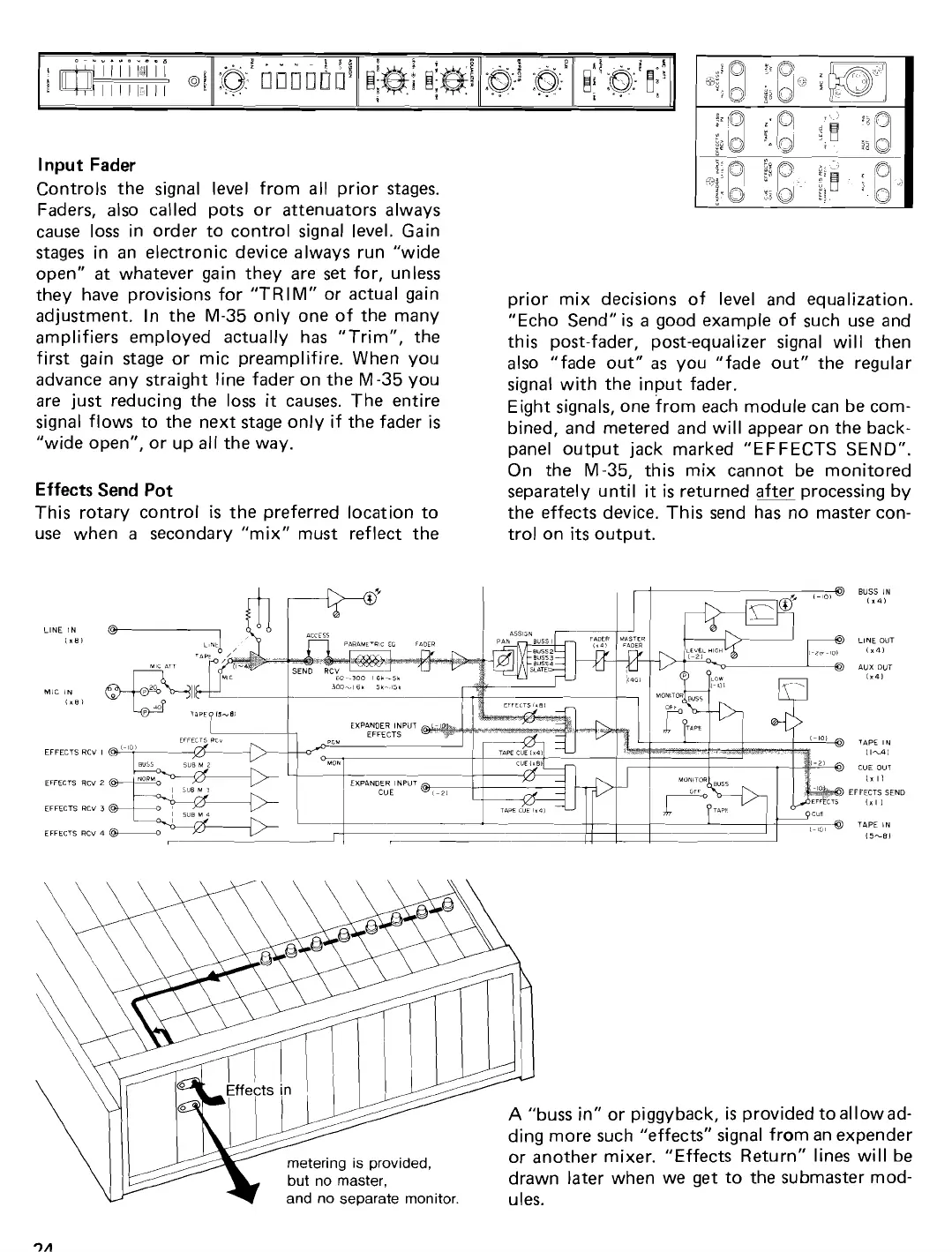
Controls the signal level from
al1 prior stages.
Faders,
also called pots or attenuators always
cause loss in order to
control signal level. Gain
stages in an electronic
device always run "wide
open"
at
whatever gain they are set for, unless
they
have provisions for "TR IM" or actual gain
adjustment. In the M-35 only one of the many
amplifiers employed
actually has "Trim", the
first gain stage or
mic preamplifire. When you
advance any straight
line fader on the M-35 you
are just reducing the loss
it
causes. 'the entire
signal flows to the next stage only if the fader
is
"wide open", or up
al1
the way.
Effects Send Pot
This rotary control
is
the preferred location to
use when a secondary "mix" must reflect the
prior mix decisions of level and equalization.
"Echo Send"
is
a
good example of such use and
this post-fader, post-equalizer signal will then
also "fade out" as you "fade out" the regular
signal with the input fader.
Eight signals, one from each
module can be com-
bined, and metered and will appear on the back-
panel output jack marked "EFFECTS SEND".
On the M-35, this mix cannot be monitored
separate1 y until
it
is
returned
aftft
processing by
the effects
device. This send has no master con-
trol on
its
output.
EXPANOER
INPUT
EFFECTS
RCV
4
A
"buss in" or piggyback,
is
provided toallowad-
ding more such "effects" signal from an expender
or another mixer. "Effects Return" lines will be
but
no master,
drawn later when we get to the submaster mod-
and no separate monitor.
ules.


 To Next Page