25
MULTI-EFFECTS
Tape Delay
This algorithm emulates the old style Tape
Delays. Before the Digital era Delays were
created using a Tape Recording device with a
tape-loop and recording/playback heads.
As you probably know analog tape-recorders
has a tendency to deteriorate/change the
recorded material. Wow and flutter combined
with a significant loss of high-end frequencies,
and to some extent also low-end frequencies,
are all elements commonly associated with
tape recordings. However, these features are at
times quite useful and sought-after as they in
some situations blend with and compliments
the source material in a highly musical manner.
Among other things the M300 Tape Delay uses
a HiCut with a rather low Cross-over frequency
to emulate the loss of highs found on
conventional Tape delays.
Compare this to the clean Studio Delay
algorithm, which has a considerably higher
HiCut frequency to see what fits your
application.
Studio Delay
As opposed to the Tape Delay algorithm
described above the Studio Delay algorithm will
give you a clearer reproduction of the material
fed to the M300. To soften the Delay as it is
commonly done in studio productions the
Studio Delay uses a subtle yet significant HiCut
at a relatively High crossover frequency.
Delay
Standard Delay. The M300 processing power
and excellent 24 bit converters will process a
precise high quality Delay with no deterioration
of the sound.
PingPong Delay
The PingPong Delay basically pans the Delay
repeats from left to right and back while
keeping the Input signal at its original position.
This gives a very wide spread special effect.
Slapback Delay
Slapback Delay is a very short Delay with only
a single or a few repeats. The effect is
commonly used as a “doubling-effect” making
the processed material seam more massive.
Short Slapback Delays are also often used on
funky rhythm guitars, - a bit longer on
Rockabilly guitar or vocals.
Phaser
Phaser and Vintage Phaser
The Vintage Phaser utilizes four all-pass filters.
These filters create comb-looking characteristics.
When the filtered sound is mixed with the direct
sound the “phasing sound” occurs.
The Standard Phaser utilizes twelve all-pass
filters. Due to the higher number of filters in the
Smooth Phaser, compared to the Vintage
Phaser, the Standard Phaser simply sounds
smoother than the Vintage type.
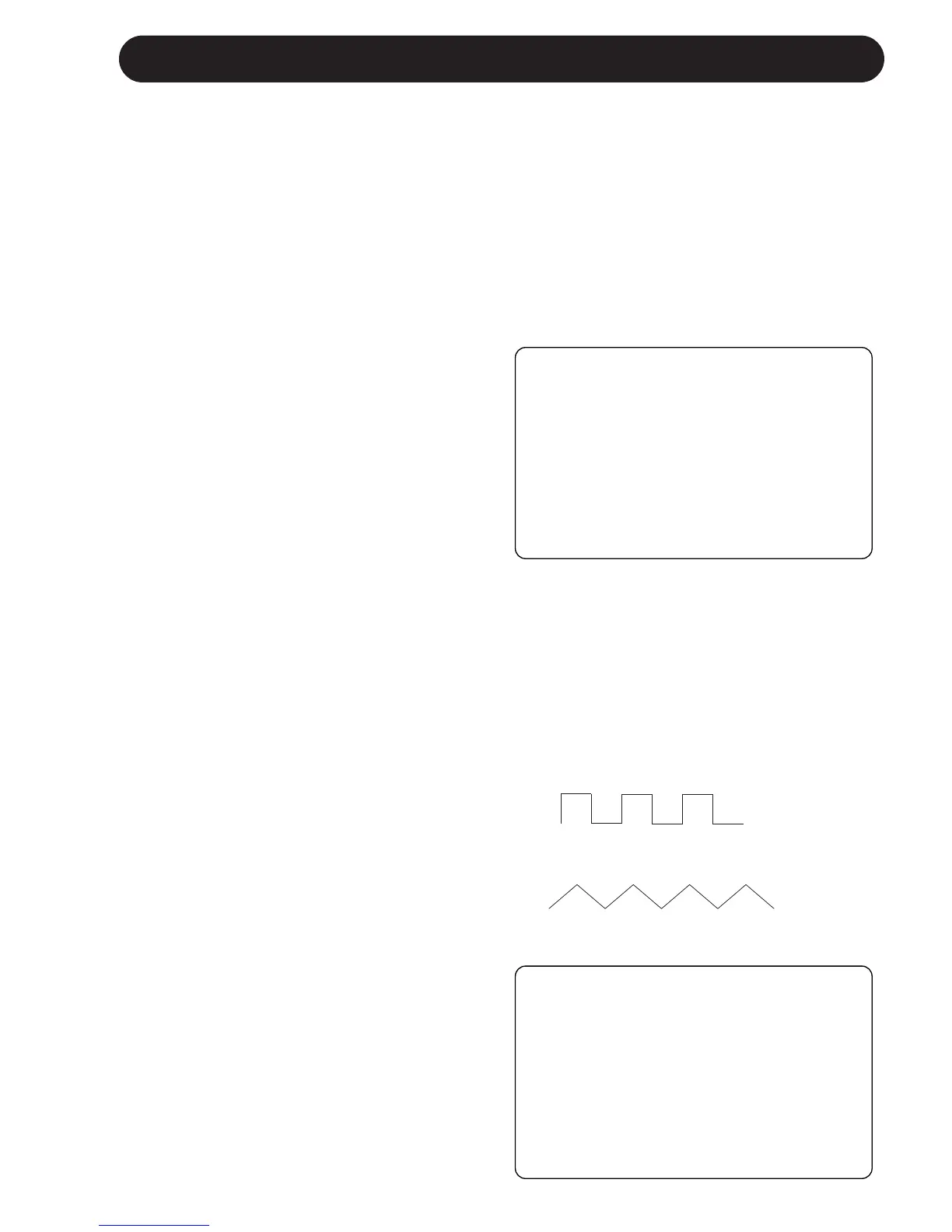
Hard Tremolo/Soft Tremolo
A Tremolo is basically a repeated level change
controlled by an LFO. The M300 offers a Hard
Tremolo that used a “square” wave-shape and
Soft Tremolo that use a “triangular” wave
shape. Please see the illustration below. The
difference is quite obvious. Listen and enjoy!
Hard Tremolo - Square shape
Soft Tremolo - Triangular shape
Phaser - controls
TIMING knob
In the Phaser algorithm the TIMING knob
sets the Speed of the Phaser.
FEEDBACK/DEPTH knob
In the Phaser algorithm the
FEEDBACK/DEPTH knob sets the Depth of
the Phasing effect.
Tremolo - controls
TIMING knob
In the Tremolo algorithm the TIMING knob
sets the Speed of the Tremolo.
FEEDBACK/DEPTH knob
In the Tremolo algorithm the
FEEDBACK/DEPTH knob sets the Depth of
the Tremolo effect.


 To Next Page