The IDMx40 is a family of fully digital intelligent servo drives, encompassing models like the IDM240-5EI and IDM640-8EI. These drives are built on advanced DSP technology, offering high performance and integrating an embedded motion controller. They are designed for controlling brushless DC, brushless AC (using vector control), DC brushed motors, and step motors. Position feedback is typically handled by incremental encoders (quadrature).
Function Description:
The IDMx40 drives are capable of performing position, speed, or torque control and can operate in single-axis, multi-axis, or standalone configurations. A key feature is their embedded motion controller, which combines controller, drive, and PLC functionalities into a single compact unit. This allows the drives to execute complex motions without needing an external motion controller. The high-level Technosoft Motion Language (TML) enables direct execution of various operations at the drive level.
Usage Features:
With TML, users can:
- Set various motion modes, including profiles (trapezoidal or S-curve speed shape), Position, Velocity, Time (PVT) 3rd order interpolation, Position, Time (PT) 1st order interpolation, electronic gearing, and camming. Some of these are optional for the IDM640 CANopen execution.
- Change motion modes and parameters dynamically.
- Execute homing sequences (available only for IDMx40 CAN executions), with 33 different homing modes.
- Control program flow using conditional jumps, calls of TML functions, and TML interrupts triggered by predefined or programmable conditions (e.g., protections, limit switch transitions, capture inputs).
- Implement waits for programmed events.
- Handle digital I/O and analog input signals.
- Execute arithmetic and logic operations.
- Perform data transfers between axes.
- Control motion of one axis from another via inter-axis motion commands.
- Send commands to groups of axes (multicast) to start simultaneous motion sequences.
- Synchronize all axes within a network.
The EasyMotion Studio software facilitates TML programming, allowing for distributed intelligence in multi-axis applications, reducing development time and communication requirements. Users can program drives to execute complex motion tasks and inform the master upon completion, reducing the master's workload to calling TML functions stored in the drive EEPROM.
The IDMx40 can also be controlled by a CANopen master or from a PC or PLC using the TML_LIB motion libraries. Commissioning is performed using the EasySetUp software.
Important Technical Specifications:
- Motor Control: Digital drives for brushless DC, brushless AC (vector control), DC brushed, and step motors.
- Control Modes: Position, speed, or torque control.
- Feedback Interfaces: Incremental encoder and digital Hall sensors (5V single-ended, open-collector, or RS-422 differential). A second incremental encoder / pulse & direction interface (5V or 24V single-ended, open-collector, or RS-422 differential) is available for external (master) digital reference (optional for IDM640 CANopen execution).
- Digital I/Os:
- 6 inputs: 24V, opto-isolated, common I/O ground (2 general-purpose, 2 for limit switches, 2 for Reset and Enable/emergency shutdown).
- 2 inputs: 24V / 5V compatible (shared with second encoder / pulse & direction).
- 6 digital outputs: opto-isolated, 24V PNP-type, 80/160 mA, short-circuit protected (4 general-purpose, 2 for Ready and Error).
- Analog Inputs: 2 differential analog inputs +/-10 V for reference and feedback.
- Communication:
- RS-232 serial communication up to 115kbaud.
- RS-485 serial communication (available only for IDMx40 CAN executions).
- CAN-bus 2.0A / 2.0B up to 1Mbit/s, opto-isolated, with selectable communication protocols: CANopen (compatible with CiA standards: DS301 and DSP402) and TMLCAN (compatible with all Technosoft drives with CANbus interface).
- Motor Temperature Sensor Interface.
- Memory: 4K×16 SRAM for data acquisitions and 8K×16 E2ROM for setup data and TML programs.
- PWM Switching Frequency: Nominal 20 kHz (higher values possible in specific configurations).
- Torque Loop Update Frequency: Nominal 10 kHz.
- Speed/Position Loop Update Frequency: 1-10 kHz (1-2kHz covers all cases, higher values possible with quadrature encoders).
- Continuous Output Current: 8 ARMS.
- Peak Output Current: 16.5 A.
- Logic Power Supply: 12÷48 VDC.
- Motor Power Supply: 12÷80 VDC.
- Minimal Load Inductance: 50μH @12V, 200 μH @ 48 V, 330 μH @80V.
- Operating Ambient Temperature: 0-40°C (can be extended up to +80°C with reduced current/power ratings).
- Dimensions: Compact design: 136 x 95 x 26 mm.
Maintenance Features:
- Firmware Updates: EasySetUp includes a firmware programmer to update drive firmware to the latest revision.
- Troubleshooting: EasySetUp and EasyMotion Studio offer evaluation tools like Data Logger, Control Panel, and Command Interpreter to measure, check, and analyze drive commissioning and motion application behavior, aiding in troubleshooting errors and protection triggers.
- ESD Protection: The drives contain electrostatically sensitive components and should be handled in an ESD protected environment.
- Wiring Recommendations: Detailed guidelines are provided for motor, power supply, analog, digital, serial, and CAN wiring to prevent damage and ensure optimal performance, including recommendations for shielding, cable lengths, and termination resistors.
- Over-voltage Protection: Options are provided to limit over-voltage during braking, such as adding external capacitors or brake resistors.
- DIP-Switch Settings: DIP switches allow for configuration of firmware update mode, RS-485/RS-232 communication mode, Axis ID, and Auto/External run mode for TMLCAN protocol.
- LED Indicators: Green LED indicates power-on and initialization completion (off on error); Red LED indicates an error condition or when OUT#12 is set to 24V.
The manual also provides detailed information on scaling factors between SI units and the drive's internal units for position, speed, acceleration, jerk, current, voltage, time, and temperature, which is crucial for precise control and programming. Memory mapping details are also provided for advanced programming and data acquisition.

 Need help?
 General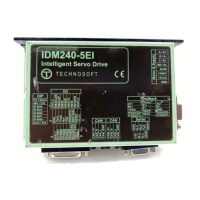

 To Next Page