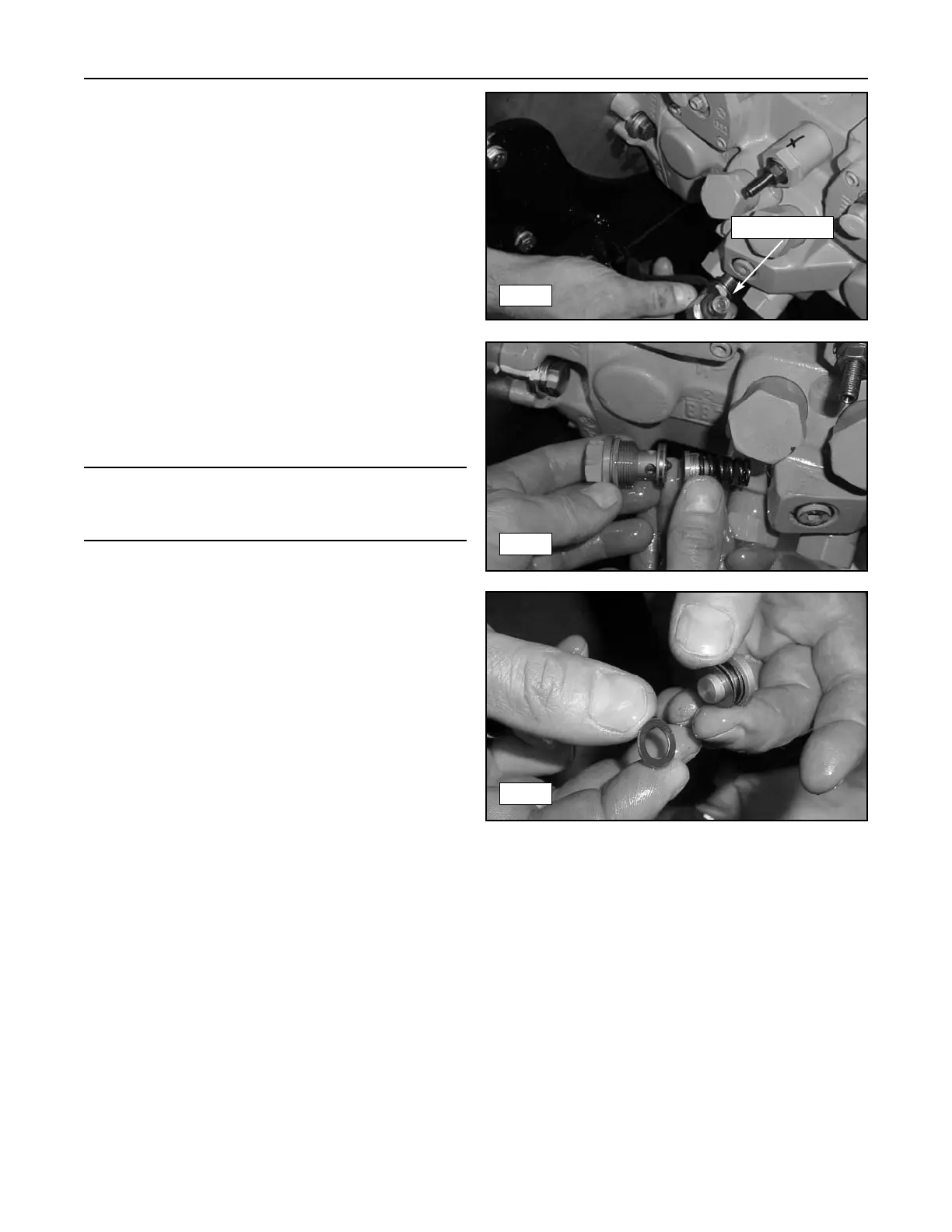
1. Attach the gauge to test port A. (fig. 14-1) Route
the gauge so that you or an assistant can read it
during testing.
2. Make sure any bystanders are clear of moving
components, then start the engine.
3. Allow the engine to warm up to operating tempera-
ture, then with the engine at wide open throttle,
check the charge pressure. Record your reading. It
should read 700 +/- 50 psi (4826 +/-345 kPa) at
wide open and 500 +/- 50 psi (3447 +/- 345 kPa)
at idle, at test port A. If the reading at port (A) is
lower than specified, check the pressure reading
at the pump test port (B) prior to adjustment. If the
reading at port (A) is higher than specified, change
the hydraulic filters and re-check. If reading is still
higher, check the pressure at port (B) prior to
adjustment.
Note: To check pressure at test port B, remove the plug in
port B and install a quick coupler fitting similar to the one
installed in port A. If one is not available, swap the positions
of the plug in (B) and the coupler in (A) to test port B.
4. The charge pressure at the pump should read 440
+/- 30 psi ( 3034 +/-207 kPa). This can be checked
at test port (B) shown in figure 14-2. If your read-
ing differs, adjustment is necessary.
5. If necessary, adjust the charge relief pressure.
To adjust:
a) Remove the relief valve from the side of the
pump as shown. (fig. 14-3)
b) Add shims to increase the pressure setting, or
remove shims to decrease the setting until
within specification. (fig. 14-4)
14-2
Compact Track Loader
14. Hydraulic Pressure
14-2
Test Port (B)
14-3
14-4



 To Next Page