Page 7 of 29 Revision 3.3 Feb 2021
ProReact EN Analogue Installation Manual
Document Ref. PACC-MAN
Theory of Operation
The ProReact EN Analogue LHD system uses a heat sensitive cable to
monitor an area, critical equipment or the like, for an overheat or re
condition.
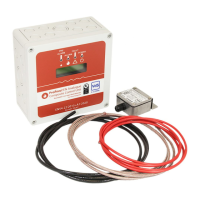
The ProReact EN Analogue Composite Control Unit continuously
monitors the resistance of temperature sensitive polymers within the
ProReact EN Analogue LHD cable. The resistance of the ProReact EN
Analogue LHD cable decreases as the temperature around the cable
increases. An abnormal change in resistance, due to an overheat
condition, along the cable triggers either a Pre-Alarm or Alarm on
the ProReact EN Analogue Composite Control Unit. The ProReact EN
Analogue Composite Control Unit can be interfaced to a conventional or
addressable re alarm system.
For the alarm temperature to be stable across a range of ambient
temperatures, the ProReact EN Analogue Composite Control Unit
measures the average ambient temperature across the entire cable and
dynamically adjusts the alarm threshold accordingly.
It is important therefore to ensure that the ProReact EN Analogue
Composite Control Unit is set up correctly and the cable resistance and
the average ambient temperature as shown on the ProReact EN Analogue
Composite Control Unit are as expected. See the Commissioning section
for more information about setting up a ProReact EN Analogue LHD
system.
Alarm Temperatures
The ProReact EN Analogue LHD system is designed so that an alarm will
be triggered when the temperature around a section of ProReact EN
Analogue LHD cable (equal to 3% of its total length) reaches a nominal
alarm temperature predetermined by the chosen setting on the ProReact
Composite Control Unit (as shown in Table 1).
The actual exposure temperature required to trigger an alarm will
be lower than the nominal alarm temperature (as shown in Table 1)
if a larger section of ProReact EN Analogue LHD cable is exposed
to an abnormal rise in temperature. Likewise, the actual exposure
temperature will be higher that the nominal alarm temperature
if a shorter section of ProReact EN Analogue LHD cable is exposed
to an abnormal rise in temperature.
When the sensor cable is installed and operated in hotter environments,
the sensor cable may need to be exposed to a higher temperature than
that required in a cooler environment in order to trigger an alarm for a
given setting on the ProReact EN Analogue Composite Control Unit. In
such circumstances, the ProReact EN Analogue Composite Control Unit
dynamically adjusts the alarm threshold to reduce the likelihood of false
alarms.
Refer to the “Application Temperatures” section for more information on the
typical and maximum application temperature for each controller setting.
Please refer to the charts on the following page for illustrative examples
of the expected temperature a given portion of Analogue LHD cable
must be exposed to in order to trigger an alarm by ProReact Composite
Control Unit setting.
Rate-of-rise activation
Note: for the Class A1I/A2I, 54°C and 64°C Alarm settings the control
unit will also trigger an alarm if approximately 2% of the sensor cable is
heated at more than 15°C per minute for longer than 3 minutes. This will
show as a rate alarm (see step 25 in the commissioning procedure).
VdS EN54-22:2015
+A1:2020 Approved
UL listed
(UQGS)
Available Controller Setting
Nominal Alarm Temperature
°C °F
3 ✗
Class A1I/A2I 66 151
3 ✗
Class BI 80 176
✗ 3
54 54 129
✗ 3
64 64 147
✗ 3
72 72 162
✗ 3
79 79 174
✗ 3
86 86 187
✗ 3
100 100 212
Table 1 - ProReact EN Analogue Composite Control Unit settings & nominal alarm temperatures in typical
application temperatures (based on 3% of total cable length)


 To Next Page