95
DMC3S - Manual - 08 - 2021
5 AUTOMATION FUNCTIONS
— Logical selectivity block - FSL
Preface
Logical selectivity reduces the time to eliminate faults which, in scalar time system would require
programming significantly long operating times for the power sources.
The implementation of the IEC 61850 protocol provides that panels DV7500, DV7203 and RGDM use
their real time communications capacity to send and receive BLIND signals.
These signals temporarily inhibit the open orders issued by the directional protection functions (67,
67N and 32P) and thus enable exclusive selection of the branch of the line affected by the fault.
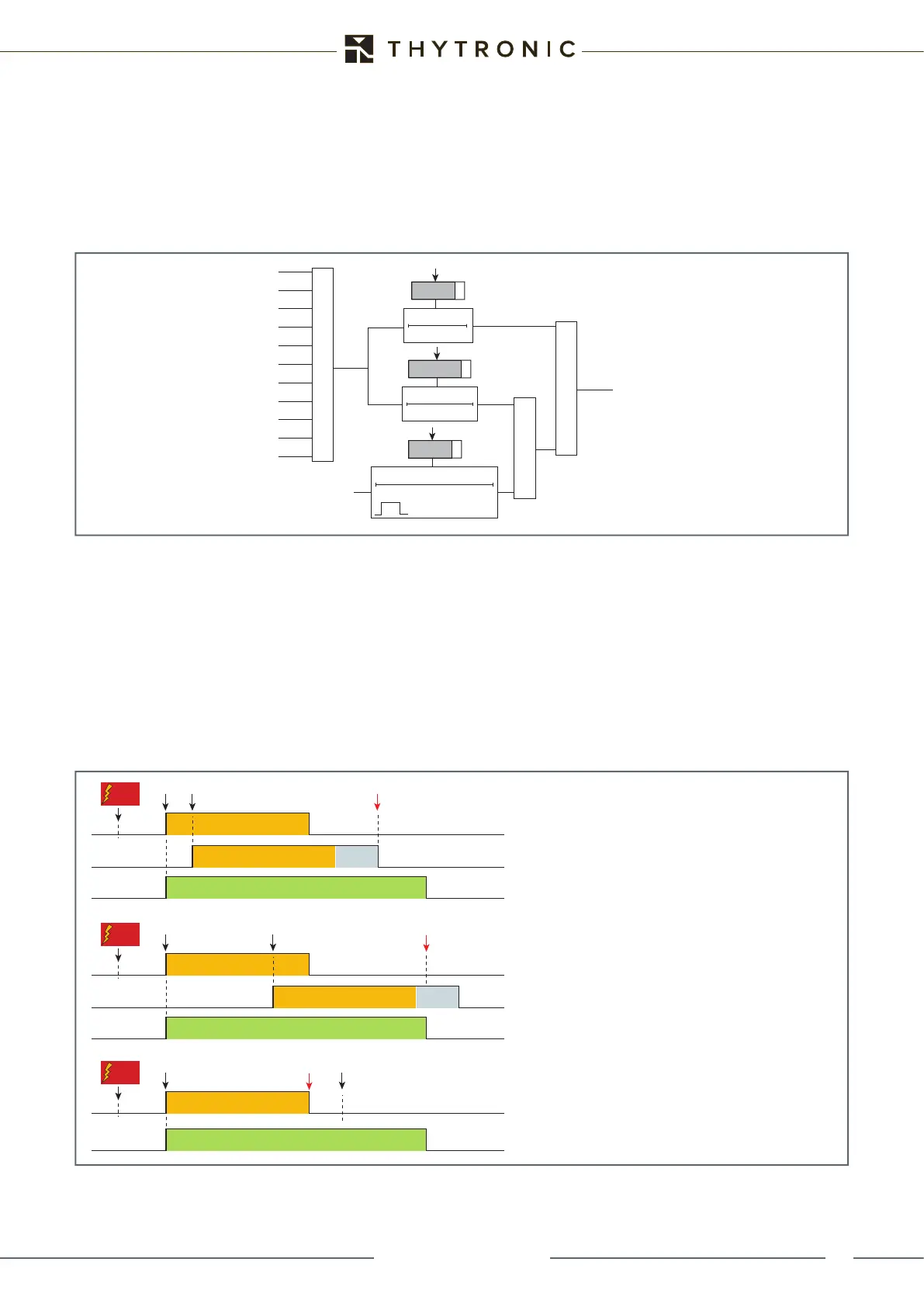
When a directional protection function threshold is started, the DMC panel:
• Issues a BLIND GOOSE (IEC61850) over its LAN
• Starts the operating timer (Tatt)
• Starts the back-up timer (Tr) (with Tr>Tatt)
The following situations may occur:
A) If the function resets within the operating time Tatt, so that the start signal returns to standby, all
timers are reset,
B) If the function does not reset within the operating time Tatt and not even one BLIND signal is
received from a device in the list of subscribers, when Tatt expires the DMC panel opens the
breaker and remotely reports the tripped status to the RTU/display,
C) If, whether a BLIND signal is received or not, the function does not drop-out within the drop-out
time Tr, the DMC panel opens the breaker and remotely reports the tripped status to the RTU/
display.
FSL.ai
t
r xxx def
T
T
0
t
xxx> xx def
0
≥1
≥1
&
Trip
BLIND
T
t
FSL-Add
0
t
xxx>xxdef +
t
FSL-Add
Start
P
1
>
Start
P
2
>
Start
I
PD
>
Start
I
PD
>>
Start
I
PD
>>>
Start
I
PD
>>>>
Start
I
ED
>
Start
I
ED
>>a
Start
I
ED
>>b
Start
I
ED
>>>
Start
I
EDSb
Functional diagram of the FSL function
Back-up time
Operating time
BLIND held
BLIND received within the operating time:
the operating timer is forced to zero when the BLIND is
received and the open command (Trip) is issued when
(t trip +t FSL-Add) times out
BLIND received within the operating time:
the operating timer is forced to zero when the BLIND is
received and the open command (Trip) is issued when
the back-up time times out, which is less than
(t trip +t FSL-Add)
BLIND received after the operating time:
the operating timer is not forced to zero when the BLIND
is received and the open command (Trip) is issued when
(t trip) times out
t meas.
t FSL-Add
t trip
t trip
t back-up
FAULT
START BLIND TRIP
t meas.
t FSL-Add
t trip
t trip
t back-up
FAULT
START BLIND
TRIP
t meas.
t trip
t back-up
FAULT
START BLIND
TRIP


 To Next Page