44 45
Cleaning and Maintenance
English
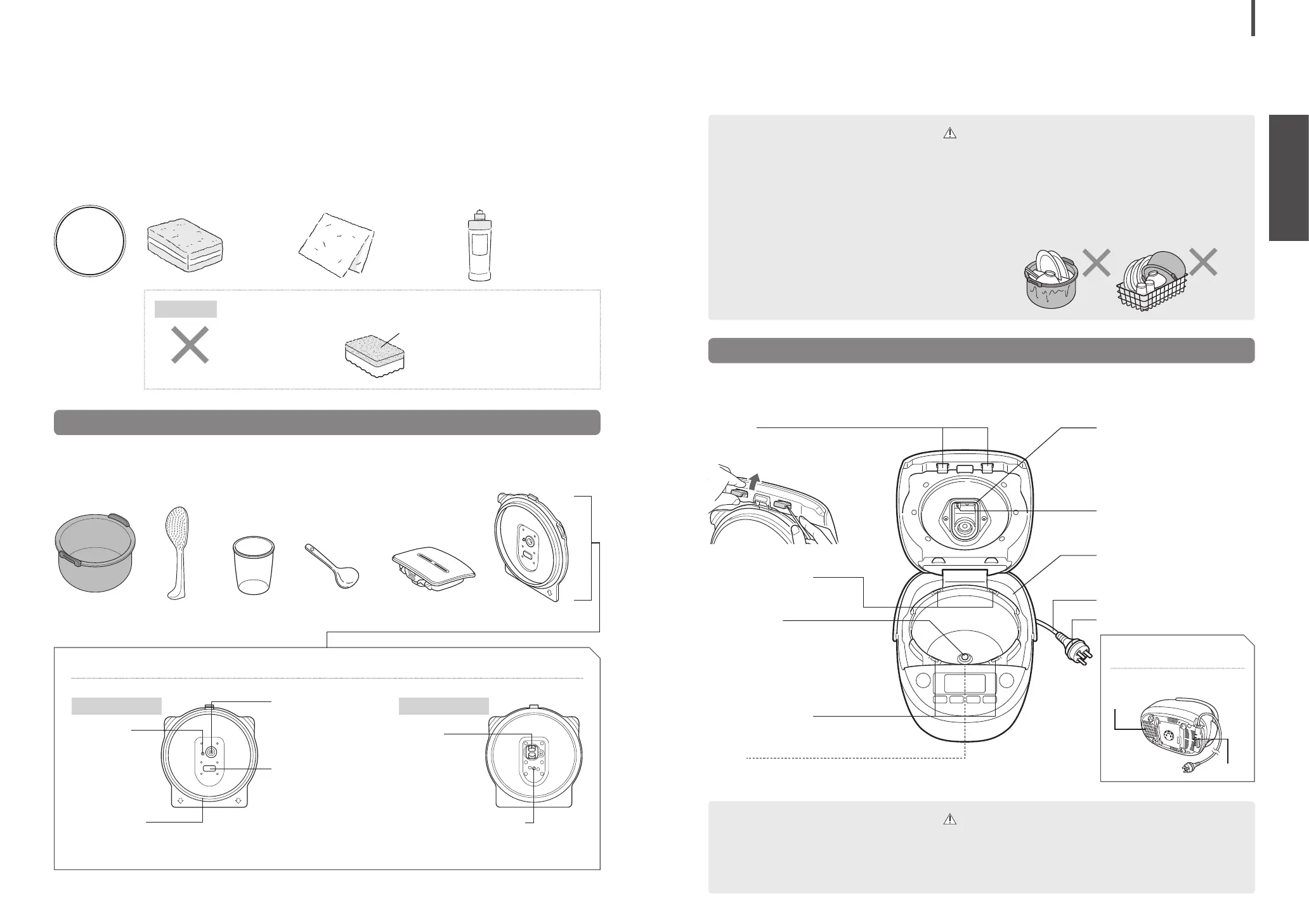
Inner lid (front side) Inner lid (back side)
Do not use
Any repair services not described in this manual should be performed by an authorized service representative.
Be sure to disconnect the power plug and allow the rice cooker, inner pot, inner lid, and steam cap to cool
down before cleaning.
To maintain cleanliness, always clean the rice cooker on the same day it is used.
The rice cooker should also be cleaned on the day that it is used in order to remove any odors that remain
from cooking. → P. 48
Parts to wash after every use
1.
Wash it well using a sponge with detergent diluted with cold or lukewarm water, and rinse it with water.
2. Wipe o the water using a dry cloth and completely dry all parts.
Pressure
adjusting balls
If any grains of
cooked rice have
adhered, wash
them well under
running water.
Pressure valve reducing hole
If any grains of cooked rice have adhered,
wash them well under running water.
Pressure adjusting
holes
If any grains of cooked
rice have adhered, wash
them well under running
water.
Inner lid gasket
Keep it attached to the inner lid during washing.
It cannot be reattached once it is removed.
Safety valve
From the front side
of the inner lid, lightly
push it a few times
with your nger to
check for clogging
and wash the inside
under running water.
Gasket for
depressurization
Keep it attached to the
inner lid during washing.
If it comes o, match the
direction and attach it.
→ P. 47
Cleaning of each part of the inner lid
How to Clean
Soft sponge Soft cloth
Detergent other than mild detergents
Thinner, cleanser, bleach
Chemically treated cloths
Hot water
Dishwasher, dryer
Melamine sponge
Mild detergent for
household use
(for dishes and
kitchen utensils)
Nylon scrubbing sponges,
metal spatulas
The abrasive side of a sponge
Do not use the abrasive side
of a sponge. Doing so may
damage the uorocarbon resin
coating of the inner pot and the
coating of the inner lid.
Items and
detergent to
be prepared
Abrasive
side
Inner pot Spatula Measuring cup
Ladle Steam cap
Inner lid
CAUTION
Do not allow water to get inside the rice cooker unit. Otherwise, electric shock, electric leakage, re, and/or
deformation or malfunction of the rice cooker may be caused.
Do not use the rice cooker if dust is adhered to the air inlet or outlet. Otherwise the temperature will increase
inside the rice cooker, resulting in malfunction or re.
Parts to wash when dirty
Wipe the rice cooker (outside and inside) using a rmly wrung out cloth.
Wipe the power cord and plug using a dry cloth.
Air inlet
Air outlet
Stoppers
Remove anything that has
adhered, such as grains of rice.
Lid gasket
Remove anything that has
adhered, such as grains of rice.
* It cannot be reattached once it is
removed. → P. 47
Lid sensor
Lightly wipe using a moistened
cloth or cotton swab.
Remove dust and other dirt
using a cotton swab.
Upper casing rubbers
Do not remove or pull them
forcibly.
Upper casing rubbers
Do not remove or pull them
forcibly.
Hooks
Remove anything that has
adhered, such as grains of rice.
Center sensor
Remove anything that has
adhered, such as grains of rice.
* If adhering objects are hard to
remove, use a commercially
available sandpaper (around
#320), then wet a cloth, wring out
excess water, and wipe.
Upper casing
Remove anything that has
adhered, such as grains of rice.
Power cord
Power plug
Cleaning of the air inlet
and air outlet
CAUTION
Always keep the inner pot and lid clean to prevent
corrosion and odors.
Rinse the parts thoroughly, since detergent
remaining on them may result in deterioration and
discoloration of materials such as plastic. (Only
washable parts)
After cleaning the steam cap and inner lid, wipe
them o using a dry cloth immediately. Otherwise,
water drops may leave marks on them.
Be sure to clean the steam cap and inner lid after
cooking rice with mixed grains. Otherwise they
may be clogged, causing problems like the lid not
opening, contents boiling over, or rice not cooking
properly.
Be sure to remove any cooked rice that has adhered
to the inner lid. Any rice on the inner lid can prevent
the lid from closing, allow steam to leak out during
cooking, or enable the lid to open and the contents
to spray out, resulting in burns or other injury.
Do not wash dishes, etc. inside the inner pot. Also,
do not place the inner pot upside down on top of
dishes, etc., to dry. Doing so may damage the
uorocarbon resin coating or cause it to peel.


 To Next Page