21D01-060en202008 Manual nanoFlu
Use
Malfunction &
Maintenance
Commis-
sioning
Introduction
General
Information
FAQ Technical DataWarranty
Customer
Service
Contact
Keyword
Index
Accessories Calibration
nanoFlu // Calibration
Before recording measurement values, check the zero value of the sensor with their reference solutions. If
necessary, determine a new zero value (see chapters 6.2.1 and 6.3.1).
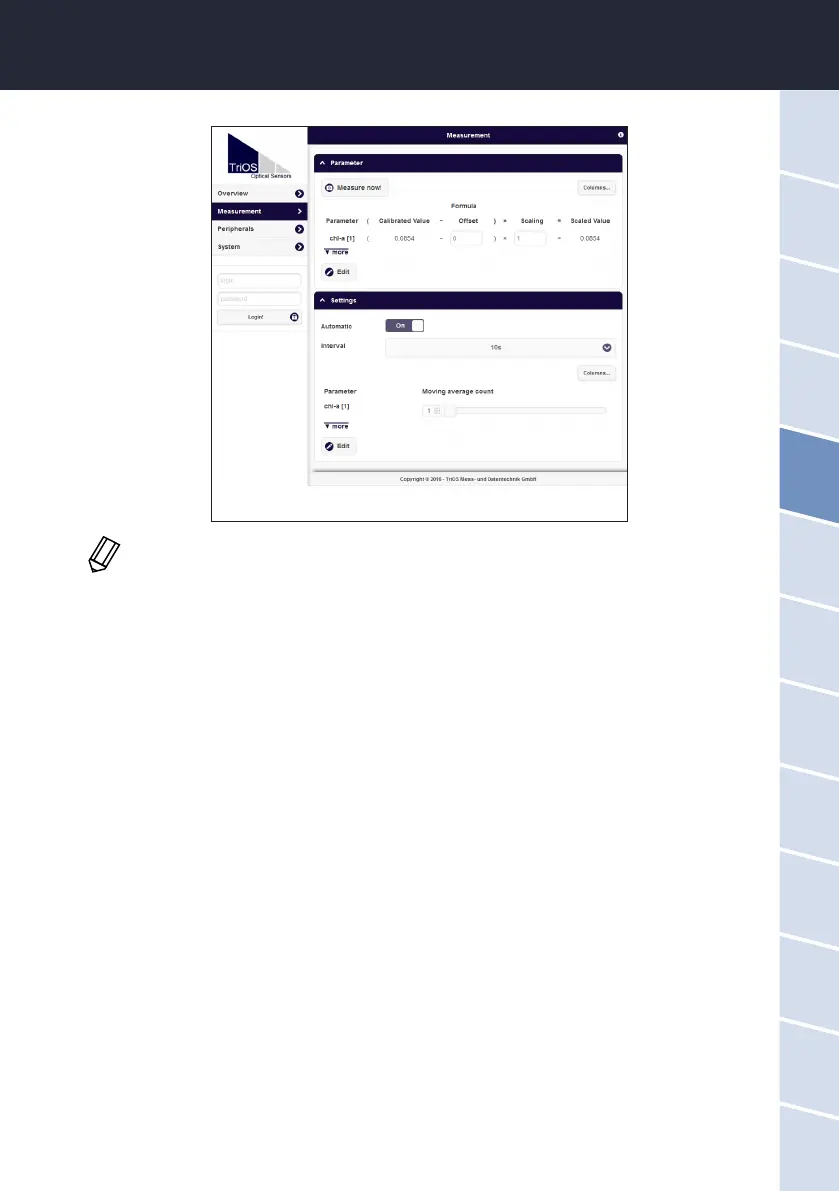
Local calibration is adjusted by means of a linear equation. Two constants are required for this: the scaling
factor and oset, which are used according to the following equation:
A = parameter - oset
B = A ∙ scaling
With A being the parameter output, which is output by the nanoFlu.
A oset corrected value
Oset oset value
B customer-calibrated parameters
For local calibration, at least two data points, i.e. a laboratory value and a sensor value, are required. The eas-
iest way to do this is to use a non-contaminated sample and a contaminated sample.
1. The non-contaminated sample is used to determine the oset. To do this, immerse the uorometer in
the uid that is not contaminated. In this specic case, the signal gives the value of the oset directly for
local calibration.
oset = measuredvalue1
If a non-contaminated sample is not available, the equation in point 5 below oers another option.
2. Now immerse the sensor in the contaminated medium and note down measuredvalue2, which is output
by the uorometer, and do a laboratory analysis of the sample.
3. Make a diagram like the one shown below and connect the two data points with a straight line. The slope
of the straight line is the scaling factor.
The customer calibration can be used as a ne adjustment of the sensor for special media
and supplements the manufacturer calibration.


 To Next Page