Need help?
Do you have a question about the True TPP-93 and is the answer not in the manual?
Safety precautions for refrigerant handling and ventilation.
General safety guidelines for operation, maintenance, and moving the unit.
Warnings and procedures for safely disposing of old units.
Procedures for ownership transfer and initial freight damage inspection.
Details on appliance rating, testing, and suitable location requirements.
Guide for selecting appropriate wire gauge based on distance and amperage.
Important note regarding product spoilage and pre-operation testing.
Step-by-step guide for safely removing packaging and shipping brackets.
Instructions for installing leveling legs and castors for proper unit stability.
Detailed steps for attaching and adjusting castors for cabinet leveling.
Specific instructions for installing castors on previous TFP model designs.
How to ensure the cabinet is level using a carpenter's level.
Procedure for sealing the cabinet base to the floor for stability and hygiene.
Warnings against using adapter plugs and extension cords for safety.
Overview of plug types and requirements for different regions.
Instructions for properly connecting the unit to an electrical power source.
Information on where to find the unit's wiring diagram.
Step-by-step guide to installing shelf clips and shelves securely.
Information on adjusting shelves for customer application and weight capacity.
Critical instructions on maintaining airflow by not removing baffles.
Detailed procedures for removing and installing drawers of different styles.
Steps for initial startup, including running the unit empty before loading.
Identifies locations of temperature controls and light switches on various models.
Explains what happens when the unit is plugged in, including lights, controls, and defrost cycles.
Instructions and safety precautions for cleaning the condenser coil.
Steps for clearing clogs in the drain line to ensure proper drainage.
Details on what cleaning aspects are not covered by the warranty.
Comprehensive guide on cleaning and protecting stainless steel surfaces.
Instructions for cleaning and maintaining cabinet lids and their components.
Guidance on caring for composite cutting boards to prevent warping.
Procedures for removing and reinstalling false bottom panels for cleaning.
Guidelines for servicing units and replacing parts using OEM components.
Step-by-step instructions for reversing the door swing on specific models.
Continuation of door reversal steps, focusing on hinge adjustments and alignment.
Details the standard warranty coverage for parts and labor.
Outlines extended warranty coverage for HFC and Hydrocarbon compressors.
Steps and information required for submitting a warranty claim.
Lists what is not covered under the manufacturer's warranty.
This document is an installation manual for True Manufacturing Co., Inc. refrigerated food preparation units, including undercounters, worktops, sandwich/salad, pizza prep, and food prep models. It provides comprehensive instructions for installation, operation, maintenance, and servicing to ensure efficient and successful operation.
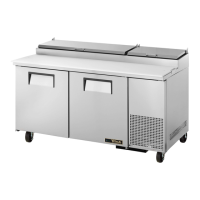
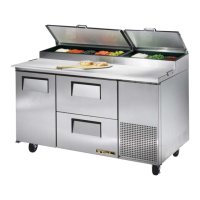
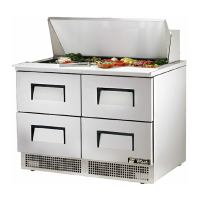
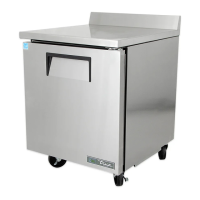
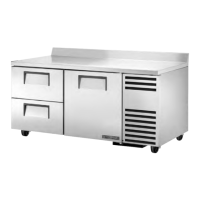
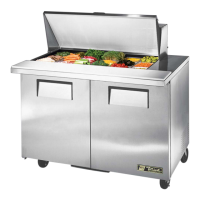
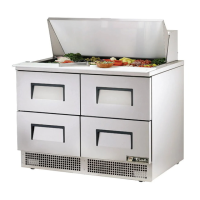
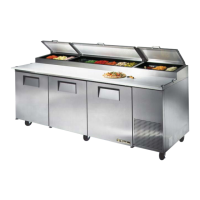
True refrigerated food prep units are commercial refrigerators designed to store food products at safe temperatures while providing a convenient workspace for food preparation. These units are available in various configurations, including undercounters, worktops, and specialized models for sandwich/salad and pizza preparation. They feature a refrigeration system that maintains consistent internal temperatures, crucial for food safety. Some models include digital temperature controls for precise temperature management, while others use mechanical controls. The units are designed to accommodate food pans for ingredients and often include cutting boards for on-site preparation.
The manual emphasizes proper installation for optimal performance. This includes ensuring the unit is level, which is critical for effective condensate removal and door operation. Leveling legs or castors are provided for this purpose, with specific instructions for their installation and adjustment. For non-mobile models, sealing the cabinet to the floor is recommended to protect against chemical attack from asphalt floors and ensure stability.
Electrical installation and safety are paramount. The manual strictly warns against using adapter plugs or extension cords, stressing the importance of plugging the unit into a dedicated electrical circuit with the correct NEMA plug configuration. It also advises checking incoming voltage with a voltmeter before connection to ensure it meets the rated voltage requirements.
Cabinet setup involves installing shelves, with detailed steps on how to properly secure shelf clips and place shelves to ensure stability. For TPP models, ensuring correct airflow in the condiment pan area is highlighted, with a caution against removing baffles that could adversely affect refrigeration performance. Drawer removal and installation procedures are also provided for different drawer styles, ensuring users can easily access and clean these components.
For operation, the manual explains that the compressor is ready upon purchase and simply needs to be plugged in. It recommends running the unit empty for 24 hours before loading product to verify proper operation, as the factory warranty does not cover product loss. It also advises against excessive tampering with the temperature control. Good airflow inside the unit is critical, so users should prevent products from pressing against the sides or back wall and maintain a 4-inch clearance from the evaporator housing. The manual describes the general sequence of operation, including the illumination of interior lights, digital displays, and the cycling of the compressor and evaporator fans. It notes that defrost events are initiated by a timer or electronic control to prevent frost and ice buildup.
Regular maintenance is crucial for the longevity and efficiency of True refrigeration units. The manual provides detailed instructions for cleaning the condenser coil, which should be done every 30 days or as needed. It warns against using pressure washers or hoses and advises caution due to sharp fins, recommending eye protection. Tools required for condenser cleaning include a Phillips screwdriver or nut driver, stiff bristle brush, compressed air, vacuum cleaner, and flashlight. The process involves disconnecting power, accessing the condenser coil (either by opening a grill assembly door or removing a rear cover), and carefully cleaning accumulated dirt from the fins.
Drain line cleaning is also covered, requiring a Phillips screwdriver or bit driver, a drill (optional), a narrow tube brush, and a large container to catch trapped liquid. The procedure involves removing the rear cover, accessing the clogged drain line, and clearing the clog with a tube brush.
Stainless steel equipment care and cleaning instructions are provided, with strict warnings against using steel wool, abrasive, or chlorine-based products, as these can damage the passive layer and lead to corrosion. The manual offers "8 Tips to Help Prevent Rust on Stainless Steel," including maintaining cleanliness, using correct cleaning tools (non-abrasive), cleaning along polishing lines, using alkaline or non-chloride cleaners, rinsing thoroughly, never using hydrochloric acid, treating water, and regularly restoring/passivating stainless steel. For routine cleaning, white vinegar, ammonia, or commercial detergents are recommended, while stainless steel polish or olive oil can act as a barrier against fingerprints. Degreasers are suggested for heavy grease and food residue.
Lid maintenance involves periodically checking and tightening lid pin screws for cleaning. Composite cutting board maintenance advises regularly turning the board over to prevent warping, which can be caused by continued moisture and temperature differences. False bottom panel removal and installation procedures are detailed for TFP/TSSU models, allowing for easy cleaning and sanitizing of the area underneath the product pans. These panels must be correctly reinstalled for proper cabinet operation and product temperatures.
For cabinet adjustments, servicing, and component replacement, the manual states that any adjustments should be made after the cabinet is level and properly supported. It emphasizes replacing component parts with original equipment manufacturer (OEM) components and having a licensed service provider perform servicing to minimize risks. Users are reminded to unplug the refrigerator/freezer before any cleaning or repairs. Instructions for reversing doors on specific TUC/TWT and TSSU models are also included, detailing the steps for moving hinge brackets, shifting front grills, and repositioning bushings to change the door's swing direction.
 General
| Model | TPP-93 |
|---|---|
| Type | Food Prep Table |
| Material | Stainless Steel |
| Number of Doors | 3 |
| Temperature Range | 33°F to 41°F |
| Voltage | 115V |
| Hertz | 60 Hz |
| Phase | 1 |
| Horsepower | 1/3 HP |
| Refrigerant | R134a |

 To Next Page