Programming
61
4.1.2 Back-Pressure Flow Test
Many devices are constructed with large passages that not only
must remain open but also be open a minimum amount to
function normally when in use. In some cases, the part’s passages
have a sufficient tolerance that more precise testing such as mass
flow is not necessary or within the project’s budget.
A back-pressure test is typically suitable for parts with large
passages and therefore high flow rates. An occlusion test,
discussed on page 64, is typically used on smaller parts
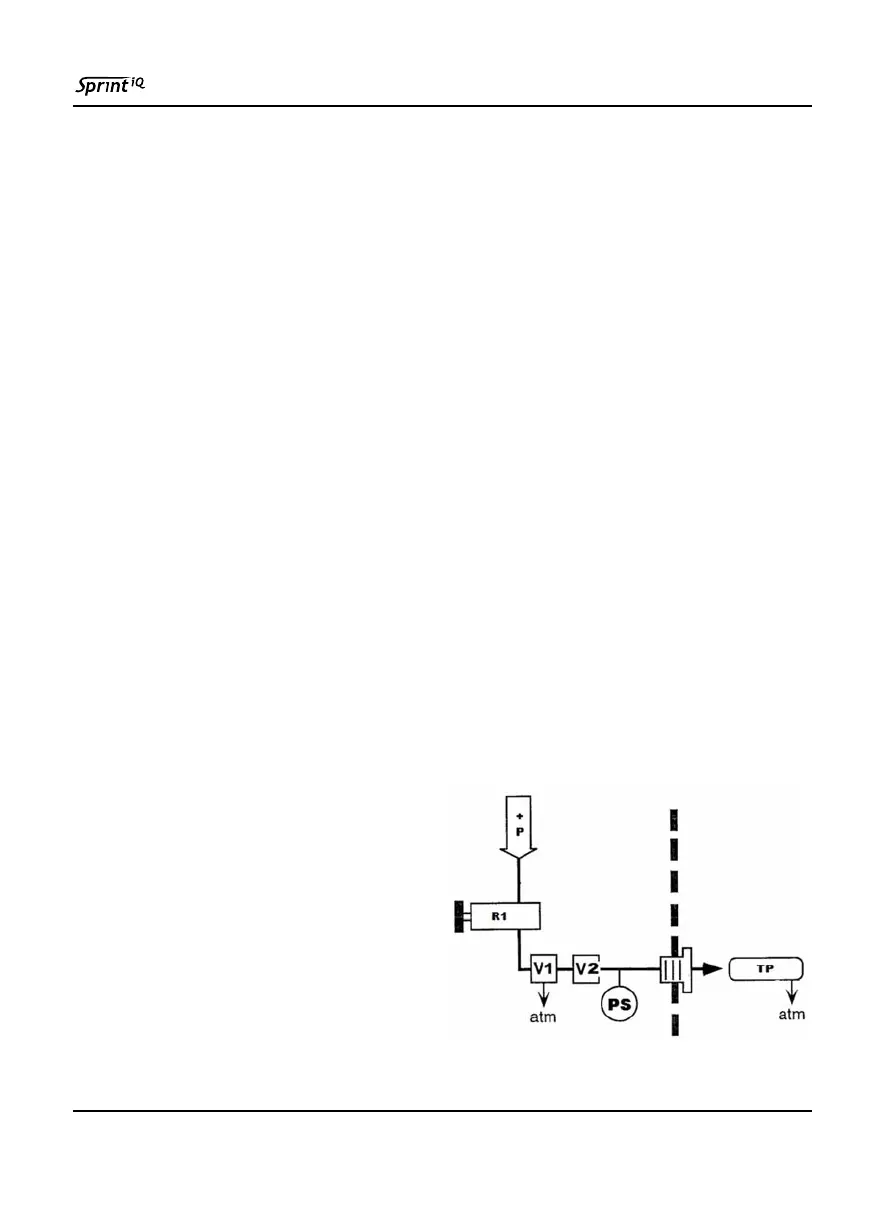
Sprint iQ testers can conduct back-pressure flow testing by using
the same basic pneumatic circuit employed in pressure decay. The
programming is the only difference since the part is not expected
to maintain pressure. The part is continuously pressurized while
air is escaping to atmosphere through the passages being checked.
The residual pressure (back-pressure) seen at the parts inlet is
measured and must remain within a specific range of pressure
defined by reject maximum and reject minimum to pass the test.
Thanks to the commonality of test circuits, it is possible (and
quite common) to conduct pressure decay tests followed by back-
pressure flow tests.
How Back-Pressure Flow Testing Works
1. The upstream end
of the part to be
tested [TP] is
attached to the
test port and the
downstream end
of the part is left
unsealed and open
to atmosphere.


 To Next Page