Need help?
Do you have a question about the Uson sprint iq and is the answer not in the manual?
Overview of electrical and pneumatic hazards and general safety issues.
Details pneumatic hazards, emphasizing fixture considerations and eye protection.
Details electrical hazards and the importance of using correct fuses.
Covers general safety practices, including reading manuals before operation.
Step-by-step guide for initial setup, connecting air, power, and peripherals.
Ensuring supply air is clean, dry, and within pressure limits for optimal performance.
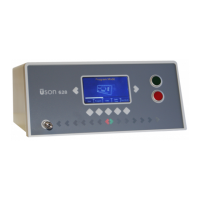
Description of the LCD display, keypad, lockout keyswitch, USB port, and Start/Stop buttons.
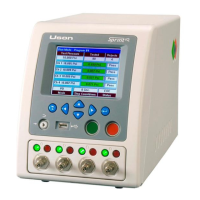
Explanation of green and red indicator lights for test results on each channel.
Identification and description of components located on the rear panel of the tester.
Instructions for safely connecting the AC and DC power supplies to the tester.
Procedure for powering on the tester, including lockout keyswitch and initialization.
Explanation of the information presented on the Run Mode display during tests.
List and explanation of test modes displayed in the Mode Box.
Explanation of messages displayed in the Status Box for test phases and outcomes.
Setting test parameters and tolerances for product testing.
Tips for adjusting test parameters for optimal performance and accuracy.
Guidance on preparing and starting actual product testing operations.
Troubleshooting checklist and support contact information for common issues.
Configuration options for local (front panel) or remote test starting.
Safety restriction on starting tests while navigating the menu system.
Overview of the two menu systems: Run screen and Program Mode.
How to access and navigate the Run Mode Options Menu and its sub-menus.
How to access and navigate the Program Mode Menu and its sub-menus.
Overview of factory-installed programs and user modification capabilities.
Explanation of pressure and vacuum decay testing principles and operation.
Key parameters required for setting up decay tests, including pressure and timers.
Definition and importance of setting the correct test pressure for decay tests.
How pressure error is monitored and used to stop tests if deviations occur.
Explanation of Couple Time, Fill Time, Stab Time, Test Time, and Vent Time.
Calculating pressure change (decay rate) and setting reject limits.
Formulae and methods for calculating leak rate from pressure changes.
Understanding the PSN Ratio for test repeatability and recommended rules.
Testing with back-pressure flow, suitable for large passages and high flow rates.
Testing for blockages or obstructions by monitoring pressure drop.
Measuring air flow through a product and checking against set limits.
Parameters specific to flow tests, including Max/Min Flow setpoints.
Using flow to detect leaks, especially for small products with high acceptable leak rates.
Maximum pressure limits for flow ranges to protect the sensor.
Testing for devices opening under pressure and rapidly dropping to zero.
Testing product ability to hold pressure without failing, potentially with size increase.
Detecting slight openings or pressure changes, often in valves.
Linking test programs based on pass/reject conditions and pausing sequences.
Setting timers for various test functions like coupling, fill, stabilization, and test.
Technical specifications of the Sprint iQ, including display, ranges, and units.
List of standard hardware and software features of the Sprint iQ.
List of optional hardware and software features available for the Sprint iQ.
Mapping of functions to pin numbers for digital input/output connections.
Method for calculating leak rate in flow units from pressure measurements.
Fundamental concepts related to pressure, vacuum, and air composition.
Glossary of terms and definitions used throughout the manual.
Details on the electronic programmable regulator for precise pressure control.
 General
| Brand | Uson |
|---|---|
| Model | sprint iq |
| Category | Test Equipment |
| Language | English |

 To Next Page