No Output
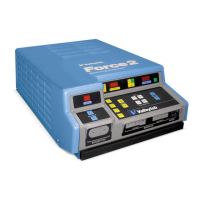
5-4 Force 2 User’s Guide
6. If the REM alarm cannot be cleared by these procedures, use a backup
generator and repeat steps 1 through 5.
7. Once the REM alarm clears, leave the generator in the ready mode
during draping to avoid disturbing the return electrode(s).
8. Remove any return electrodes which are not in use.
No Output
1. Generator not plugged in.
2. Generator not turned on.
3. Malfunction in accessory or footswitch.
4. Patient return electrode not in contact with patient.
5. Patient return electrode not connected to generator.
6. Broken patient return electrode cord.
7. An alarm condition exists.
8. Power set too low.
9. An internal generator failure; use backup generator.
Monitor Interference
Continuous Interference
1. Check the chassis ground connections for both monitor and generator.
2. Check all other electrical equipment in the operating room for
defective grounds.
3. If the electrical equipment is grounded to different objects, rather than
a common ground, voltage differences can appear between the two
grounded objects. The monitor may respond to these voltages. Some
types of input amplifiers can be balanced to achieve optimal common
mode rejection and may correct the problem.
Interference Only when Generator is Activated
1. Check all connections to the generator, patient return electrode, and
active accessory to look for possible metal-to-metal sparking.
2. Interference is usually greatest during fulguration. The amount of
interference can be reduced by using lower power settings or using a
lower voltage (low voltage coag or cut).
3. If interference continues when the generator is activated and while the
active electrode is not in contact with the patient, the monitor is
responding to radio frequencies. Some manufacturers offer RF choke



 To Next Page