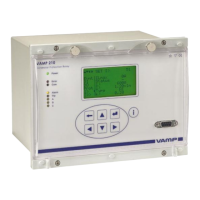
VAMP Ltd
Over-, under-, residual voltage and
frequency relay
Technical description
VAMP 135
VM135.EN008 VAMP 24h support phone : +358 (0)20 753 3264
5
2. Functions
The individual protection functions of the VAMP 135 voltage
and frequency relay with residual voltage protection can
independently of each other be enabled or disabled according to
the requirements of the application. See the configuration
instructions, Chapter 5 and 7, in the Operation and
configuration instructions.
2.1. Principles of the numerical protection
technique
The VAMP 135 relay is designed using numerical technology.
This means that all signal filtering, protection and control
functions are made by digital processing.
The numerical technology used in the relay is primarily based
on an adapted fast Fourier-analysis (FFT), in which case the
number of calculations (multiplications and additions) required
to filter out the measuring quantities remains reasonable.
By using synchronized sampling of the measured signal (phase
or residual voltage) and a sample rate according to the 2
n
series, the FFT technique leads to a solution, which can be
realized with just a 16-bit microcontroller, without using a
separate DSP (Digital Signal Processor).
The synchronized sampling means an even number of 2
n
samples per period, e.g. 16 samples/period. This means that the
frequency must be measured and the number of samples per
period must be controlled accordingly, so that the number of
samples per period remains constant should the frequency
change.
Figure 2.1-1 shows the main components of a relay using
numerical technology; i.e. the relay comprises input
transformers, digital input adapters, output relays, A/D
converters and a micro controller including memory circuits.
Further the relay needs a power supply and a user interface.
Figure 2.1-2 shows the heart of the numerical technology or the
main block diagram of the calculated functions.
Figure 2.1-3 shows a functional principle diagram of a single-
phase overvoltage function.


 To Next Page