Parameters of piping back sealing welding for mild steel(DCEP)
Piping
diameter
Φ/mm
Tungsten
electrode
diameter/mm
Gas nozzle
diameter/mm
Welding
wire diameter/mm
Welding current/A
Welding
current/A
Arc
voltage/V
Argon flow
1
rate/L•min-
Welding
1
rate/cm•min-
38
42
60
76
108
133
159
219
273
325
2.0
2.0
2.0
2.5
2.5
2.5
2.5
2.5
2.5
2.5
8
8
8
8~10
8~10
8~10
8~10
8~10
8~10
8~10
2
2
2
2.5
2.5
2.5
2.5.
2.5
2.5
2.5
75~90
75~95
75~100
80~105
90~110
90~115
95~120
100~ 120
110~ 125
120~ 140
11~13
11~13
11~13
14~16
14~16
14~16
14~16
14~16
14~16
14~16
6~8
6~8
7~9
8~10
9~11
10~12
11~13
12~14
12~14
12~14
4~5
4~5
4~5
4~5
5~6
5~6
5~6
5~6
5~6
5~6
Notice: the above parameters originate from <<Welding Dictionary>> P167,
Volume 1 of Edition 2.
TIG of stainless steel(single run welding)
Workpiece
thickness
/mm
Joint form
tungsten
electrode
diameter
/mm
welding
wire
diameter
/mm
Argon gas
flow rate/
1
L•min-
welding
current
(DCEP)
Welding
speed/
cm•min-1
0.8
1.0
1.5
1.5
2.4
2.4
3.2
3.2
4.8
4.8
6.0
Butt joint
Butt joint
Butt joint
Corner joint
Butt joint
Corner joint
Butt joint
Corner joint
Butt joint
Corner joint
Butt joint
1.0
1.6
1.6
1.6
1.6
1.6
1.6
1.6
2.4
3.2
4.0
1.6
1.6
1.6
1.6
2.4
2.4
2.4
2.4
3.2
3.2
4.0
5
5
7
7
7
7
7
7
8
9
10-12
20~50
50~80
65~105
75~125
85~125
95~135
100~135
115~145
150~225
175~250
220~300
66
56
30
25
30
25
30
25
25
20
25
Notice: the above parameters originate from <<Welding Dictionary>> P150,Volume 1 of Edition 2.
4.5 MMA basic welding technique
Arc Welding Practice
The techniques used for arc welding are almost identical regardless of what types of
metals are being joined. Naturally enough, different types of electrodes would be used
for different metals as described in the preceding section.
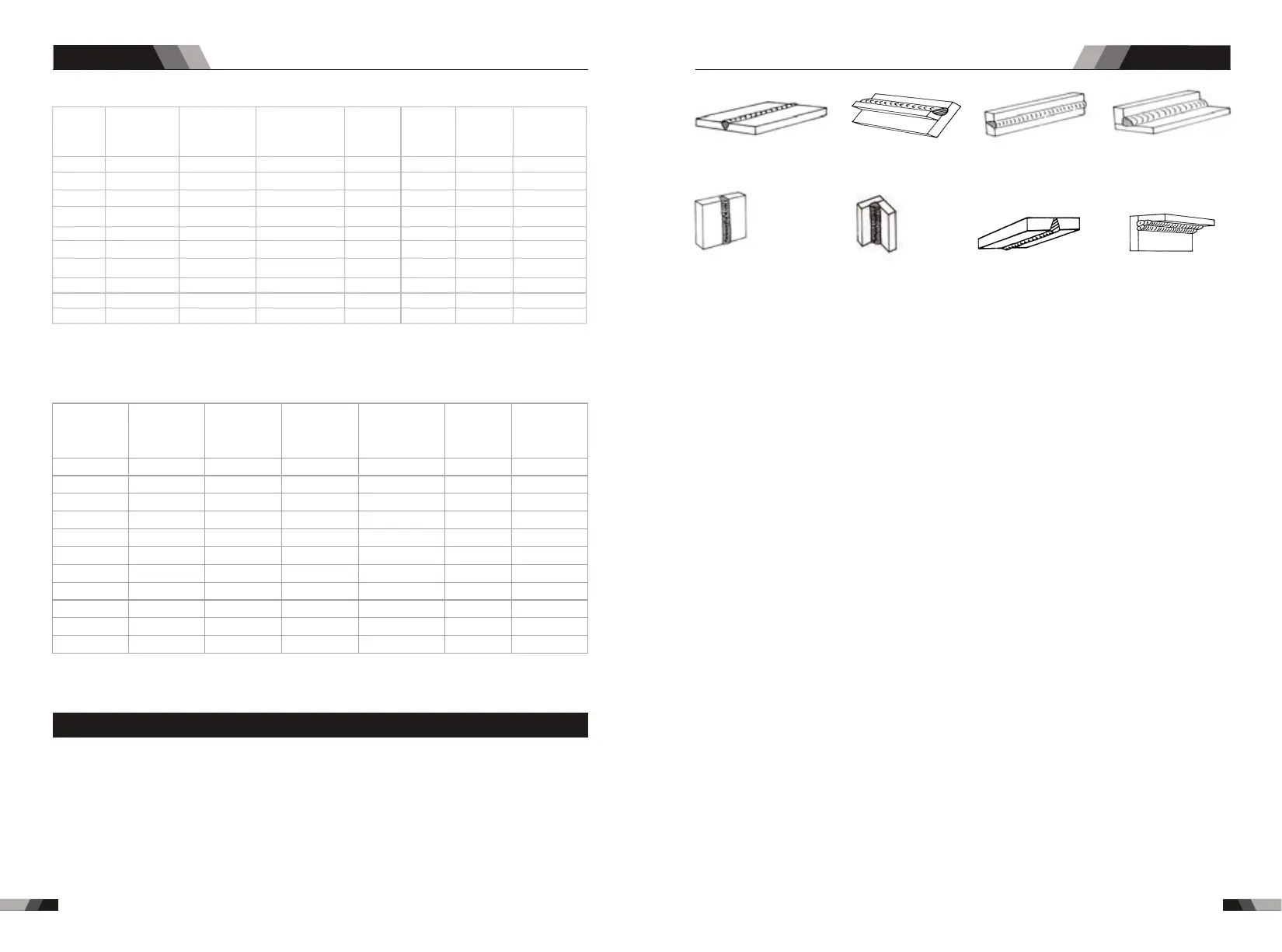
Welding Position
The electrodes dealt with in this publication can be used in most positions, i.e. they
are suitable for welding in flat, horizontal, vertical and overhead positions. Numerous
applications call for welds to be made in positions intermediate between these. Some
of the common types of welds are shown
Flat Position,
Down Hand Butt Weld
Flat Position,
Gravity Fillet Weld
Horizontal Position,
Butt Weld
Horizontal-Vertical
(HV) Position
Vertical Position,
Butt Weld
Vertical Position,
Fillet Weld
Vertical Position,
Fillet Weld
Overhead Position,
Fillet Weld
Welding techniqueWelding technique
65
66
Joint Preparations
In many cases, it will be possible to weld steel sections without any special preparation.
For heavier sections and for repair work on castings, etc., it will be necessary to cut or grind
an angle between the pieces being joined to ensure proper penetration of the weld metal
and to produce sound joints.
In general, surfaces being welded should be clean and free of rust, scale, dirt, grease, etc.
Slag should be removed from oxy-cut surfaces.
Arc Welding Technique - A Word to Beginners
For those who have not yet done any welding, the simplest way to commence is to run beads
on a piece of scrap plate. Use mild steel plate about 6.4mm (1/4") thick and a 3.2mm (1/8")
electrode. Clean any paint, loose scale or grease off the plate and set it firmly on the work
bench so that welding can be carried out in the downhand position. Make sure that the work
clamp is making good electrical contact with the work, either directly or through the work
table. For light gauge material, always clamp the work lead directly to the job, otherwise
a poor circuit will probably result.
The Welder
Place yourself in a comfortable position before beginning to weld. Get a seat of suitable
height and do as much work as possible sitting down. Don't hold your body tense. A taut
attitude of mind and a tensed body will soon make you feel tired. Relax and you will find
that the job becomes much easier. You can add much to your peace of mind by wearing
a leather apron and gauntlets. You won't be worrying then about being burnt or sparks
setting alight to your clothes.
Place the work so that the direction of welding is across, rather than to or from your body.
The electrode holder lead should be clear of any obstruction so that you can move your
arm freely along as the electrode burns down. If the lead is slung over your shoulder,
it allows greater freedom of movement and takes a lot of weight off your hand. Be sure the
insulation on your cable and electrode holder is not faulty, otherwise you are risking an
electric shock.
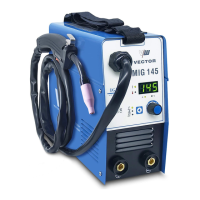
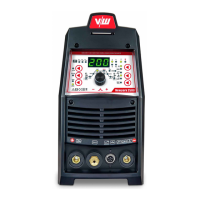
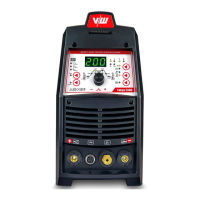
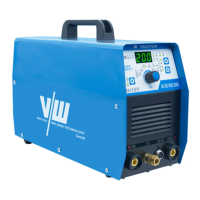
DC TIG SERIES EQUIPMENTDC TIG SERIES EQUIPMENT



 To Next Page