Magnetic Force Microscopy
Rev. C Dimension 3100 Manual 15-307
Drive Amplitude continued...
Setpoint
For the most reproducible results, it is best to use a consistent setpoint.
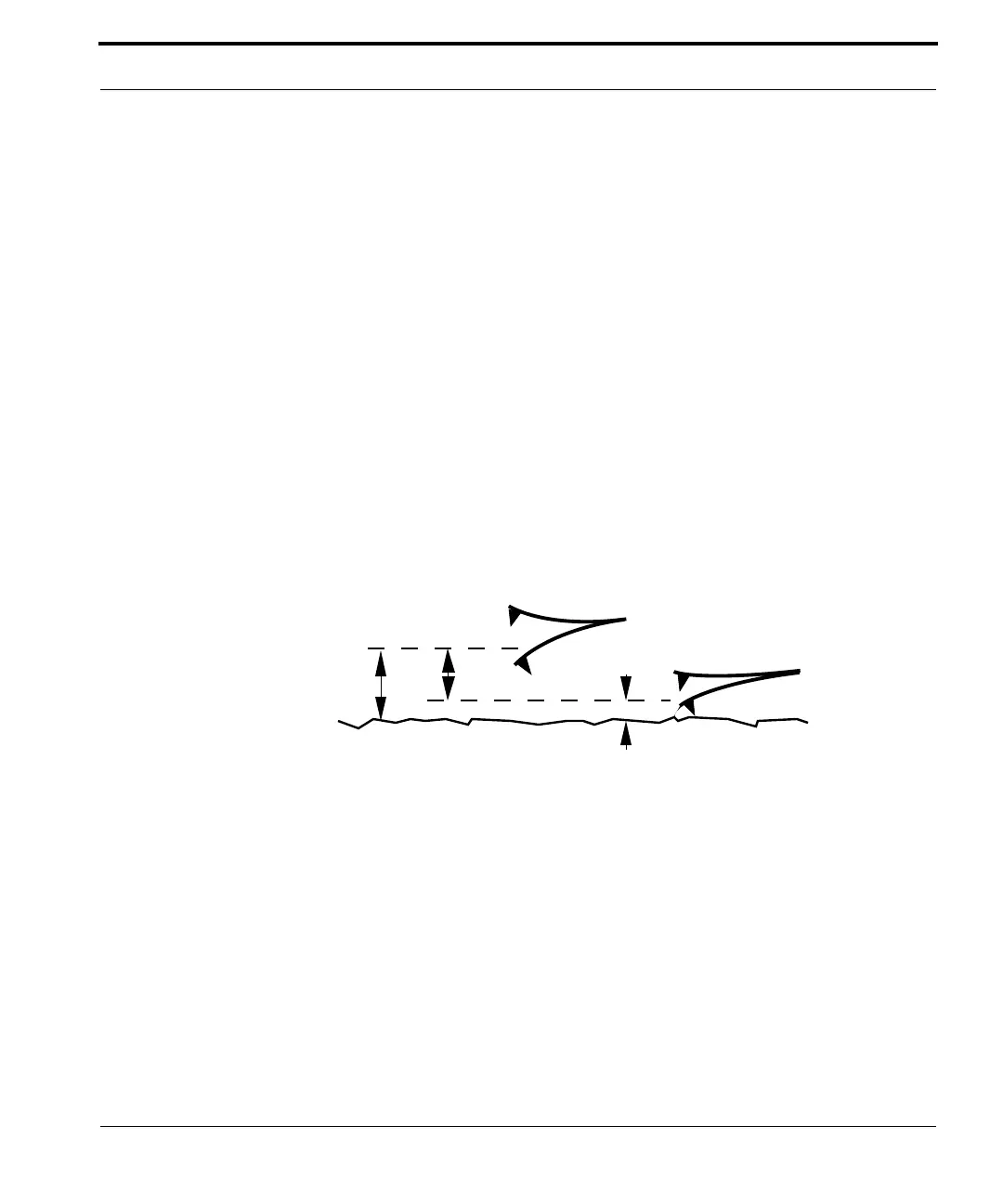
In LiftMode, the total tip-sample distance h
tot
is the sum of the average
tip-sample distance in Tapping Mode h
T
, and the lift scan height h
lift
(See Figure 15.4b). In Tapping Mode, the average tip-sample distance
h
T
is equal to the oscillation amplitude, which is determined by the
setpoint and the amplitude sensitivity of the tip. MESPs typically have
an amplitude sensitivity of approximately 25 nm/V.
Large variations in setpoint can change the total tip-sample distance in
Liftmode, sometimes with visible results in the magnetic image. For
this reason, reproducible results are most easily obtained by using
consistent setpoints. Note that a lift scan height of 0 nm still gives a
mean tip-sample distance of h
T
in LiftMode.
Figure 15.4b Tip Height and Oscillation Amplitudes (Tapping Mode & LiftMode)
The relationship between setpoint voltage and oscillation amplitude is
known as the sensitivity. Its value can be determined with Force
Calibration (See Chapter 13). For 225 µm MFM cantilevers, the
sensitivity is typically in the range 20-25 nm/V. The exact value depends
on the position of the laser spot on the cantilever, the cantilever
geometry, and the particular instrument. A 1V Setpoint typically
corresponds to h
T
~14-18 nm.
TappingMode pass
Lift pass
h
lift
h
T
h
tot
=
h
T
+ h
lift


 To Next Page