28 HE250 - Installation and Operation Manual
5.2.2 How Often Should You Clean the Chimney?
It is not possible to predict how much or how quickly creosote will form in your chimney. It is important,
therefore, to check the build-up in your chimney monthly when getting used to the new fireplace until you
determine the rate of creosote formation. Even if creosote forms slowly in your system, the chimney should
be cleaned and inspected at least once each year. Do not allow more than 1/8″ (3 mm) creosote buildup in
the chimney.
It is recommended to clean thoroughly the chimney system at the end of every heating season. During
summer, the air is damper and with minimal air circulation within the stove or furnace, it can mix with
creosote and/or sooth deposits in the chimney system to form an acid that could accelerate the corrosion
process and induce premature decay of the steel. Corrosion damages are not covered under warranty. Have
your chimney system cleaned by a professional chimney sweep. Use a plastic or steel brush.
Contact your local municipal or provincial fire authority for information on how to handle a chimney fire.
Have a clearly understood plan to handle a chimney fire.
5.2.3 Cleaning the Chimney
Chimney cleaning can be a difficult and
dangerous job. If you don’t have experience
cleaning chimneys, you might want to hire a
professional chimney sweep to clean and
inspect th
e system for the first time. After
having seen the cleaning process, you can
decide if it is a job you would like to take on.
The most common equipment used are
fibreglass rods with threaded fittings and stiff
plastic brushes. The brush is forced up and
down inside the chimney flue to scrub off the
creosote.
The chimney should be checked regularly for
creosote build-up. Inspection and cleaning of
the chimney can be faci
the baffle.
Do not expect chemical cleaners to keep your
chimney clean.
The rain cap can be removed for inspection and/or cleaning of the chimney.
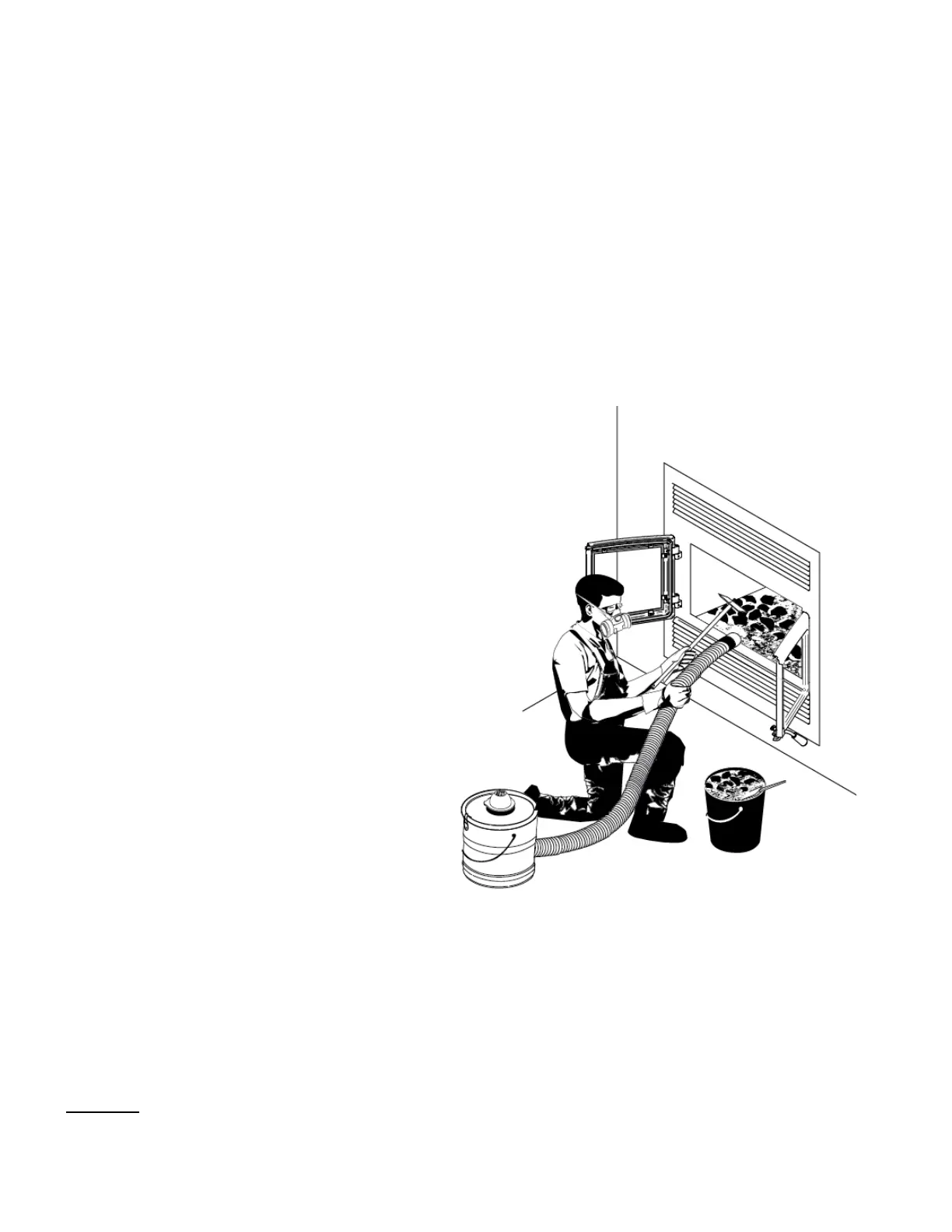
The chimney should be swept following these steps:
1) Remove the fire baffle and air tubes.
2) Remove the rain cap.
3) Sweep the chimney.
4) Clean the inside of the firebox.
5) Re-install the baffle, the air tubes and the rain cap.
CAUTION: OPERATION OF YOUR HE250 WITHOUT THE BAFFLE MAY CAUSE UNSAFE AND HAZARDOUS
TEMPERATURE CONDITIONS AND WILL VOID THE WARRANTY.


 To Next Page