Operation - 33
GENERAL OPERATION
Daily Inspection
WARNING
Always engage the parking brake, shut o the pow-
er unit engine, remove the ignition key, and ensure
that all moving parts have come to a complete stop
before inspecting the components, or attempting
any repair or adjustment.
1. Park the machine on a level surface, with the en-
gine shut o and all uids cold.
2. Perform a visual inspection of the power unit.
Look for loose or missing hardware, damaged
components, or signs of wear.
3. Inspect the ROPS structure and seat belt for dam-
age or signs of wear.
4. Inspect the battery, the electrical connections, and
the lights.
5. Ensure the parking brake is set to the proper ten-
sion. Adjust the tension as required.
6. Inspect the hydraulic hoses and the hydraulic t-
tings to ensure tight, leak free connections.
7. Inspect the fuel lines to ensure tight, leak free
connections.
8. Inspect the belts for damage or excessive wear.
Refer to the Belt Inspection section of this manual.
9. Inspect the power unit’s engine oil level, the
hydraulic oil level, the coolant level, and the fuel
level. Add uid or service as required.
ATTENTION
If the power unit is equipped with a cab and heater
kit and the outside air temperature is 4° C (40° F)
or above, the radiator bae must be removed and
replaced with the radiator screen.
10. Ensure the radiator screen, the air cleaner, and
the engine compartment are clean.
11. Check the tires for proper ination.
12. Test the operator safety interlock system.
Starting the Engine
CAUTION
Use of ether or starting uids may cause engine
damage and/or personal injury. Do not use ether or
starting uids to aid in starting the engine.
The 4520 is equipped with an interlock system for op-
erator safety. The safety interlock system requires the
parking brake to be engaged and the SDLA lever to be
in the neutral position for the power unit to start.
1. Turn the fuel shut-o valve to the On position.
2. Turn the battery disconnect switch to the On
position.
3. Move the throttle lever to the slow idle position.
NOTE: if the throttle is not in the slow idle position,
the throttle lever will not operate correctly until it
has been returned to the slow idle position.
ATTENTION
Do not run the electric starter continuously for more
than 10 seconds. If the engine does not start in this
time, wait 30 seconds and try again.
4. Turn the ignition key to the On position and check
to see that the malfunction indicator light is on.
5. Turn the ignition key to the start position and hold
to engage the starter. Release the key when the
engine starts. NOTE: if engine fails to start, refer
to the troubleshooting section.
6. Check to see that the malfunction indicator light
is o. If it is still illuminated, immediately shut o
the engine and check the cause.
ATTENTION
Allow time for the hydraulic oil to circulate before
operating the power unit. Failure to allow adequate
warm up time may result in severe damage to the
hydraulic system. Warm up time is increased in
colder weather.
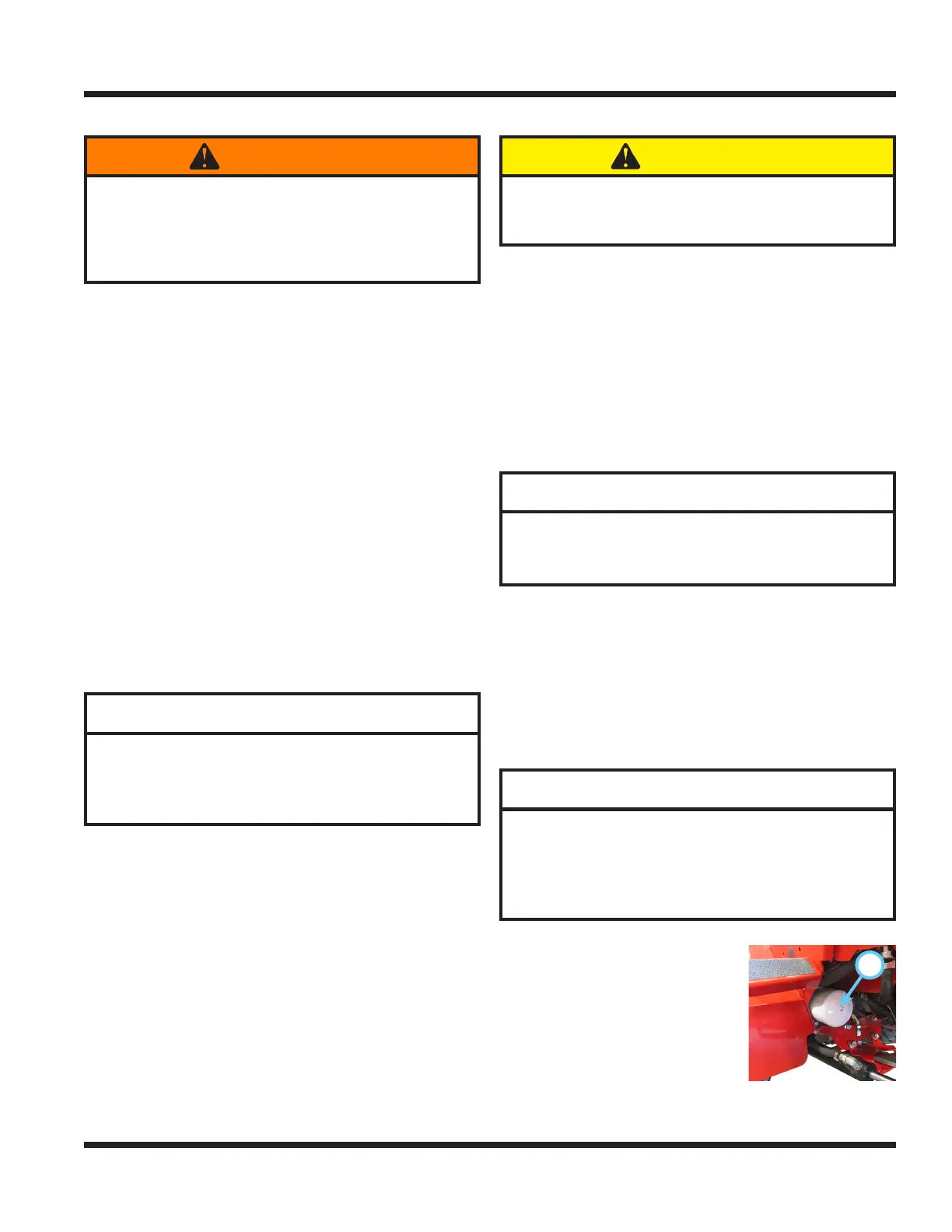
7.
A
The engine and hydraulic oil must be warmed up
before operating. Allow the
power unit to run at approxi-
mately 1,800 rpm until the
hydraulic lter is warm to the
touch. The lter (A) is located
to the inside of the left front
fender.



 To Next Page