3.3Safety equipment
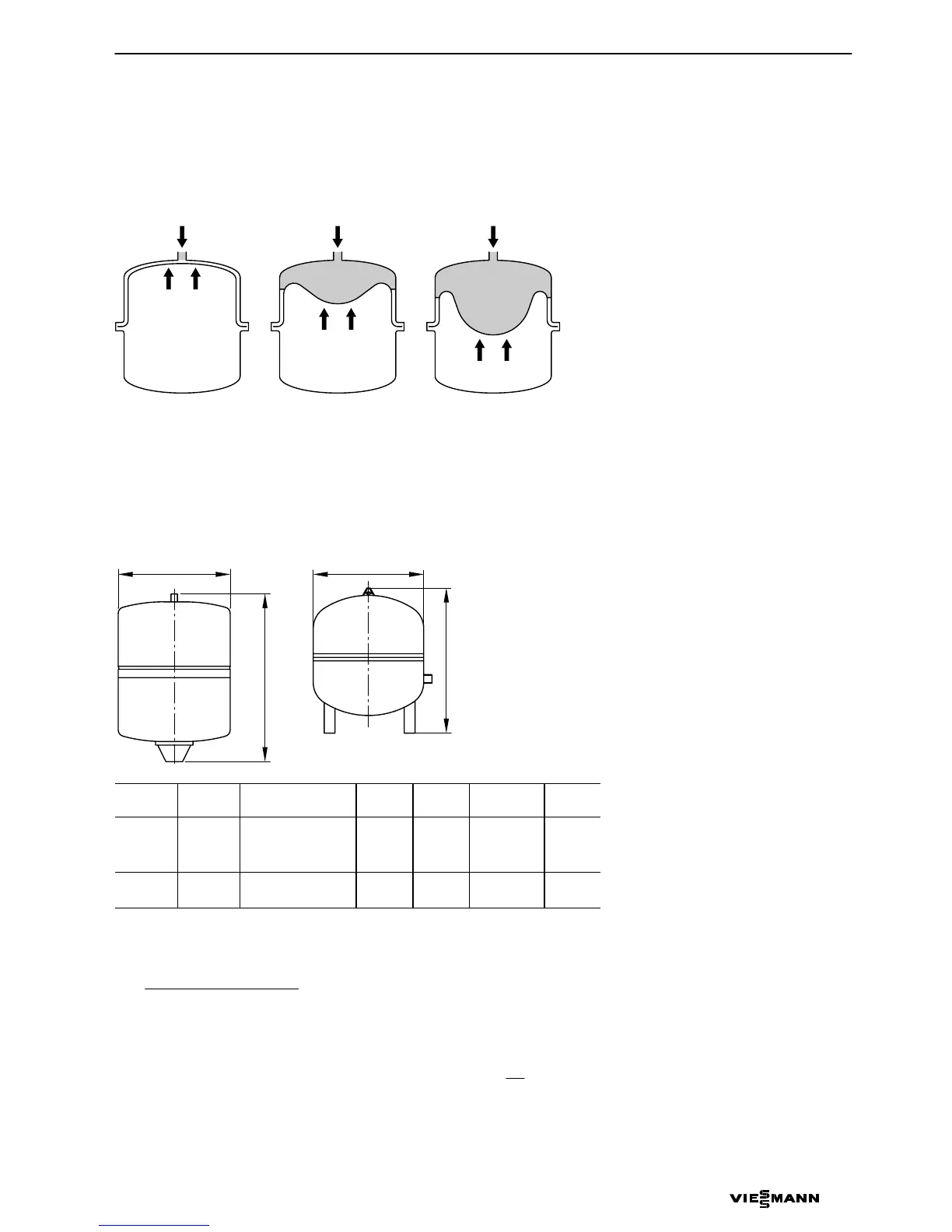
AAA
BCC
DE
As delivered condition
(3 bar charge pressure)
Solar system
filling without
heat influence
At maximum pressure at
the highest process
medium temperature
To safely prevent steam being created
during the operating phase, collectors
must indicate a pressure of at least 1.5bar
in their cold state. The charge pressure of
the expansion vessel will then be
0.1×static headh higher. In hot
conditions, the system pressure rises by
approx. 1 to 2bar.
Maximum shutdown temperature figures:
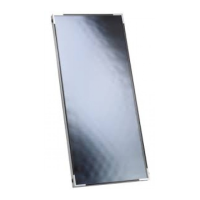
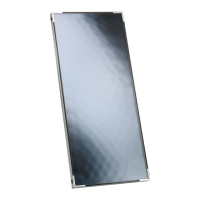
H Vitosol 100,
type s/w2.5: 211 ºC,
type 5 DI: 185 ºC
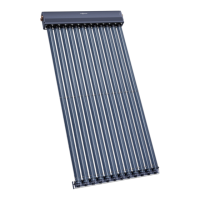
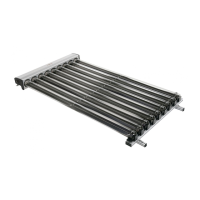
H Vitosol 200: 300 ºC,
H Vitosol 250: 286 ºC,
H Vitosol 300: 150 ºC.
To ensure that no process medium can
escape from the safety valve, the
expansion vessel must be sufficiently
large to accommodate the content of the
collector when steam forms (stagnation).
To protect the diaphragm against
unacceptably high temperatures
(generally 70 ºC), we recommend the
installation of a stratification vessel
(pre−cooling vessel) (mostly required for
systems installed in attics and for
collector areas from approx. 25 m
2
). A
generally applicable formula for
calculating the required container size
cannot be provided.
However, the vessel volume should be at
least 50% of the system volume.
b
A
b
a
Û
a
Û
B
55
VITOSOL
Diaphragm expansion vessel
Construction and operation
A Process medium
B Nitrogen filling
C Nitrogen buffer
D Safety water seal, min. 3 l
E Safety water seal
A diaphragm expansion vessel is a closed
expansion vessel whose gas chamber
(nitrogen filling) is separated from the
liquid chamber (process medium) by a
diaphragm and whose charge pressure is
subject to the system head.
Note
The charge pressure must be adjusted as
follows:
1.5 bar + 0.1 bar/m × static head.
The safety water seal should be 0.005
liquid capacity of the complete system,
but a minimum of 3 litres.
Technical data for the Viessmann expansion vessel
Expansion
vessel
Contents
litres
Operating pressure
bar
∅a
mm
b
mm
Connection
R
Weight
kg
A 18 10 280 370 ¾" 7.5
25 10 280 490 ¾" 9.1
40 10 354 520 ¾" 9.9
B 50 10 409 505 1" 12.3
80 10 480 566 1" 18.4
The nominal capacity of the expansion
vessel is calculated according to the
equation
V
N
=
(V
v
V
2
z V
k
) (p
e
1)
p
e
p
st
Whereby
V
N
= nominal capacity of the diaphragm
expansion vessel (MAG) in litres
V
v
= safety water seal
(process medium) in litres
V
v
=0.005·V
A
in litres
(min. 3 litres)
V
A
= liquid content of the entire system
(see page53)
V
2
= volume increase during system heat−up
V
2
=V
A
·
= expansion quotient (=0.13
for Viessmann process
medium from 20 to 120 ºC)
p
e
= permissible end pressure in bar (ü)
p
e
=p
si
0.1·p
si
p
si
= safety valve blow off pressure
p
st
= nitrogeninletpressureofMAGinbar(ü)
p
st
= 1.5 bar + 0.1
bar
m
h
h = static head
in m (see drawing on page54)
z = no. of collectors
V
k
= collector capacity in litres
(see page53)
5822135 GB






 To Next Page