1.2Solar energy
Example:
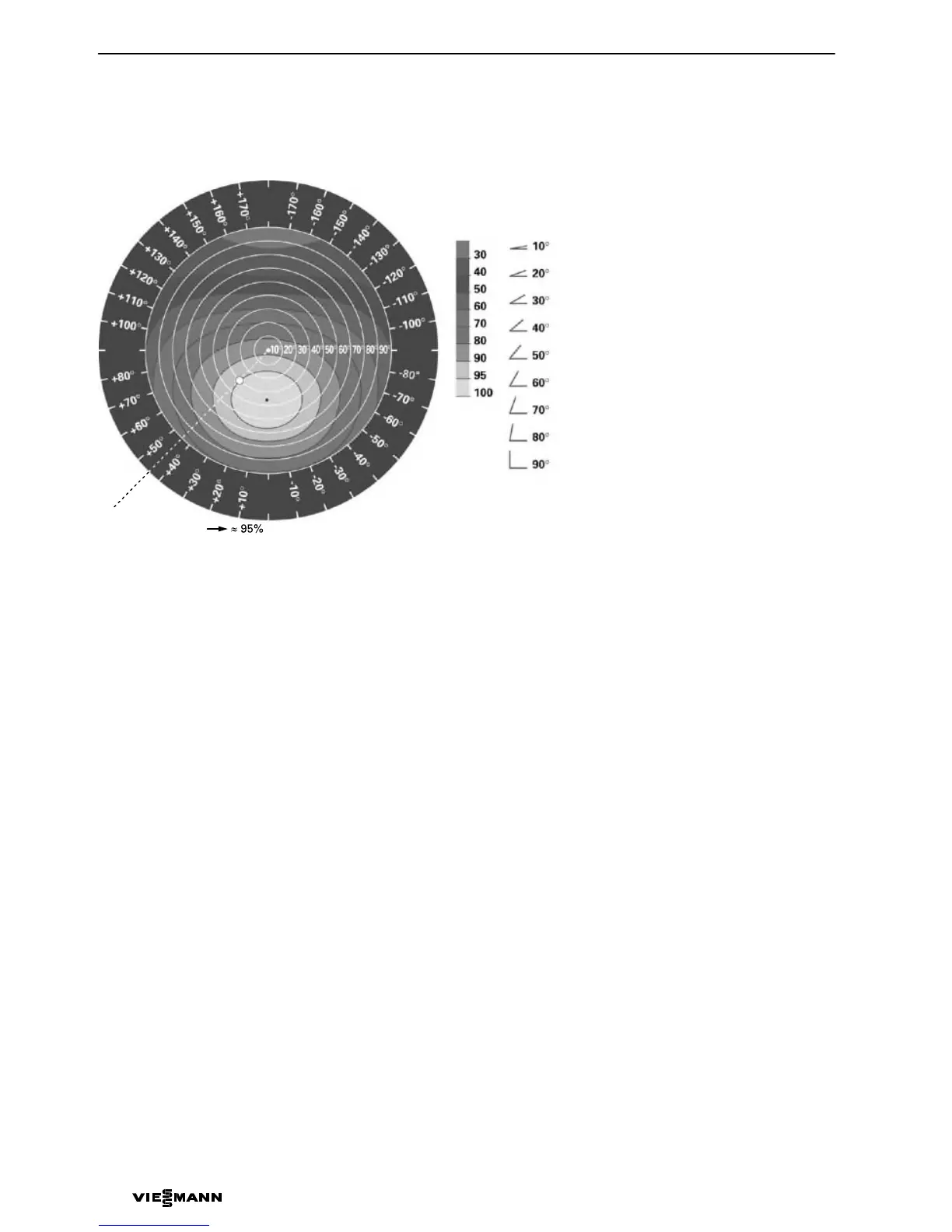
30°; 45° south−west
Annual
irradiation
in %
Angle of
inclinationSouth
EastWest
North
6
VITOSOL
Influence of alignment, inclination and shade on the energy yield
Optimum alignment and inclination
In Germany, the solar heating system
provides the highest energy yields over
an annual average when facing south and
with an inclination of approx. 30 to 35º to
the horizontal plane. However, the
installation of a solar heating system is
still viable even when the installation
deviates quite significantly from the
above (south−westerly to south−easterly
alignment, 25 to 70º).
The graph illustrates the loss of annual
irradiation resulting from an installation
of the collector array which is less than
perfect. The graph indicates that a
shallower inclination is more favourable,
if the collector surface cannot be pointed
south. A solar heating system with a 30º
inclination and a south−westerly
alignment of 45º still achieves 95% of its
optimum yield. Even with an
east−westerly alignment, you can still
expect up to 85% with a roof slope
between 25º and 40º.
A more steeply raked installation would
be more favourable in winter, however
the system would achieve only two thirds
of its yield during the summer months.
On the other hand, avoid angles of
inclination less than 20º, otherwise
collector contamination will increase.
Installing the total collector surface on
different roofs requires complex hydraulic
interconnections between the individual
collectors.
Every array is equipped with a separate
collector temperature sensor and a
separate pump line.
The increase in energy yield is therefore
offset by the higher installation costs,
resulting in a significantly reduced
cost:benefit ratio.
Shade reduces energy yield
Position and size the collector array so
that the influence of neighbouring
structures, trees, etc., which throw
shadows over the panels, is minimised.
5822135 GB




 To Next Page