VISUAL
TECHNOLOGY
INCORPORATED,
RAILROAD
AVENUE,
DUNDEE
PARK,
ANDOVER,
MA
01810
4.11
READ
COMMANDS
The
following
read command descriptions
assume
that
the terminal
is
operating in
full
duplex.
If
the terminal
is
operated in
half
duplex
the
computer
must
send
the selected
turn-around character
after
the
read
command before the terminal
will
transmit
the
requested
message.
READ
CURSOR ADDRESS: This command
causes
the terminal
to
transmit a
message
indicating the present position
of
the cursor. In Visual
200
(VT
-52+)
mode
full
duplex
the
format
will
be
Y position X position. In Visual
200
(VT
-52+)
mode
half
duplex
the
format
will
be Y position X position carriage return.
In
ADM-3A+
and
ADDS
520+ modes
full
duplex
the
format
is
Y position X position carriage return. In
ADM-3A+
and
ADDS
520+ modes
half
duplex
the
message
is
Y position X position followed
by
an
EaT,
CR,
or
ETX
as
defined
by
the
setting
of
switches 5, 6
of
the
left
bank
of
switches on the rear panel.
I
n Hazeltine 1500+ mode the
message
format
is
X position Y position carriage return.
Consult
Appendix
III,
IV,
or
V
for
the X and Y characters
for
the appropriate emulation.
READ
TERMINAL
10: This command
causes
the terminal
to
transmit
a
fixed
ID
message.
In Visual 200
(VT
-52+)
mode
(FDX)
the
message
is
ESC/K. In
ADDS
520+,
ADM-3A+
and Visual
200
(H
DX)
modes the
message
is
ESC/K carriage return. I n Hazeltine 1500+
mode the
message
is
~/K
carriage return.
READ
TERMINAL
STATUS:
The read terminal status command
causes
the terminal
to
transmit
an
eleven character
message
which defines the current configuration
of
the terminal
including; data rate,
parity,
emulation mode, communications configuration, present cursor
position, checksum
of
half
intensity data, scroll mode, and screen mode. The
format
and
values
of
each
character
of
the
message
is
detailed in Figure 4-1.
If
the terminal
is
operating
in
half
duplex mode,
it
is
necessary
for
the
computer
to
end the
read
terminal status com-
mand
with
a turn-around code before the terminal
will
transmit
the status.
4.12
BLOCK
MODE
4.12.1 General
The Block Mode
Option
(factory
installed) provides
for
sending buffered
messages
from
the
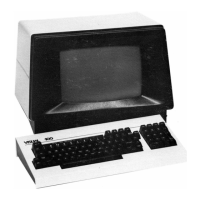
VISUAL
200, and includes the
following
key features:
• Three transmission modes including Line transmit,
Page
transmit
and Batch
transmit.
• Fourteen user programmable
Function
Keys.
• User programmable Start
of
Message
Codes.
• User programmable End
of
Line and End
of
Message
Codes.
• User programmable Field Separator Codes.
• Protect/Un protect Mode.
•
Ability
for
host
to
initiate
transmission via remote
transmit
command, and
to
suspend and resume transmission using XON
XOF
F Protocol.
18



 To Next Page