EN | 2928 | EN
Danger to life from CO
2
bottle pressure! In the case of improper
handling, the pressure on the CO
2
bottle can lead to serious or even fatal
injuries. Before replacing the CO
2
bottle:
• Establish a pressureless state.
Also discharge residual energy.
• Always ensure that the unintended
escape of CO
2
is prevented.
• Have defective parts to which
pressure would be applied during
normal operation immediately
replaced by a trained person.
• Always secure CO
2
bottles in an
upright position and secure against
falling.
• Always observe the safety notes on
the CO
2
bottle.
Replacing the CO
2
gas bottle
Safety instructions for using CO
2
gas cylinders.
Not following these instructions may lead to serious or fatal injuries!
Always connect the CO
2
cylinder to
the regulator. Never connect the cylin-
der directly to the carbonator to avoid
the danger of bursting. Never unscrew
ttings from containers. Always keep
the cylinder away from heat.
Only connect the CO
2
cylinder if:
• The gas cylinder location is suf-
ciently ventilated or a CO
2
warning
device is installed. Always ventilate
the area after CO
2
leakage!
• The CO
2
gas cylinder B is in an up-
right position, secured well with the
safety strap and located at a safe
distance (minimum 20 in) from any
heat sources.
• it is proved that there is no liquid gas
escape.
• The suitable pressure regulator C
with safety valve D for the dispenser
is available.
• the safety valve is sealed and fully
functional.
Danger! CO
2
is a colourless,
odourless gas. Danger of
suffocation.
• Observe the operating instructions
for handling CO
2
compressed gas
cylinders.
• Ensure that the CO
2
bottle size cal-
culated from the spatial volume of
the installation room is not exceed-
ed. Contact customer service in the
case of questions about the size of
the CO
2
bottle
• In the case of a suspected increase
in CO
2
concentrations, do not
inhale, exit the danger area and
sufciently ventilate the place of
installation.
• Dissipate the CO
2
in accordance
with the corresponding statutory
provisions.
• Always run hoses so that they
cannot come into contact with heat
sources, moisture, oil, sharp ob-
jects, sharp edges etc. Do not bend
or pinch hoses.
• Do not touch a frozen CO
2
bottle.
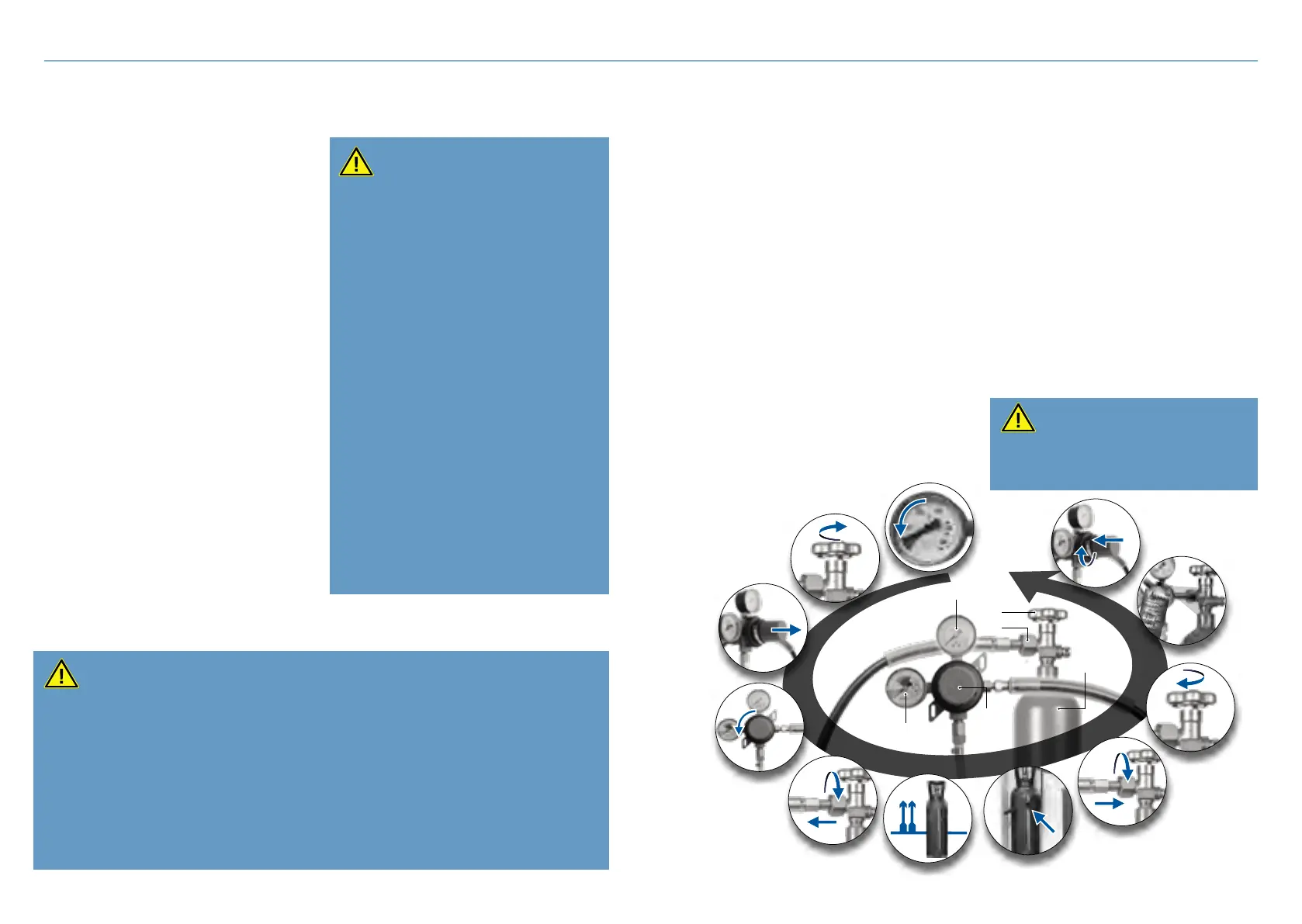
11 steps to change the CO
2
cylinder safely:
1. CO
2
bottle is empty.
2. Close the CO
2
bottle valve F.
3. Pull the cap C up.
4. Turn knob (counterclockwise) as
far as it will go.
5. Remove the hose from the empty
cylinder E.
6. Remove cyclinder D. Secure it
upright.
7. Secure the new cylinder upright
with safety strap. Remove dust
cap from new cylinder.
8. With cylinder valve F in closed
position, reattach regulator to
cylinder E. Taprite regulators have
an inlet nipple seal (O-ring) that
eliminates the need for a washer.
Tighten nut with wrench. Ensure
all connections are tightened. Do
not overtighten.
9. Open CO
2
bottle valve F all the
way. Check gauge A. The dis-
played pressure gauge should
stay stable when you close valve
again.
10. Check for leakage with solution
of soapy water or an equivalent.
Appearing bubbles are a sign of
leakage. If leakage problem can
not be solved, contact customer
service (see back page).
11. Open the CO
2
bottle valve F. Turn
cap knob (clockwise) until 65 PSI
is reached and then press down
on the cap to lock in place.
WARNING!
Increasing the pressure
above 65 PSI can cause damage
resulting in leaks and/or system
failure.
D
E
F
4.
5.
1.
3.
2.
6.
7.
8.
9.
10.
11.



 To Next Page