EasyManua.ls Logo

Volvo 819 E - Ignition Systems - Basic Parameters

Volvo 819 E
108 pages
Print Icon
To Next Page IconTo Next Page
To Previous Page IconTo Previous Page
Loading...
Group
28
Ignition
systems
Design
and
function
-
General
B
A
¢ \
c
o
147080
II I 111
Ignition
systems
-
basic
parameters
The
ignition
system
control
unit
must
be
supplied
with
certain basic
information
in
order
to
compute
the
frequency
or rate at w hich HT
ignition
pulses
must
be delivered
to
the
spark plugs,
when
(in
relation
to
the
position
of
t
he
par-
ticular
piston
before
TOG)
each pulse
must
be generated and
to
which
plug
the
pulse
is
to
be
delivered.
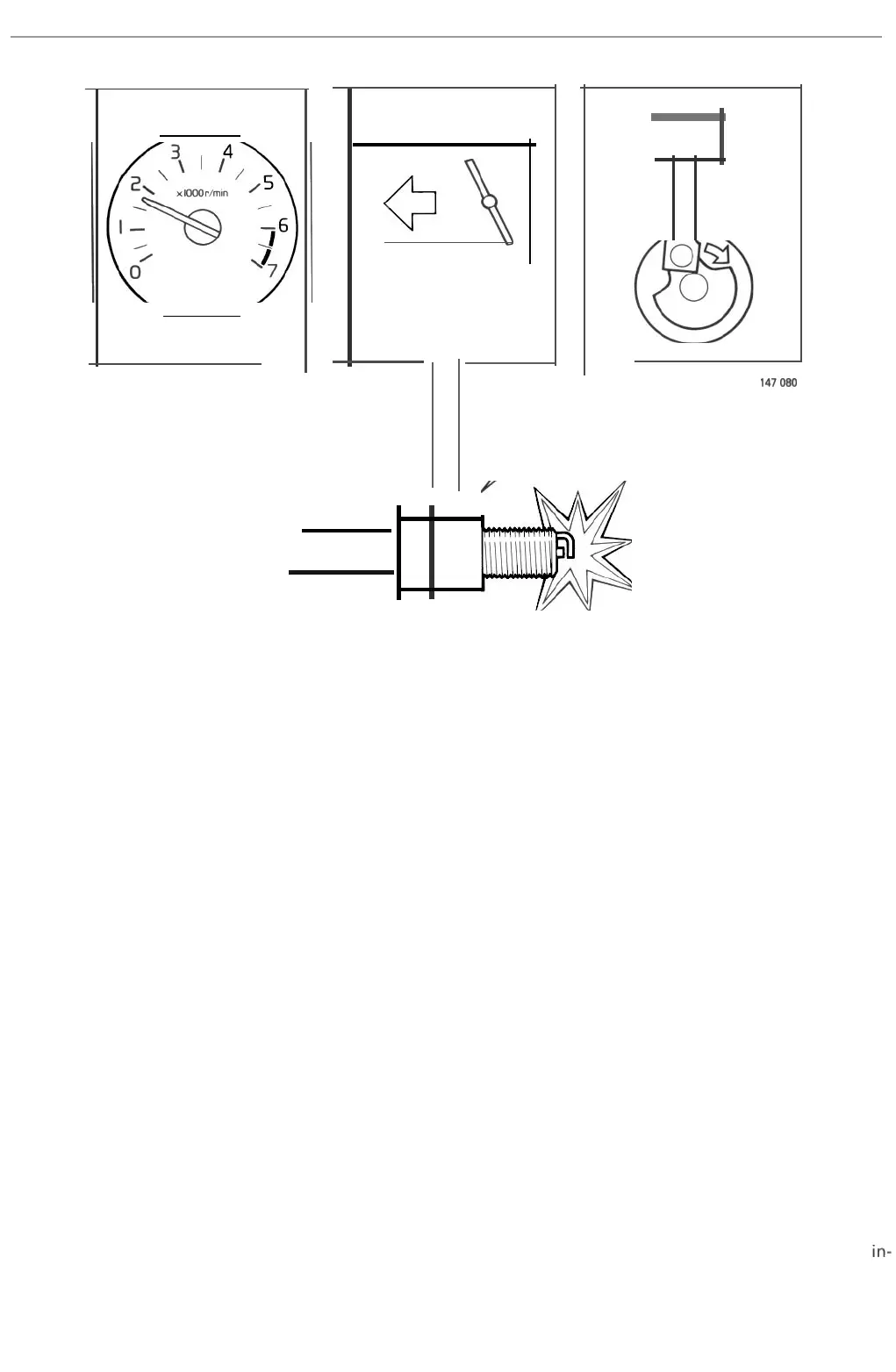
The
signals
requi
red
for
this
purpose
are
derived
from
the
engine
speed (A),
engine
load
(B)
and
crankshaft
position
(G).
Speed
information
A. T
he
engine
speed
provides
information
on
the
number
of
ignition
pulses
which
must
be
generated
per
unit
of
time.
The
number
of
high-tension
(HT) pulses delivered
to
the
plugs
must
be
increased as
the
engine
speed rises.
The speed
signal
is
the
most
vital piece
of
information
supplied
to
the
control
unit.
For
example,
the
engine
cannot
be started in
this
signal
is unavailable.
The
control
unit
a
lso
uses
the
engine
speed
to
determine
the
point
at
which
the
ignition
pulse
must
be
delivered
in
r
elation
to
the
position
of
the
piston
before
TOG.
Ignition
must
take place
earlier
at
higher
speeds since
the
upward
and d
ownward
movement
of
the
pistons
is faster
under
these
conditions.
As a result,
the
time
available
for
combus-
tion
of
the
fuel/
air
mixture
is less and
the
timing
must
be advanced
to
ensure
that
the
mixture
is
burned
as
comple
te-
ly
as
possible.
Load
information
B. Except in
turbocharged
engines,
the
engine
load
varies
with
the
vacuum in
the
intake
manifold.
At
low
loads,
the
th
r
ott
le is
only
partially
open
and
the
flow
of
induction
air
is
low,
resulting in a
high
vacuum.
At
higher
loads,
the
thro
ttl
e
opens
wider
and
more
air
is
supplied
to
the
engine.
Under
these
conditions,
the
vacuum
in
the
manifold
ap-
proaches
closer
to
atmospheric
pressure
as
the
load is increased. It
follows
from
this
that
a
greater
quantity
of
fuel/
air
mixture
is available
for
combustion
as
engine
load increases and
that
the
higher
volume
of
gas
produced
rein-
forces the pressure
due
to
compression.
Since
the
rate
of
combustion
is accelerated
by
higher
gas
compression,
the
t
iming
is
retarded
as
engine
load is increased.
At
low
engine
loads,
on
the
other
hand.
the
timing
may
be
advanced
to
compensate
for
the
low
er
rate
of
combus
t
ion
and
to
improve
fuel
utilization.
Crankshaft
po
s
ition
information
C.
The
crankshaft
position
(i.e.
angle
)
provides
information
on
the
position
of
each
piston
in relat
ion
to
TOC.
This
in-
formation
is essential
to
the
system
control
functions.
which
compute
the
timing
continuously
on
this
basis.
11

Related product manuals