EasyManua.ls Logo

Volvo 819 E - Temperature Sensor

Volvo 819 E
108 pages
Print Icon
To Next Page IconTo Next Page
To Previous Page IconTo Previous Page
Loading...
Group
28
Igni
t
ion
systems
Design
and
function
-
Compensation
funct
ions
[]
3
Temperature
sensor
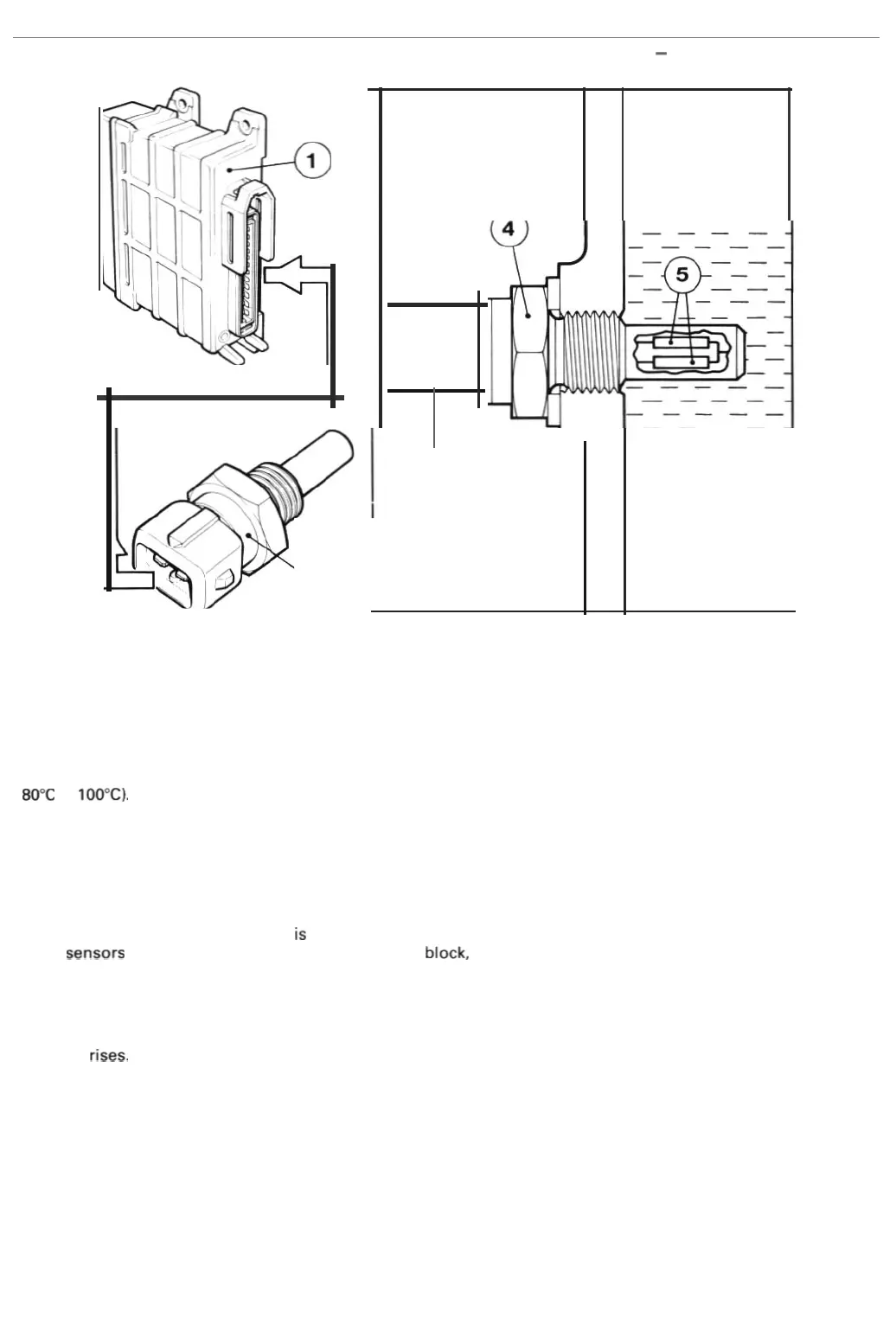
Function and location
The
control
unit
(1)
compensates
the
tim
ing
for
engine
temperature
with
the
aid
of
the
temperature
sensor
(2).
This
function
is
used
to
adjust
the
ti
ming
at t
emperatures
deviating
from
the
normal
operating
range
(i.e.
outside
approx.
8O"C
to
1000C).
The
temperature
sensor
is
normally
mounted
in
the
cylinder
head
and
is
co
mpletely
immersed
in
the
coolant.
Construction
Th
e
temperature
sensor
consis
ts
of
a
connector
(3) and a
body
(4)
provided
with
a
male
thread
and
enclosing
one
or
two
temperature
-sensitive
resistors
(5)
w
ith
a
negative
temperatur
e
coefficient
(NTC). On
most
fuel
-
injec
ted
engines,
the
dev
ice is
equipped
with
two
resistors
,
one
of
which
is
connected
to
the
fuel
syst
em
control
unit
to
provide
a fuel
enrichment
signal
when
the
engine
is
cold
and
th
e o
ther
to
the
ignition
system
control
unit
.
(Twin-resistor
temper-
ature
sensors are
normally
grounded
to
the
cylinder
block,
while
the
single-resistor
type
is
grounded
through
the
control
unit
.)
Signal
The resistance
of
the
temperature
sensor
varies
in
direct
pr
o
pon
ion
to
the
coolant
temperature
.
falling
as
the
tem
-
perature
rises. Since
the
control
unit
cont
i
nuously
supplies
the
sensor w i
th
a
constant
current,
the
variat
ion
in resist-
ance is reflected
by
the
voltage
drop
across
the
device.
enabling
the
control
unit
to
determine
when
the
various
tem-
perat
ure-dependent
timing
adjustments
must
be
made.
B
efore
cons
idering
the
beneficial
effects
of
tempera
ture
compensation
on
the
tim
ing,
some
effort
should
be
made
to
gain
an
understanding
of
th
e effects
of
variations
in t
iming
on
the cylinder, exhaust gas and
coolan
t
temperatures
.
4 1

Related product manuals