EasyManua.ls Logo

Volvo 819 E - Knock Sensor

Volvo 819 E
108 pages
Print Icon
To Next Page IconTo Next Page
To Previous Page IconTo Previous Page
Loading...
Group
28
Ignition
sys
t
ems
D
esign
and
function
-
Compensation
funct
i
ons
B
Knock
sensor
c D
1U095
Function
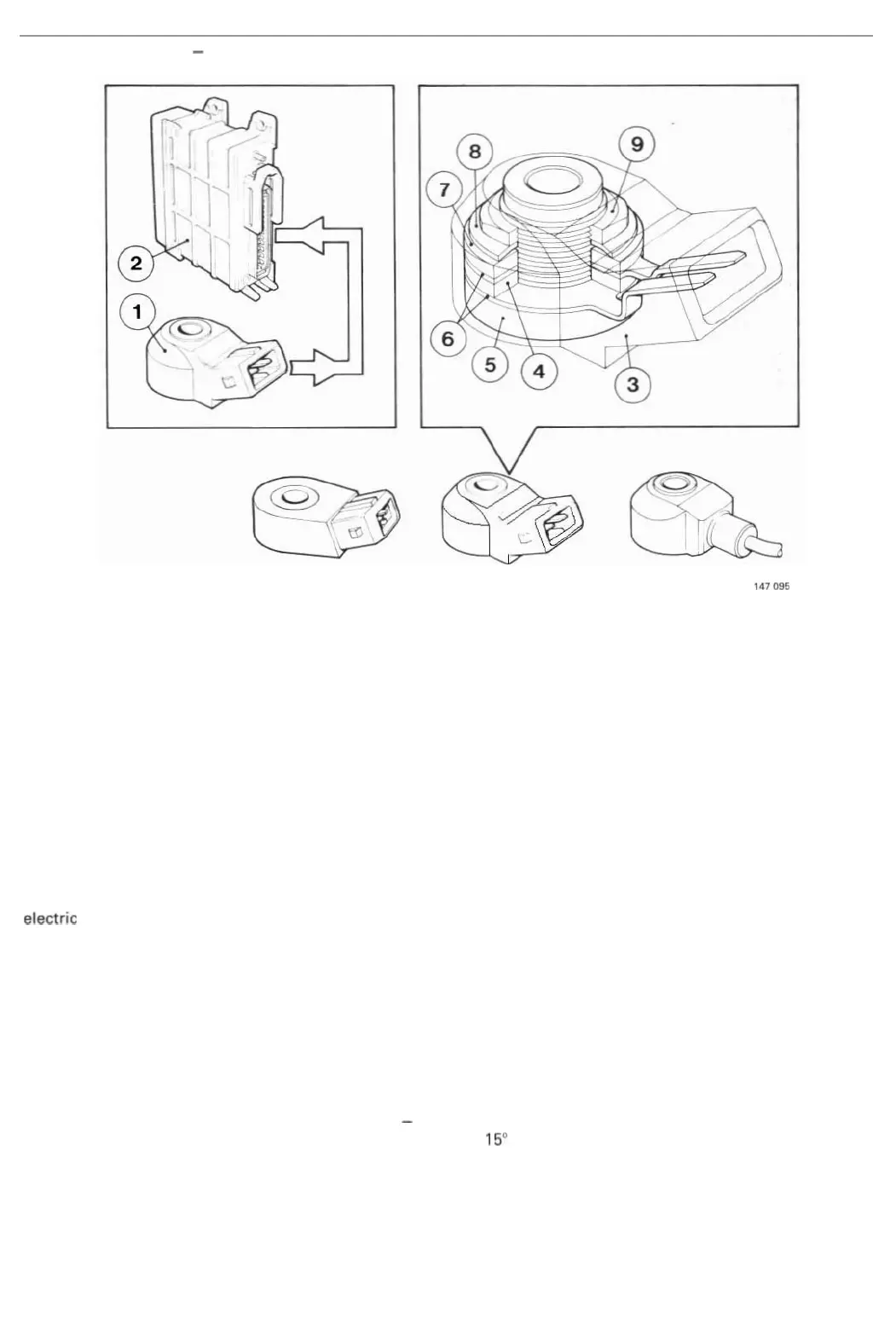
The knock
sensor
(1) is used
to
detect
engine
knock,
enabling
the con
tr
ol
unit
(2) to take
the
appropriate
action
by
re
-
tarding
the
igni
ti
on.
Construct
i
on
The knock
sensor
(s
ee pic
ture
C)
consis
ts
of
a casing {3)
housing
a piezoelectric crystal (4)
mounted
on
a
threaded
sleeve (5)
between
two
connector
strips
(6). One
side
of
the
assembly
is fi
tt
ed
with
a
damping
weigh
t (7)
and
spring
washer (8) secured
by
a
nut
(9
).
Operation
Mounted
on
the
cy
lin
der
blo
ck,
the
sensor
detects
the
vibration
caused
by
knock. Since
the
dev
ice
employs
a piezo-
electric
crys
tal
lin
which
a
potent
ial
gradient
is set
up
when
the
material
is
subjected
to
strain),
the
sensor
develops
i
ts
'o
wn
'
signal.
The
vibrations
caused
by
kno
ck
produce
an ins
tantaneous
pressure on
the
bottom
of
the
sensor,
wh
ich
responds
by
generating
an
output
voltage.
Signal
The
signal
delivered
by
th
e piezoelectric crystal
consis
ts
of a
con
t
inuous,
variable
voltage
of
a
frequency
co
rrespond-
i
ng
to
the
engine
vibrations.
The
signal
is fed
to
the
control
unit
wh
ich
co
mputes
a
mean
or
'reference' value.
Sensing
of
signals
The
control
unit
is
programmed
specifically
to
detect signals
of
the
frequency generated
by
k
nock
{approx.
7.5
kH
z).
The
unit
is
provided
wi
th a '
measurement
window
' - in effect, a specific range
of
crankshaft
angles
wi
th
in w hich t
he
unit
is
'o
pen'
to receive
signals
from
the
knock sensor (approx. 15
0
before TOC
to
app
rox. 55
0
after TOC). I
mmedia
t
ely
on
detecting
knock in a c
ylinder
,
the
devi
ce
generates a signal
whi
ch deviates
significantly
from
the
compu
t
ed
'refe
r-
ence' signal.
This
is in
terpreted
by
the
control
unit
as
confirmation
that
knock has occurred.
After
an
interval
of
th
ree
ignit
i
on
pulses (in
the
case
of
4
-cyli
nder
engines)
,
the
con
tro
l
unit
re
tards
the
ignition
,
thereby
correc
ti
ng
the
condi-
tion in
the
individual
cylinder
concerned.
30

Related product manuals