EasyManua.ls Logo

Volvo 819 E - Contact-Breaker Versus Electronic Systems

Volvo 819 E
108 pages
Print Icon
To Next Page IconTo Next Page
To Previous Page IconTo Previous Page
Loading...
Group
28
Ignition
systems
Design
and
function
-
General
0·
1
0"
---=:J;
~~
L-...l
-10
-20 -30
-
~O
-
50
°
2
1
A
'
0·
Contact-breake
r
versus
electronic
systems
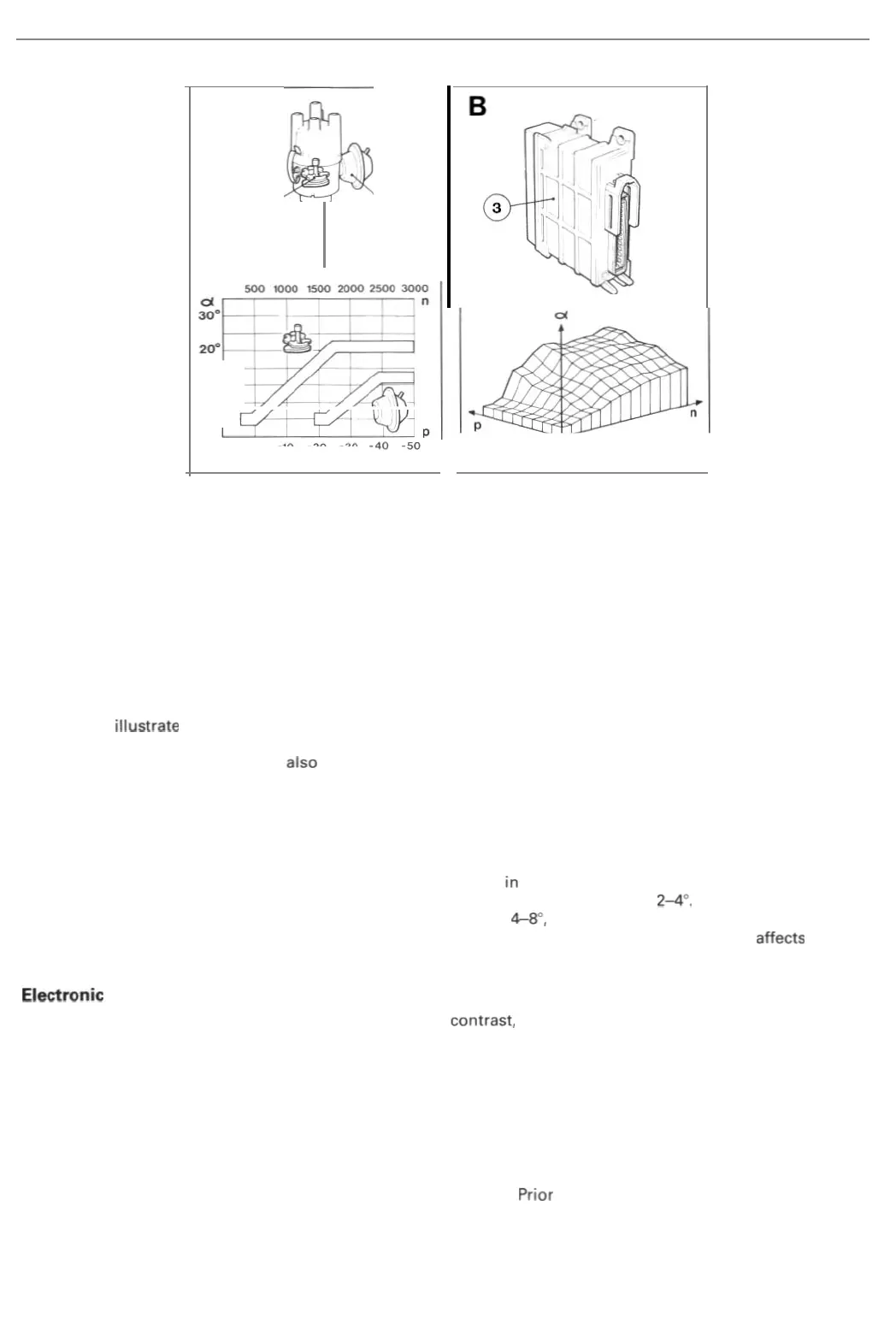
Figure {AI
shows
the
tim
ing
curve
for
a con
tact
-breaker
ignition
system,
wh
ile (BI
illustrates
the
settings
with
wh
ich
an
electronic
system
is
programmed
, in
the
form
of
a
three
-
dimensional
map
_In each case,
both
engine
speed
and
load
are taken
into
account
when
determining
the
setting
.
However
, in
co
ntrast
with
the
electronic
system,
which
computes
the
t
iming,
the
con
ta
ct-breaker
system
controls
it
w i
thin
a specified range.
The
timing
must
be
con
trolled
to
a
high
degree
of
accuracy
to
meet
the
demands
of
the
modern
engine
for
the
clean-
es
t
possib
le exhaust
emissions,
maximum
fuel
economy
and
high
performance
under
fluc
tuating
condi
tions.
N
either
may
the
se
requirements
be
permitted
to
vary, even
following
an
extended
period
of
driving
.
Timing curve
symbols
Both
figures
illustrate
the
manner
in
whi
ch
the
t
iming
angle
{al
varies
w i
th
the
engine
speed (n)
and
the
va
cu
um
(pi
in
the
intake
man
i
fo
ld.
The
ang
le (a) increases
with
speed; in
other
word
s,
igni
t
ion
of
the
fuel/air
mixture
takes place
earlier
as
the
speed rises.
The
angle
also
increases w i
th
the
vacuum
in
the
intake
manifold
i.e.
as
the
eng
ine
load
falls
and
the
fuel/air
charge
supplied
to
the
engine
becomes
smaller
.
Contact-breaker
ignition
systems
A. Co
nt
ac
t-breaker
ignition
systems
con
trol
the
timing
with
the
aid
of
a
centrif
ugal
governor
(1)
and
a
vacuum
ad-
vance
un
it (2). (Being a
speed
-
dependent
device
,
the
governor
advances
the
ignition
as
the
speed increases,
while
the
vacuum
advance
unit
retards
it
as
the
engine
load
increases
in
response
to
the
vacuum
signal
from
the
intake
manifold
.)
T
he
two
devices
operate
independently
w i
thin
a
tol
erance
band
of
approx
.
2-4
". Overall,
this
means
that
the
system
controls
the
tim
ing
with
in a
to
l
eran
ce
range
of
approx.
4-8"
, since
the
setting
is
the
sum
of
the
angles
in-
dicated
by
the
two
curves.
Furthermore
,
the
variat
i
on
wh
ich results
from
wear
of
the
breaker
points
affects
the
over-
all t
iming.
Electronic ignition
systems
:
B.
The
co
ntrol
unit
(
3)
of
an electronic
ignit
i
on
system,
by
contrast, is
programmed
w i
th
a series
of
specific
settings
f
or
a
number
of
defined
speeds
and
engine
loads. This means
that
the
timing
can be
controlled
to
an accuracy
as
h
igh
8S
8 fraction
of
a
degree
and
that each
ignit
ion pulse is delivered
as
close
as
pos
sible to
the
op
ti
mum
point.
(
Thi
s
high
level
of
accuracy is achieved
partly
by
the fact
that
the con
trol
unit
interpola
tes
between
the
programmed
speed
and
load
points
. In
other
words
,
it
is
capable
of
computing
an
intermediate
setting.)
Furthermore
,
the
timing
can
be
com
put
ed
over
a
wider
range
and
is
not
restricted
by
the
type
of
linear
functions
typ
ical
of
a
centrifugal
gov
-
ernor
.
The
t
iming
is
computed
with
th
e aid of
sensors
wh
ich
determine
the
engine
load
and speed.
Th
is
in
format
io
n is
transmitted
electrically
to
the
control
unit
electronics,
in
wh
ich
details
of a
number
of
different
speed
and
load
com-
binations
,
together
with
the
appropriate
t
iming
se
tt
ings, are s
tored
.
Pr
i
or
to
each
igni
ti
on
pulse
,
the
control
unit
com-
putes a
setting
wh
ich is
perfectly
mat
ched
to
the
engine
running
co
nd
i
tion
s
prevailing
at
the
precise
instant
.
Adjustments
required
by
the
various
timing
co
mpensation
fun
c
tions
are added
to
the
three
-
dimensional
map.
13

Related product manuals