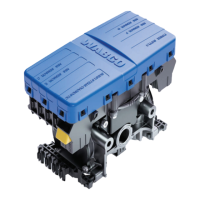
TEBS E
10
Operation
175
Button
symbol
Function
Indication of the axle load (with version ELEX1 or higher)
Activation: Touch button.
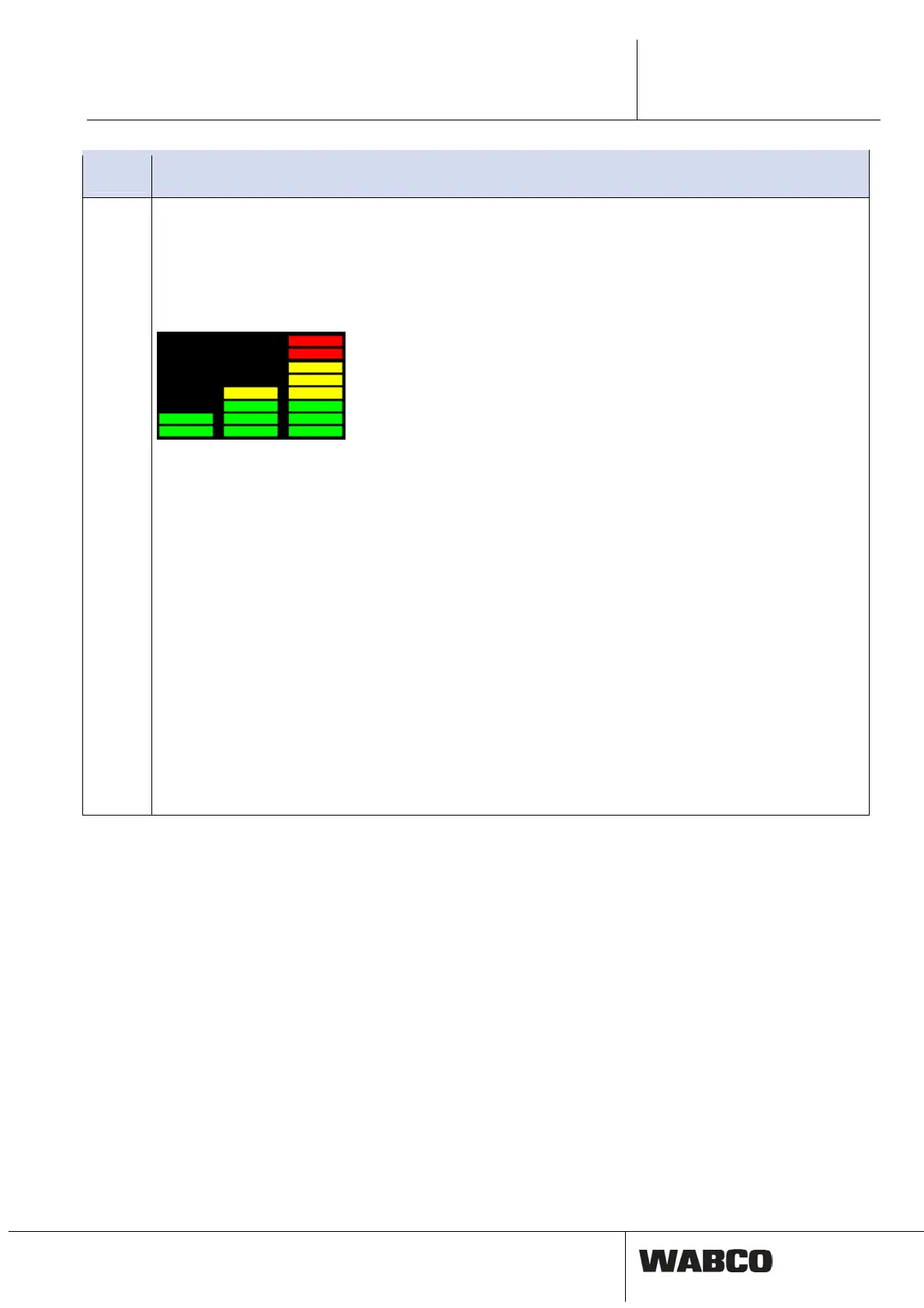
A ‘T’ appears (total mass), after 2 seconds the total mass is displayed:
In the left-hand column, one LED corresponds to 10,000 kg mass respectively
In the middle column, one LED corresponds to 1,000 kg mass respectively
In the right-hand column, one LED corresponds to 100 kg mass respectively
Example: 2x 10,000 kg + 4x 1,000 kg + 8x 100 kg = 24,800 kg
The +/- buttons can be pressed to switch to any axle and display its load.
Pressing the +/- button once will display the currently selected axle: ‘T’ = total mass ‘1’ = axle 1 ‘2’ = axle 2 etc.
Pressing the +/- button again will select the desired axle.
The selected axle is indicated for 2 seconds before the load on this axle is shown automatically by the LED rows.
The TEBS E Diagnostic Software can be used to define the maximum permissible axle loads.
If the permissible axle load for one axle or the permissible total load is exceeded, the system automatically
switches to the axle with the overload and shows its load.
While an overload condition is detected, the display flashes and a warning tone is output which can be deactivated
by pressing a button.
Disabling: Touch button again.
Notes:
The axle loads are determined through the bellows pressures. Their accuracy therefore depends on the LSV val-
ues parameterised for axle load and bellows pressure.
If the axles are under tension, the bellows pressures do not reflect the actual axle load (loaded axles: if the wheels
want to turn, but cannot, since the brakes are applied).
The axle load can therefore only be measured if the vehicle is not under tension (relieve chassis/suspension by
releasing the brake, then reapply the brake).
The measurement may be inaccurate if the vehicle is not at normal level.



 To Next Page