
 Need help?
Do you have a question about the WANHAO DUPLICATOR I3 MINI and is the answer not in the manual?
Explains the fundamental process of 3D printing and FFF technology.
Details the workflow from obtaining a 3D design to the final printed object.
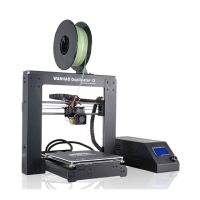
Illustrates and labels the front-facing components of the 3D printer.
Illustrates and labels the rear-facing components of the 3D printer.
Details the components and layout of the printer's control panel.
Provides step-by-step instructions for unpacking and assembling the 3D printer.
Describes the elements and information displayed on the printer's home screen.
Explains how to navigate through the printer's menu system using the dial.
Visual representation of the printer's menu hierarchy and options.
Step-by-step guide on how to load filament into the 3D printer.
Instructions on how to level the print bed for optimal print adhesion.
Instructions on how to select and start printing a GCODE file.
How to adjust print speed and nozzle temperature while printing.
Essential tips for achieving high-quality prints before, during, and after printing.
Safe and effective methods for detaching finished prints from the build plate.
Procedures for safely removing filament from the printer.
Access and adjust common printer settings like speed and nozzle temperature.
Overview of advanced settings for experienced users, with caution advised.
Details on using WANHAO PLA filament and recommended materials.
Specifics on PLA filament, including advantages and disadvantages.
Guidelines for storing PLA filament to maintain quality and prevent moisture issues.
Steps for saving files, creating GCODE using Cura, and installing the software.
How to configure Cura to recognize and work with the Duplicator i3 Mini.
Instructions on importing 3D model files (.STL, .OBJ, etc.) into Cura.
General maintenance procedures for the 3D printer.
Step-by-step guide for replacing the printer's build surface mat.
Methods for cleaning a potentially blocked printer nozzle.
Regular inspection of motor connectors, axis lubrication, and nuts/bolts.
Recommendations for storing the 3D printer when not in use.
Methods and tools for post-processing 3D prints.
How to safely remove support structures from printed objects.
Techniques for sanding prints to achieve a smooth surface finish.
Steps for applying primer, paint, and varnish for a professional finish.
Guidelines for performing maintenance on the Duplicator i3 Mini.
Proper procedures for disposing of product packaging and materials.
Instructions for safely and responsibly disposing of the 3D printer.
General advice for resolving common issues encountered with the 3D printer.
Solutions for common printing issues like clicking sounds, file errors, and extrusion problems.
Addresses issues causing stringing, print stoppages, motor function, and head/bed movement.
Solutions for issues related to the printer not turning on or the SD card not being recognized.
Addresses filament stuck issues and provides guidance on purchasing filament.
Definitions of common terms used in 3D printing and the manual.
Lists sources for 3D models used in the manual.
 General
| Build Volume | 120 x 120 x 120 mm |
|---|---|
| Layer Resolution | 0.1 - 0.4 mm |
| Nozzle Diameter | 0.4 mm |
| Filament Diameter | 1.75 mm |
| Connectivity | USB, SD Card |
| Feeder System | Bowden |
| Frame | Metal |
| Heated Bed | Yes |
| Bed Temperature | Up to 100 °C |
| Nozzle Temperature | Up to 260 °C |
| Display | LCD |
| Supported Filament Types | PLA |
| Print Technology | Fused Deposition Modeling (FDM) |
| Power Supply | 110V/220V |

 To Next Page